


The "Red Crystal" is scheduled to make its debut today as an additional emblem that can be used to protect relief workers in combat where the Red Cross or Red Crescent meets hostility. But it is unlikely to be widely displayed in the near future.
The emblem was designed as part of complicated, long-running negotiations to include Israel in the Red Cross movement without giving the red shield used by Magen David Adom -- similar to the star on the Israeli flag -- the same status as the cross and crescent, which have been used by medics on the battlefield for more than a century.
Some countries feared that adding the red star of David to the list of protective emblems would open the door to proliferation of such symbols and undermine the recognition that any emblem had to protect humanitarian workers.
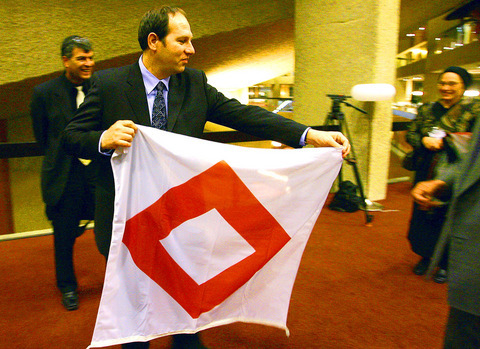
PHOTO: AP
But Red Cross officials on Friday conceded it would take time before the crystal, a red square frame standing on one corner, will be known widely enough for medics to work under it on the battlefield without fear of being targeted by one side or the other.
"We have no indication at the moment that anybody is going to start using it" immediately, said Antonella Notari, chief spokeswoman of the International Committee of the Red Cross.
"It's legally now a protective emblem, but there's a lot of work to be done for it to be in reality and concretely a protective emblem because it needs to be known in the field and respected," she said.
The treaty authorizing the new symbol is entering into force six months after Switzerland and Norway became the first two countries to ratify the accord aimed at including Israel's Magen David Adom society in the Red Cross movement. So far, 84 countries have signed the treaty and nine have ratified it.
"We are pleased they created especially for us a new symbol that will be accepted the world over," said Noam Yifrach, chairman of the executive committee of Magen David Adom. The Israeli organization puts the red Star of David inside the crystal's frame.
Any national society in the international Red Cross movement will be able to use the crystal if it wants. Military medics for any country also will be able to display it instead of the cross or crescent. In combat, the crystal is supposed to stand alone, but for fundraising and identification purposes at home a society such as the Israeli organization could put its own emblem inside the frame.
Israel, which became a member of the Red Cross last June after a meeting of the movement cleared the way for the new symbol, will still be able to use the star on ambulances inside Israel.
The simple red cross on a white background -- the reversal of colors of the Swiss flag -- was adopted as the emblem of the movement when it was founded in 1863 by Swiss humanitarians trying to care for battlefield casualties who otherwise would have been left to suffer.
But the symbol unintentionally reminded Muslims of the Christian crusaders, and they began using a red crescent in the 19th century.
When Israel's society bid for membership in 1949, it objected to using both the cross and the crescent, but the Red Cross movement refused to admit the Israeli star.

The pitch is a classic: A young celebrity with no climbing experience spends a year in hard training and scales Mount Everest, succeeding against some — if not all — odds. French YouTuber Ines Benazzouz, known as Inoxtag, brought the story to life with a two-hour-plus documentary about his year preparing for the ultimate challenge. The film, titled Kaizen, proved a smash hit on its release last weekend. Young fans queued around the block to get into a preview screening in Paris, with Inoxtag’s management on Monday saying the film had smashed the box office record for a special cinema

CRITICISM: ‘One has to choose the lesser of two evils,’ Pope Francis said, as he criticized Trump’s anti-immigrant policies and Harris’ pro-choice position Pope Francis on Friday accused both former US president Donald Trump and US Vice President Kamala Harris of being “against life” as he returned to Rome from a 12-day tour of the Asia-Pacific region. The 87-year-old pontiff’s comments on the US presidential hopefuls came as he defied health concerns to connect with believers from the jungle of Papua New Guinea to the skyscrapers of Singapore. It was Francis’ longest trip in duration and distance since becoming head of the world’s nearly 1.4 billion Roman Catholics more than 11 years ago. Despite the marathon visit, he held a long and spirited

‘DISAPPEARED COMPLETELY’: The melting of thousands of glaciers is a major threat to people in the landlocked region that already suffers from a water shortage Near a wooden hut high up in the Kyrgyz mountains, scientist Gulbara Omorova walked to a pile of gray rocks, reminiscing how the same spot was a glacier just a few years ago. At an altitude of 4,000m, the 35-year-old researcher is surrounded by the giant peaks of the towering Tian Shan range that also stretches into China, Kazakhstan and Uzbekistan. The area is home to thousands of glaciers that are melting at an alarming rate in Central Asia, already hard-hit by climate change. A glaciologist, Omarova is recording that process — worried about the future. She hiked six hours to get to

The number of people in Japan aged 100 or older has hit a record high of more than 95,000, almost 90 percent of whom are women, government data showed yesterday. The figures further highlight the slow-burning demographic crisis gripping the world’s fourth-biggest economy as its population ages and shrinks. As of Sept. 1, Japan had 95,119 centenarians, up 2,980 year-on-year, with 83,958 of them women and 11,161 men, the Japanese Ministry of Health said in a statement. On Sunday, separate government data showed that the number of over-65s has hit a record high of 36.25 million, accounting for 29.3 percent of


 RSS
RSS