


The top US anti-drug official said that Afghan poppies would be sprayed with herbicide to combat an opium trade that produced a record heroin haul this year, a measure likely to anger farmers and scare Afghans unfamiliar with weed killers.
John Walters, the director of the US Office of National Drug Control Policy, said on Saturday that Afghanistan could turn into a narco-state unless "giant steps" are made toward eliminating poppy cultivation.
"We cannot fail in this mission," Walters said.
"Proceeds from opium production feed the insurgency and burden Afghanistan's nascent political institutions with the scourge of corruption," he said.
Afghans are deeply opposed to spraying poppies. After nearly three decades of war, Western science and assurances can do little to assuage their fears of chemicals being dropped from airplanes. Because of those fears -- and because crop dusters could be shot down by insurgents -- spraying would need to be done on the ground.
The Afghan government has not publicly said it will spray, and President Hamid Karzai has said in the past that herbicides pose too big a risk, contaminating water and killing the produce that grows alongside poppies.
But Walters said Karzai and other officials have agreed to ground spraying.
"I think the president has said yes, and I think some of the ministers have repeated yes," Walters said without specifying when spraying would start.
"The particulars of the application have not been decided yet, but yes, the goal is to carry out ground spraying," he said.
Afghanistan's deputy minister for counter-narcotics, General Khodaidad, said the government hadn't yet made any decisions. But a top Afghan official close to Karzai said the issue was being looked at closely.
"We are thinking about it, we are looking into it. We're just trying to see how the procedure will go," said the official, who asked not to be named because of the sensitivity of the issue.
Opium production in Afghanistan this year rose 49 percent to 6,100 tonnes -- enough to make about 670 tonnes of heroin. That's more than 90 percent of the world's supply and more than the world's addicts consume in a year.
A US official told reporters last month that if Afghans don't spray next year "there's going to be a lot of pressure on the government for spraying ... a lot of pressure from the US."
The official asked not to be named.
At the news conference on Saturday, Walters tried to emphasize to the largely Afghan media members in attendance that spraying was perfectly safe. He said the herbicide glyphosate -- sold commercially in the US under the name Roundup -- would be used, and that it was a safe and common weed killer.
He said the US uses glyphosate to spray marijuana plants in Hawaii and that it's also used against coca plants in Colombia.
"We are not experimenting on the people of Afghanistan," Walters said.
"We are not using a chemical that has a history of questionable effects on the environment," he said.
Walters said he didn't expect the fight against poppies "to be a one year success story."
A recent UN report said it would take a generation -- 20 years -- to defeat the drug trade in Afghanistan.
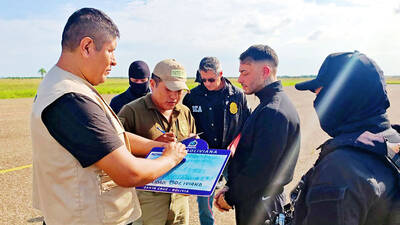
KINGPIN: Marset allegedly laundered the proceeds of his drug enterprise by purchasing and sponsoring professional soccer teams and even put himself in the starting lineups Notorious Latin American narco trafficker Sebastian Marset, who eluded police for years, was handed over to US authorities after his arrest on Friday in Bolivia. Marset, a Uruguayan national who was on the US most-wanted list, was passed to agents of the US Drug Enforcement Administration at Santa Cruz airport in Bolivia, then put on a US airplane, Bolivian state television showed. “The arrest and deportation were carried out pursuant to a court order issued by the US justice system,” Bolivian Minister of Government Marco Antonio Oviedo told reporters. The alleged kingpin was arrested in an upscale neighborhood of Santa

ACTIONABLE ADVICE: The majority of chatbots tested provided guidance on weapons, tactics and target selections, with Perplexity and Meta AI deemed to be the least safe From school shootings to synagogue bombings, leading artificial intelligence (AI) chatbots helped researchers plot violent attacks, according to a study published on Wednesday that highlighted the technology’s potential for real-world harm. Researchers from the nonprofit watchdog Center for Countering Digital Hate and CNN posed as 13-year-old boys in the US and Ireland to test 10 chatbots, including ChatGPT, Google Gemini, Perplexity, Deepseek and Meta AI. Eight of the chatbots assisted the make-believe attackers in more than half the responses, providing advice on “locations to target” and “weapons to use” in an attack, the study said. The chatbots had become a “powerful accelerant for
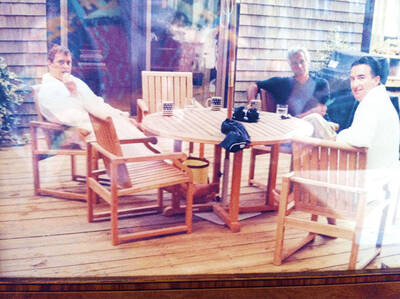
SCANDAL: Other images discovered earlier show Andrew bent over a female and lying across the laps of a number of women, while Mandelson is pictured in his underpants A photograph of former British prince Andrew and veteran politician Peter Mandelson sitting in bathrobes alongside late sex offender Jeffrey Epstein was unearthed on Friday in previously published documents. The image is believed to be the first known photograph of the two men with Epstein. They are currently engulfed in scandal in the UK over their ties to their mutual friend. The undated photograph, first reported by ITV News, shows King Charles III’s disgraced brother and former British ambassador to the US sitting barefoot outside on a wooden deck. They appear to have mugs with a US flag on them
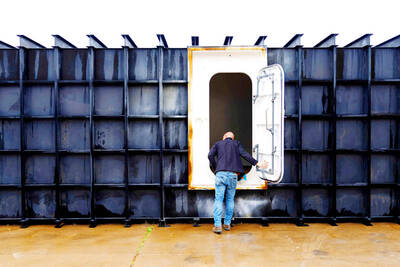
Since the war in the Middle East began nearly two weeks ago, the telephone at Ron Hubbard’s bomb shelter company in Texas has not stopped ringing. Foreign and US clients are rushing to buy his bunkers, seeking refuge in case of air raids, nuclear fallout or apocalypse. With the US and Israel pounding Iran, and Tehran retaliating with strikes across the region, Hubbard has seen demand for his product soar, mostly from Gulf nation customers in Bahrain, Qatar, Kuwait and the United Arab Emirates. “You can imagine how many people are thinking: ‘I wish I had a bomb shelter,’” Hubbard, 63, said in


 RSS
RSS