


Only in Beirut do war scars and champagne chic blend so easily. In Achrafiye, an upmarket district of hip restaurants and nightclubs where a bottle of bubbly can cost US$1,000, a ravaged building totters over a street corner.
Bullet holes pock the walls and the windows have long disappeared. Rubbish and barbed wire clog the front door and weeds sprout from the upper floors.
The lonely ruin is what remains of the Green Line, the infamous boundary that divided Christian East and Muslim West Beirut during the 17-year-old civil war of the 1970s and 1980s. Until recently it was a reminder of a bitter conflict most Lebanese thought was over.
But since this summer's 34-day war with Israel, there are fears of fresh divisions within Lebanese society that could heave the country into a new era of turmoil. The new green line wobbles uncertainly around the role of Hezbollah.
As Israeli warplanes pulverized Lebanon's infrastructure and laid entire villages to waste, many Lebanese silently rallied around the fighters' resistance.
But since a ceasefire took hold 11 days ago, sectarian dissent has slowly swelled.
Druze, Sunni and some Christian leaders blame Hezbollah for provoking Israel and are demanding the group submit to the national government.
"The [political] situation has become dramatically worse since July 12," said Michael Young, an editor at the Daily Star newspaper. "The perception among non-Shia communities is that Hezbollah went to war without consulting with anyone."
Some quietly suggest Israel should have gone further to crush the militant group.
"I wish with all my heart this war had not ended," one Christian woman, who asked not to be named, said in the southern city of Tyre.
An exception is the Christian leader Michel Aoun, who has forged an alliance with Hezbollah in what he depicts as an effort to build bridges with Muslims. But this is controversial among other Christians, who say Hezbollah has let countries such as Syria and Iran use Lebanon as a battleground for their interests.
The fiercest argument centers on disarmament. Israel, the US and the UN say Hezbollah must surrender its arms to ensure peace.
"To play a patriotic role they don't need weapons," said Elias Attallah of the Democratic Left party. "An army and a resistance movement cannot live side by side. In Lebanon no community can accept domination by an-other. Otherwise it will lead to war."
Others say such demands may be incendiary.
"If the government persists in trying to disarm Hezbollah and if the US keeps pushing them, this will create sectarian tensions, a split in the army, and could very well lead to a civil war," said Amal Saad-Ghorayeb, a lecturer at the American University of Beirut.
Among its Shia supporters, at least, Hezbollah is riding a wave of popularity. In Beirut yesterday officials handed out thick wads of US dollars to war refugees whose houses had been destroyed. The funding is widely believed to come from oil-rich Iran, Hezbollah's main sponsor.
Musa Trablisi, 57, slipped US$12,000 into his pocket, the maximum under Hezbollah's compensation system. His house in Ainata near the Israeli border has been flattened, he said.

SPEAKING OUT: After Siranudh Scott’s allegations surfaced, celebrities and public figures took to social media to share their own experiences of sexual misconduct and abuse A high-profile alleged sexual abuse case within a wealthy Thai beer brewing family has prompted a wave of painful accounts from survivors of unconnected abuse in the conservative nation. Siranudh Scott, a member of the billionaire Thai family that founded the ubiquitous Singha beer brand, posted an emotional video this month accusing his elder brother Sunit of repeatedly abusing him when he was a teenager. Sunit, who is in his 30s, later denied the allegations in a video posted online, but Singha parent Boonrawd dismissed him from his executive role with the company on Tuesday last week. “I felt I needed to speak
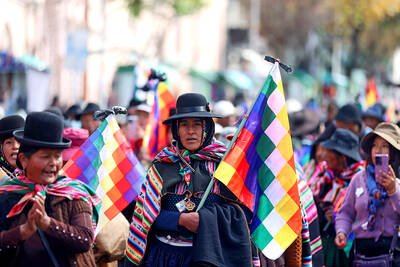
SEEKING ORDER: Rodrigo Paz said that ‘anyone who wants to destroy the nation will have to deal with this president and the full force of the constitution’ Bolivian President Rodrigo Paz on Wednesday said that the nation was at a “breaking point” after nearly a month of protests that have caused shortages of food, fuel and medicine. Paz, who took office six months ago amid the worst economic crisis there in four decades, is battling a groundswell of fury over his policies. The political capital, La Paz, has been besieged by low-income workers and members of the indigenous majority calling for his resignation. “The country needs order and is reaching breaking point,” the 58-year-old said at a public event in La Paz, renewing his appeal for dialogue. On Tuesday, the Bolivian

‘CROSSING THE LINE’: China’s embassy in Seoul criticized US Forces Korea Commander General Xavier Brunson, asking if his ‘hostile’ remarks were authorized by Washington South Korea and the US are in talks over recent public remarks by the commander of US Forces Korea, Seoul’s presidential office said yesterday, after the comments drew sharp criticism from China. In a recent podcast interview, US Forces Korea Commander General Xavier Brunson described South Korea as “the dagger in the heart of Asia” from China’s east coast, prompting the Chinese embassy in Seoul to say that he had “truly crossed the line.” The interview came amid growing speculation that Washington might seek to expand the role of US Forces Korea in countering the growing regional influence of China, a key

Forecasters in Europe yesterday warned of exceptional heat as record temperatures driven by a “heat dome” push temperatures well above seasonal norms across the continent. The surge follows a record-breaking Monday, with France logging its hottest day in the month of May on record, its weather agency said, and the UK also posting unprecedented highs. A so-called “heat dome” of warm air from northern Africa trapped under a high-pressure system over western Europe is behind the high temperatures not usually seen until high summer. Restrictions on outdoor work were imposed in parts of Italy, beaches in southwest France filled earlier than usual and


 RSS
RSS