


As refugees flood back to their war-ravaged villages, Hezbollah has flung itself to the front of the burgeoning reconstruction effort in southern Lebanon, funded with a deluge of petro-dollars from neighboring Iran.
"We want to bring south Lebanon back to life and rebuild it better than it was before the war," said Nabil Kaouk, Hezbollah's top official in southern Lebanon, standing before the group's flattened headquarters building in Tyre.
In nearby villages, his supporters were already hard at work. Hezbollah activists in T-shirts and green caps cleared rubble-strewn roads and piles of rotting refuse and ferried the dead and wounded through the scrub-covered hills in shiny modern ambulances.
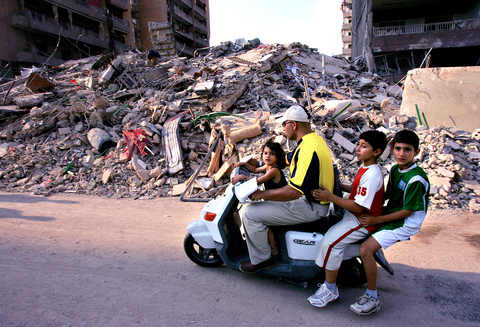
PHOTO: AP
But the most extravagant element of Hezbollah's plan is to provide a year's rent and a set of new furniture for every family whose house has been destroyed. The promise was made by Hezbollah's leader, Hassan Nasrallah, within hours of Monday's ceasefire.
The housing scheme will benefit 15,000 families, Nasrallah said, and will cost up to US$150 million, according to one estimate. Funding will come from oil-rich Iran, which until now has mostly supplied Hezbollah with thousands of missiles used against Israel.
On Wednesday in Beirut, hun-dreds of refugees shuffled through a registration center where officials noted their losses and made promises of help. The cash will be spent in towns such as Bint Jbail, near the southern border, where entire neighborhoods have been razed.
"There is no central government presence here. Hezbollah is doing everything," said local official Hamed Harab, standing outside the bomb-pocked town hospital.
Behind him stood a group of trim young men in dark t-shirts who refused to have their photographs taken. They watched a stream of overloaded cars carrying residents home.
"The people want things to move quickly. They know that we can deliver," he said.
This multimillion dollar aid drive marks a new phase in Hezbollah's struggle. The militant group has already won admiration across the Arab world for its fierce resistance to Israeli attack.
Now it is fighting to retain the support of Lebanon's Shia Muslims, who constitute about one-third of the population, and to maintain the "state within a state" that allowed the militant group to develop the military arsenal and network of village bunkers that thwarted the Israeli invasion.
The success of this strategy is evident from the proclamations of undying loyalty, even from families who have lost everything.
"When Sayed Hassan [Nasrallah] speaks, we listen," said Amar Balhas outside the remains of his house. "If he asks, I will give my life for Hezbollah."
But other residents are shocked by the destruction that Hezbollah's belligerence has wrought on their already impoverished lives.
"I will be sleeping in the streets tonight," said Nohead Hamoud, 46, on Wednesday after arriving in Bent Jbail to find a pile of broken bricks and furniture where her home once stood.
She cringed in fear as an Israeli fighter jet roared overhead.
Asked her opinion of Hezbollah's popularity, she replied, tersely: "That is a question I cannot answer."
Some fear the housing scheme will further weaken the influence of the central government in Hezbollah strongholds, deepening rifts between Lebanon's rival religious confessions.
Some Christian and Druze leaders resent Hezbollah's autonomy and have called for it to disarm.
That tension is one of several problems facing the 30,000-strong peacekeeping force in the process of deployment. Of this pool, foreign countries are due to contribute a total of 13,000 troops.

‘CROSSING THE LINE’: China’s embassy in Seoul criticized US Forces Korea Commander General Xavier Brunson, asking if his ‘hostile’ remarks were authorized by Washington South Korea and the US are in talks over recent public remarks by the commander of US Forces Korea, Seoul’s presidential office said yesterday, after the comments drew sharp criticism from China. In a recent podcast interview, US Forces Korea Commander General Xavier Brunson described South Korea as “the dagger in the heart of Asia” from China’s east coast, prompting the Chinese embassy in Seoul to say that he had “truly crossed the line.” The interview came amid growing speculation that Washington might seek to expand the role of US Forces Korea in countering the growing regional influence of China, a key

SEEKING ORDER: Rodrigo Paz said that ‘anyone who wants to destroy the nation will have to deal with this president and the full force of the constitution’ Bolivian President Rodrigo Paz on Wednesday said that the nation was at a “breaking point” after nearly a month of protests that have caused shortages of food, fuel and medicine. Paz, who took office six months ago amid the worst economic crisis there in four decades, is battling a groundswell of fury over his policies. The political capital, La Paz, has been besieged by low-income workers and members of the indigenous majority calling for his resignation. “The country needs order and is reaching breaking point,” the 58-year-old said at a public event in La Paz, renewing his appeal for dialogue. On Tuesday, the Bolivian

Forecasters in Europe yesterday warned of exceptional heat as record temperatures driven by a “heat dome” push temperatures well above seasonal norms across the continent. The surge follows a record-breaking Monday, with France logging its hottest day in the month of May on record, its weather agency said, and the UK also posting unprecedented highs. A so-called “heat dome” of warm air from northern Africa trapped under a high-pressure system over western Europe is behind the high temperatures not usually seen until high summer. Restrictions on outdoor work were imposed in parts of Italy, beaches in southwest France filled earlier than usual and

Australian researchers have trained lab-grown brain cells on a silicon computer chip to play the 1990s shooter game Doom and said they are just scratching the surface of what the neurons could be capable of doing. It is the science-fiction work of biotech boffins at Cortical Labs, who researched and developed the technology that harnesses the workings of the brain’s networking system. Each so-called “biological computer” contains about 200,000 living human brain cells, grown from stem cells that were harvested from blood donations. Having mastered the simple computer game Pong, where a paddle is moved up and down to send a ball


 RSS
RSS