


At least two Israeli fighter pilots have deliberately missed civilian targets in Lebanon as disquiet grows in the military about flawed intelligence, it has emerged. Sources say the pilots were worried that targets had been wrongly identified as Hezbollah facilities.
Voices expressing concern over the armed forces' failures are getting louder. One Israeli Cabinet minister said last week: "We gave the army so much money. Why are we getting these results?"
Last week saw Hezbollah's guerrilla force, dismissed by senior Israeli military officials as "ragtag," inflict further casualties on one of the world's most powerful armies in southern Lebanon.
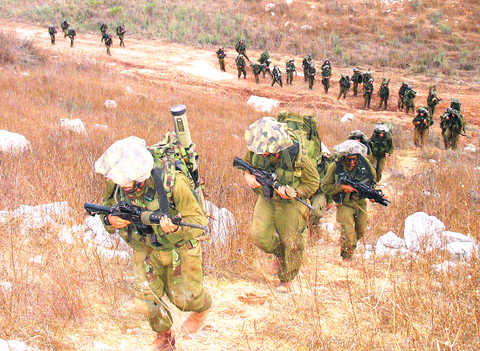
PHOTO: AP
At least 12 elite troops have already been killed, and by Saturday afternoon Israel's military death toll had climbed to 45.
As the bodies pile up, so the Israeli media has begun to turn, accusing the military of lacking the proper equipment, training and intelligence to fight a guerrilla war in Lebanon.
Israeli Defense Minister Amir Peretz, on a tour of the front lines, was confronted by troubled reserve soldiers who told him they lacked proper equipment and training.
Israel's chief of staff, Major General Dan Halutz, had vowed to wipe out Hezbollah's missile threat within 10 days. These claims are now being mocked as rockets rain down on Israel's north with ever greater intensity, despite an intense and highly destructive air bombardment.
As one well-connected Israeli expert put it: "If we have such good information in Lebanon, how come we still don't know the hideout of missiles and launchers? ... If we don't know the location of their weapons, why should we know which house is a Hezbollah house."
As international outrage over civilian deaths grows, the spotlight is increasingly turning on Israeli air operations.
One senior commander who has been involved in the air attacks in Lebanon has already raised concerns that some of the air force's actions might be considered "war crimes."
Yonatan Shapiro, a former Black-hawk helicopter pilot dismissed from reserve duty after signing a "refusenik" letter in 2004, said he had spoken with Israeli F-16 pilots in recent days and learnt that some had aborted missions because of concerns about the reliability of intelligence information.
According to Shapiro, some pilots justified aborting missions out of "common sense" and in the context of the Israeli Defense Force's (IDF) moral code of conduct, which says every effort should be made to avoiding harming civilians.
"Some pilots told me they have shot at the side of targets because they're afraid people will be there, and they don't trust any more those who give them the coordinates and targets," Shapiro said.
"One pilot told me he was asked to hit a house on a hill, which was supposed to be a place from where Hezbollah was launching Katyusha missiles. But he was afraid civilians were in the house, so he shot next to the house," he said.
"Pilots are always being told they will be judged on results, but if the results are hundreds of dead civilians while Hezbollah is still able to fire all these rockets, then something is very wrong," he said.
So far none of the pilots has publicly refused to fly missions but some are wobbling, according to Shapiro.
"Their target could be a house firing a cannon at Israel and it could be a house full of children, so it's a real dilemma; it's not black and white. But ... I'm calling on them to refuse, in order save our country from self-destruction," he said.
Meron Rappoport, a former editor at the Israeli daily Haaretz and military analyst, criticized the air force's methods for selecting targets: "The impression is that information is sometimes lacking."
"One squadron leader admitted the evidence used to determine attacks on cars is sometimes circumstantial -- meaning that if people are in an area after Israeli forces warned them to leave, the assumption is that those left behind must be linked to Hezbollah ... This is problematic, as aid agencies have said many people did not leave ... because they could not, or it was unsafe to travel on the roads thanks to Israel's aerial bombardment," Rappoport said.
These revelations raise further serious questions about the airstrike in Qana on July 30 that left dozens dead, which continues to arouse international outrage.
From the outset, the Israeli military's version of events has been shrouded in ambiguity, with the army releasing a video it claims shows Katyusha rockets being fired from Qana, even though the video was dated two days earlier, and claiming that more than 150 rockets had been fired from the location.
Some Israeli military officials have continued to refer vaguely to Katyushas being launched "near houses" in the village and to non-specific "terrorist activity" inside the targeted building.
In a statement on Thursday, the IDF said that the air force did not know there were civilians in what they believed was an empty building, yet paradoxically blamed Hezbollah for using those killed as "human shields."

Chinese President Xi Jinping (習近平) is to visit Russia next month for a summit of the BRICS bloc of developing economies, Chinese Minister of Foreign Affairs Wang Yi (王毅) said on Thursday, a move that comes as Moscow and Beijing seek to counter the West’s global influence. Xi’s visit to Russia would be his second since the Kremlin sent troops into Ukraine in February 2022. China claims to take a neutral position in the conflict, but it has backed the Kremlin’s contentions that Russia’s action was provoked by the West, and it continues to supply key components needed by Moscow for

Japan scrambled fighter jets after Russian aircraft flew around the archipelago for the first time in five years, Tokyo said yesterday. From Thursday morning to afternoon, the Russian Tu-142 aircraft flew from the sea between Japan and South Korea toward the southern Okinawa region, the Japanese Ministry of Defense said in a statement. They then traveled north over the Pacific Ocean and finished their journey off the northern island of Hokkaido, it added. The planes did not enter Japanese airspace, but flew over an area subject to a territorial dispute between Japan and Russia, a ministry official said. “In response, we mobilized Air Self-Defense

CRITICISM: ‘One has to choose the lesser of two evils,’ Pope Francis said, as he criticized Trump’s anti-immigrant policies and Harris’ pro-choice position Pope Francis on Friday accused both former US president Donald Trump and US Vice President Kamala Harris of being “against life” as he returned to Rome from a 12-day tour of the Asia-Pacific region. The 87-year-old pontiff’s comments on the US presidential hopefuls came as he defied health concerns to connect with believers from the jungle of Papua New Guinea to the skyscrapers of Singapore. It was Francis’ longest trip in duration and distance since becoming head of the world’s nearly 1.4 billion Roman Catholics more than 11 years ago. Despite the marathon visit, he held a long and spirited

The pitch is a classic: A young celebrity with no climbing experience spends a year in hard training and scales Mount Everest, succeeding against some — if not all — odds. French YouTuber Ines Benazzouz, known as Inoxtag, brought the story to life with a two-hour-plus documentary about his year preparing for the ultimate challenge. The film, titled Kaizen, proved a smash hit on its release last weekend. Young fans queued around the block to get into a preview screening in Paris, with Inoxtag’s management on Monday saying the film had smashed the box office record for a special cinema


 RSS
RSS