


The bombs should be small and placed in day packs, making them harder to detect. The bombers should dress like tourists. They should not bother targeting hotels because security is too tight. Instead they should consider restaurants, discos and theaters.
A thorough survey should be done in advance by the bombers themselves. This way, they are more familiar with the sites, and no one is left behind to be hunted later by the police.
"There is no escape plan because the perpetrators will become martyrs," the planning document states. "They will go to the targets and not return."
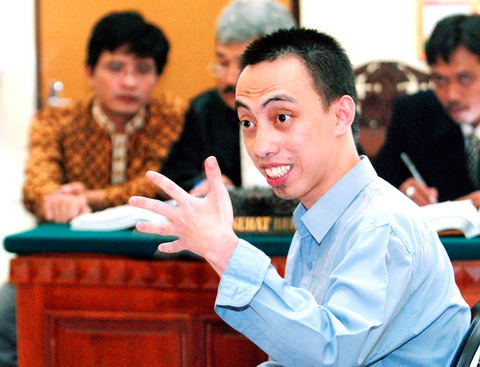
PHOTO: EPA
"5:25pm -- Pack, check out of the boarding house and synchronize watches," their minute-by-minute timetable reads.
"6:15 -- Arrive near the Hard Rock Cafe and look for a place to pray," read another of the listings.
"7:33:25 -- Make sure the delay switches are all ready and enter the restaurant."
And the final entry: "7:34 -- ALLAHU AKBAR!!!" ("God is great").
This is the minute-by-minute choreography of a suicide bombing. Indonesian police uncovered the document from the computer of one of the planners of an attack last October in Bali that killed 20 people, when three men walked into separate restaurants and blew themselves up with day packs loaded with explosives.
The document, experts say, offers a rare glimpse into the minds of terrorist plotters and the kind of meticulous planning that lies behind even a relatively simple operation. The schedule in Bali even provided for 20 minutes for the bombers to pray.
The 34-page document, titled The Bali Project, was found on the computer of Azhari Husin, a Malaysian engineer educated in Australia and Britain who became a master bomb maker and was one of the most dangerous terrorists in Southeast Asia until he was killed in a shootout with the police last November.
The document was given to the New York Times by a person who requested anonymity because it has not been officially released. It was first reported on by Tempo, a weekly English-language news magazine in Jakarta.
The author, who the police say they believe was Azhari himself, begins by asking, "Why Bali?" Because it will have a "global impact," he answers.
"Bali is known around the world, better than Indonesia itself," the author writes. "An attack in Bali will be covered by the international media."
While the targets were to be "foreign tourists from America and its allies," the bombers would have difficulty working out where the tourists were from so, "we will consider all white people the enemy."
In Section 2, "Method of Attack," he notes that the plan must differ from the first attack in Bali, in October 2002, when a minivan loaded with explosives was detonated in front of two nightclubs, killing 202 people.
Now, "security is tighter," the author writes.
The author decides that it is too risky to bring in a truck or a similarly large amount of explosives.
"The bomb must be smaller, and brought in ready to use," the document says.
"We tried to minimize the impact on Muslims," the author explains in the final section, which was written after the attack. "Nevertheless, there were still Muslim victims killed and wounded."
Azahari, who was one of Asia's most wanted men until his death, allegedly planned the attacks with compatriot Noordin Mohammad Top, who remains on the run.
Both men were key members of regional extremist network Jemaah Islamiyah (JI), but experts believe the men had largely split from JI's formal structure to form their own more radical group, though they retained some links.

Chinese President Xi Jinping (習近平) is to visit Russia next month for a summit of the BRICS bloc of developing economies, Chinese Minister of Foreign Affairs Wang Yi (王毅) said on Thursday, a move that comes as Moscow and Beijing seek to counter the West’s global influence. Xi’s visit to Russia would be his second since the Kremlin sent troops into Ukraine in February 2022. China claims to take a neutral position in the conflict, but it has backed the Kremlin’s contentions that Russia’s action was provoked by the West, and it continues to supply key components needed by Moscow for

Japan scrambled fighter jets after Russian aircraft flew around the archipelago for the first time in five years, Tokyo said yesterday. From Thursday morning to afternoon, the Russian Tu-142 aircraft flew from the sea between Japan and South Korea toward the southern Okinawa region, the Japanese Ministry of Defense said in a statement. They then traveled north over the Pacific Ocean and finished their journey off the northern island of Hokkaido, it added. The planes did not enter Japanese airspace, but flew over an area subject to a territorial dispute between Japan and Russia, a ministry official said. “In response, we mobilized Air Self-Defense

CRITICISM: ‘One has to choose the lesser of two evils,’ Pope Francis said, as he criticized Trump’s anti-immigrant policies and Harris’ pro-choice position Pope Francis on Friday accused both former US president Donald Trump and US Vice President Kamala Harris of being “against life” as he returned to Rome from a 12-day tour of the Asia-Pacific region. The 87-year-old pontiff’s comments on the US presidential hopefuls came as he defied health concerns to connect with believers from the jungle of Papua New Guinea to the skyscrapers of Singapore. It was Francis’ longest trip in duration and distance since becoming head of the world’s nearly 1.4 billion Roman Catholics more than 11 years ago. Despite the marathon visit, he held a long and spirited

China would train thousands of foreign law enforcement officers to see the world order “develop in a more fair, reasonable and efficient direction,” its minister for public security has said. “We will [also] send police consultants to countries in need to conduct training to help them quickly and effectively improve their law enforcement capabilities,” Chinese Minister of Public Security Wang Xiaohong (王小洪) told an annual global security forum. Wang made the announcement in the eastern city of Lianyungang on Monday in front of law enforcement representatives from 122 countries, regions and international organizations such as Interpol. The forum is part of ongoing


 RSS
RSS