


Sri Lanka's air force pounded Tamil Tiger rebel positions in the country's north for a second day yesterday, a senior insurgent leader said ahead of a mass funeral for 64 people killed a day earlier in a bus bombing blamed on the insurgents.
The Tigers said the airstrikes near a key rebel stronghold showed that the government was on a war footing, while the country's president said he remained committed to the country's 2002 cease-fire accord, despite Thursday's bus attack.
Air force jets dropped bombs in the area around the northern town of Kilinochchi, Tiger leader Seevaratnam Puleedevan told AP, but he did not cite casualty figures.
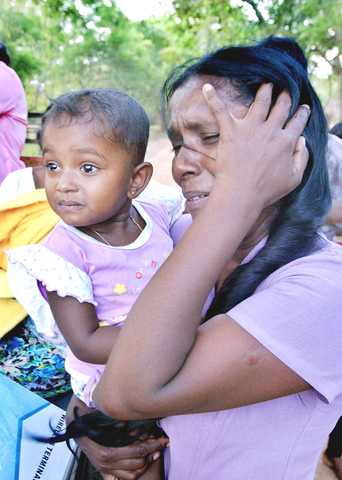
PHOTO: AP
"They are carrying out attacks. At least eight bombs have been dropped since dawn today," Puleedevan said. "I think the Sri Lankan government, by launching the air raids, is showing that they are ready for war."
"We are assessing the ground situation and our Central Command will take appropriate action," he said of possible rebel reaction to the reported bombing.
Dangerously tense relations between the rebels and the government deteriorated further on Thursday when suspected insurgents triggered hidden explosives aimed at a bus in a predominantly ethnic Sinhalese area, killing 64 people in the worst violence since the truce.
Within hours, the Sri Lankan air force began retaliatory attacks on positions controlled by the rebels, formally known as the Liberation Tigers of Tamil Eelam, or LTTE.
A top defense analyst said the air raids were intended to be a show of strength by the government, and as retaliation.
"Probably the attacks are designed to show the [rebels] that the government won't take things lying down," said Harry Goonetilleke, a retired air marshal of Sri Lankan air force.
"The attacks are also kind of retaliation ... mainly aimed at probably to show the LTTE that they will not get away," he said.
Regardless, Sri Lanka's president insisted he remains committed to peace with the Tamil Tigers, despite the bus attack.
``We will not let this incident, however barbaric it is, sabotage the peace process. We are deeply committed to the peace process,'' President Mahinda Rajapakse was quoted as saying by state-run Daily News yesterday.
With peace talks largely abandoned, the bus attack edged this tropical island nation off India's southern tip further toward all-out war in a conflict that killed 65,000 people before the truce.
The dead in the bus blast in Kabithigollewa included at least 15 children, their blue school uniforms coated with blood and gore. At least 78 people were wounded in the attack.

Chinese President Xi Jinping (習近平) is to visit Russia next month for a summit of the BRICS bloc of developing economies, Chinese Minister of Foreign Affairs Wang Yi (王毅) said on Thursday, a move that comes as Moscow and Beijing seek to counter the West’s global influence. Xi’s visit to Russia would be his second since the Kremlin sent troops into Ukraine in February 2022. China claims to take a neutral position in the conflict, but it has backed the Kremlin’s contentions that Russia’s action was provoked by the West, and it continues to supply key components needed by Moscow for

Japan scrambled fighter jets after Russian aircraft flew around the archipelago for the first time in five years, Tokyo said yesterday. From Thursday morning to afternoon, the Russian Tu-142 aircraft flew from the sea between Japan and South Korea toward the southern Okinawa region, the Japanese Ministry of Defense said in a statement. They then traveled north over the Pacific Ocean and finished their journey off the northern island of Hokkaido, it added. The planes did not enter Japanese airspace, but flew over an area subject to a territorial dispute between Japan and Russia, a ministry official said. “In response, we mobilized Air Self-Defense

CRITICISM: ‘One has to choose the lesser of two evils,’ Pope Francis said, as he criticized Trump’s anti-immigrant policies and Harris’ pro-choice position Pope Francis on Friday accused both former US president Donald Trump and US Vice President Kamala Harris of being “against life” as he returned to Rome from a 12-day tour of the Asia-Pacific region. The 87-year-old pontiff’s comments on the US presidential hopefuls came as he defied health concerns to connect with believers from the jungle of Papua New Guinea to the skyscrapers of Singapore. It was Francis’ longest trip in duration and distance since becoming head of the world’s nearly 1.4 billion Roman Catholics more than 11 years ago. Despite the marathon visit, he held a long and spirited

The pitch is a classic: A young celebrity with no climbing experience spends a year in hard training and scales Mount Everest, succeeding against some — if not all — odds. French YouTuber Ines Benazzouz, known as Inoxtag, brought the story to life with a two-hour-plus documentary about his year preparing for the ultimate challenge. The film, titled Kaizen, proved a smash hit on its release last weekend. Young fans queued around the block to get into a preview screening in Paris, with Inoxtag’s management on Monday saying the film had smashed the box office record for a special cinema


 RSS
RSS