


Extra body armor -- the lack of which caused a political storm in the US -- has flooded into Iraq, but many Marines here promptly stuck it in lockers or under bunks. Too heavy and cumbersome, many say.
Marines already carry loads as heavy as 32kg when they patrol the dangerous streets in towns and villages in restive Anbar Province. The new armor plates, while only 2.3kg per set, are not worth carrying for the additional safety they are said to provide, some say.
"We have to climb over walls and go through windows," said Sergeant Justin Shank of Greencastle, Pennsylvania. "I understand the more armor, the safer you are. But it makes you slower. People don't understand that this is combat and people are going to die."
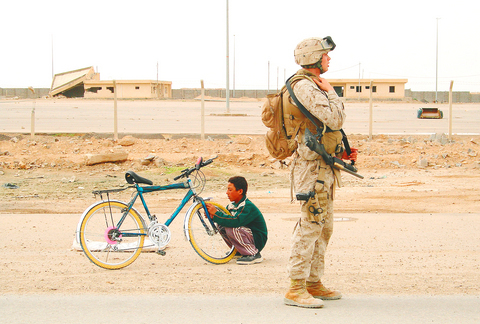
PHOTO: AP
Staff Sergeant Thomas Bain of Buffalo, New York, shared concerns about the extra weight.
"Before you know it, they're going to get us injured because we're hauling too much weight and don't have enough mobility to maneuver in a fight from house to house," said Bain, who is assigned to the 3rd Battalion, 6th Marine Regiment. "I think we're starting to go overboard on the armor."
Since the insurgency erupted in Iraq, the Pentagon has been criticized for supplying insufficient armor for Humvees and too few bulletproof vests. In one remarkable incident, soldiers publicly confronted Secretary of Defense Donald Rumsfeld about the problem on live television.
Hometown groups across the US have since raised money to send extra armor to troops, and the Pentagon, under congressional pressure, launched a program last October to reimburse troops who had purchased armor with their own money.
Soldiers and their parents spent hundreds, sometimes thousands, of dollars on armor until the Pentagon began issuing the new protective gear.
In Bain's platoon of about 35 men, Marines said only three or four wore the plates after commanders distributed them last month and told them that use was optional.
Top military officials, including Secretary of the Army Francis Harvey, acknowledge the concerns over weight and mobility but have urged that the new gear be mandatory.
"That's going to add weight, of course," Harvey said. "You've read where certain soldiers aren't happy about that. But we think it's in their best interest to do this."
Marines have shown a special aversion to the new plates because they tend to patrol on foot, sometimes conducting two patrols each day that last several hours. They feel the extra weight.
In Euphrates River cities from Ramadi and Romanna, lance corporals to captains have complained about the added weight and lack of mobility. But some commanders have refused to listen. In the former insurgent stronghold of Fallujah, for example, commanders require use of the plates. End of story.
The marine corps has said a total of 28,000 sets of the plates, officially called small-arms protective inserts, or side SAPIs, will be in combat zones by next month. The army has said it is hoping to have 230,000 sets of plates in the field this year.
Last year, a study by the Armed Forces Medical Examiner said dozens of Marines killed by wounds to the torso might have survived had the larger plates been in use.
"I'm sure people who ... lost kidneys would have loved to have had them on," said 2nd Lieutenant William Oren, a native of Southlake, Texas, who wears the plates. "More armor isn't the answer to all our problems. But I'll recommend them because it's more protection."

Chinese President Xi Jinping (習近平) is to visit Russia next month for a summit of the BRICS bloc of developing economies, Chinese Minister of Foreign Affairs Wang Yi (王毅) said on Thursday, a move that comes as Moscow and Beijing seek to counter the West’s global influence. Xi’s visit to Russia would be his second since the Kremlin sent troops into Ukraine in February 2022. China claims to take a neutral position in the conflict, but it has backed the Kremlin’s contentions that Russia’s action was provoked by the West, and it continues to supply key components needed by Moscow for

Japan scrambled fighter jets after Russian aircraft flew around the archipelago for the first time in five years, Tokyo said yesterday. From Thursday morning to afternoon, the Russian Tu-142 aircraft flew from the sea between Japan and South Korea toward the southern Okinawa region, the Japanese Ministry of Defense said in a statement. They then traveled north over the Pacific Ocean and finished their journey off the northern island of Hokkaido, it added. The planes did not enter Japanese airspace, but flew over an area subject to a territorial dispute between Japan and Russia, a ministry official said. “In response, we mobilized Air Self-Defense

CRITICISM: ‘One has to choose the lesser of two evils,’ Pope Francis said, as he criticized Trump’s anti-immigrant policies and Harris’ pro-choice position Pope Francis on Friday accused both former US president Donald Trump and US Vice President Kamala Harris of being “against life” as he returned to Rome from a 12-day tour of the Asia-Pacific region. The 87-year-old pontiff’s comments on the US presidential hopefuls came as he defied health concerns to connect with believers from the jungle of Papua New Guinea to the skyscrapers of Singapore. It was Francis’ longest trip in duration and distance since becoming head of the world’s nearly 1.4 billion Roman Catholics more than 11 years ago. Despite the marathon visit, he held a long and spirited

The pitch is a classic: A young celebrity with no climbing experience spends a year in hard training and scales Mount Everest, succeeding against some — if not all — odds. French YouTuber Ines Benazzouz, known as Inoxtag, brought the story to life with a two-hour-plus documentary about his year preparing for the ultimate challenge. The film, titled Kaizen, proved a smash hit on its release last weekend. Young fans queued around the block to get into a preview screening in Paris, with Inoxtag’s management on Monday saying the film had smashed the box office record for a special cinema


 RSS
RSS