


At least 19 Nigerian Muslims were killed by a Christian mob at the entrance to the southeastern city of Onitsha yesterday, according to an AFP correspondent who saw the bodies.
The corpses were scattered by the side of the main road into Onitsha across the Niger river bridge, where a contingent of soldiers had set up a roadblock to hold back a gang of hundreds of Christian youths wielding clubs and machetes.
The bodies, apparently all ethnic Hausa, had been beaten, slashed and in some cases burnt.
"There are thousands of boys with cutlasses and sticks on the rampage. I've counted at least 20 bodies here by the Onitsha bridge. They are Hausas. Some of them are burnt and some have their stomachs cut open," a Reuters photographer said.
A police official earlier said that five more Hausas had been killed in the neighboring city of Asaba, where thousands of Muslims had fled after the Onitsha riots.
The Hausa are the main ethnic group in predominantly Muslim northern Nigeria, while Onitsha is located in the ethnic Ibo heartland, a mainly Christian region.
Frank Nweke, a magazine editor, who ran the gauntlet of the mob to escape Onitsha and made it to the bridge, told reporters that he had seen 15 more corpses lying in the streets of the city.
Some had been beheaded, others had had their genitals removed.
"I saw one boy holding a severed head with blood dripping from it," he said.
Army officers could not confirm a total death toll but said that in the city, where control has not been restored, thousands of Muslims had taken shelter in barracks and police stations.
A doctor at the Onitsha general hospital said more than 50 newly injured people had been brought in yesterday.
Nigerian Red Cross said on Tuesday that in the mainly Muslim northern city of Bauchi, protests by Muslims targeting Christians claimed the lives of 18 people. In Onitsha, Christian mobs burned two mosques and beat to death at least six Muslims, residents and witnesses said.
The continued mayhem brought to at least 66 the total number of people killed in sectarian fighting in Nigeria since Saturday, when protests over controversial cartoons published in Europe of the Prophet Mohammed turned violent for the first time in the northern Muslim city of Maiduguri, police said.
Similar protests broke out in Bauchi city soon afterward, leaving seven dead on Monday and another 18 dead on Tuesday, Adamu Abubakar, secretary of the Red Cross in Bauchi, told reporters.
Mobs ran through Bauchi's streets wielding machetes and sticks, Abubakar said.
"I am just coming back from Gombe Road, where we carried two dead bodies, both badly mutilated, and just at Boni Haruna Street near the Specialist Hospital, two of my staff were attacked and are seriously wounded," Abubakar said. "So, the situation is still delicate."
Among the dead there were a man, his wife and their daughter. Six bodies were burnt beyond recognition.
The violence in Onitsha appeared to be a reprisal for anti-Christian attacks on Saturday in Maiduguri, where police said 30 churches were burned down and 18 people, mostly Christians, were killed. The Christian Association of Nigeria put the death toll in Maiduguri higher, at 50 dead.
"The mosque at the main market has been burnt and I've counted at least six dead bodies on the streets," Izzy Uzor, an Onitsha resident and businessman, told reporters by telephone on Tuesday. "The whole town is in a frenzy."

SPEAKING OUT: After Siranudh Scott’s allegations surfaced, celebrities and public figures took to social media to share their own experiences of sexual misconduct and abuse A high-profile alleged sexual abuse case within a wealthy Thai beer brewing family has prompted a wave of painful accounts from survivors of unconnected abuse in the conservative nation. Siranudh Scott, a member of the billionaire Thai family that founded the ubiquitous Singha beer brand, posted an emotional video this month accusing his elder brother Sunit of repeatedly abusing him when he was a teenager. Sunit, who is in his 30s, later denied the allegations in a video posted online, but Singha parent Boonrawd dismissed him from his executive role with the company on Tuesday last week. “I felt I needed to speak

SEEKING ORDER: Rodrigo Paz said that ‘anyone who wants to destroy the nation will have to deal with this president and the full force of the constitution’ Bolivian President Rodrigo Paz on Wednesday said that the nation was at a “breaking point” after nearly a month of protests that have caused shortages of food, fuel and medicine. Paz, who took office six months ago amid the worst economic crisis there in four decades, is battling a groundswell of fury over his policies. The political capital, La Paz, has been besieged by low-income workers and members of the indigenous majority calling for his resignation. “The country needs order and is reaching breaking point,” the 58-year-old said at a public event in La Paz, renewing his appeal for dialogue. On Tuesday, the Bolivian
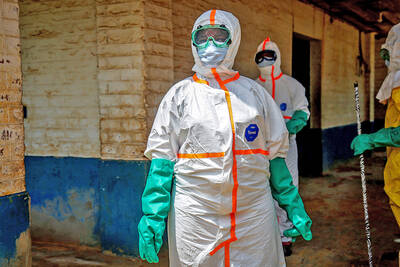
COMMUNITY CONFLICT: Concerns about disease spread from corpses has run up against friends and families’ desire to bury their dead as infection spreads in the area Angry residents of a town at the epicenter of the Ebola outbreak in the Democratic Republic of the Congo (DR Congo) attacked and burned a tent that was part of a health center where people are being treated for the virus, the staff there said Saturday. It was the second such attack in the region in a week. No one was hurt in the attack, according to reports but as patients ran out to escape the fire, 18 people with suspected Ebola infections fled the facility and are unaccounted for, a hospital director said. Angry residents arrived at the clinic in the
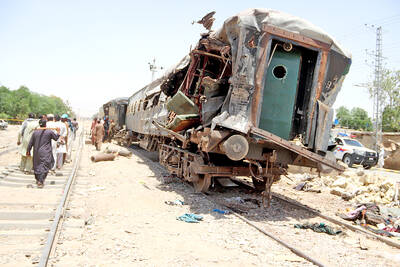
INSURGENT ACTION: A local independence movement in Balochistan, alleged by Pakistan’s government to be backed by India, claimed responsibility for the strike A suicide bomber detonated an vehicle-borne IED near a railway as a passenger train passed through the southwestern Pakistani city of Quetta yesterday, killing at least 23 people and wounding over 70, officials said. The explosion caused two of the train cars to overturn and catch fire, according to footage shared online. The attack happened in an area where security forces are usually stationed, badly damaging several nearby buildings and smashing more than a dozen vehicles parked along the road, according to witnesses and images circulating on social media. Doctors at local hospitals said they had received the wounded, with 20 in critical


 RSS
RSS