


Nearly 100 brightly dressed riders set out at the weekend on the first stage of the sixth annual Tour of Eritrea, the cycling-mad east African nation's top sporting event.
The nine-day competition, which kicked off in the capital Asmara, is known as much for athletic prowess as oppressive heat and unique obstacles along the course -- like rock-throwing baboons and malingering camels.
Professionals and amateurs, Eritreans and foreigners are competing in this year's tour as they have in the five previous ones, all reminders of the Italian colonial influence of the last century when the sport took hold here.
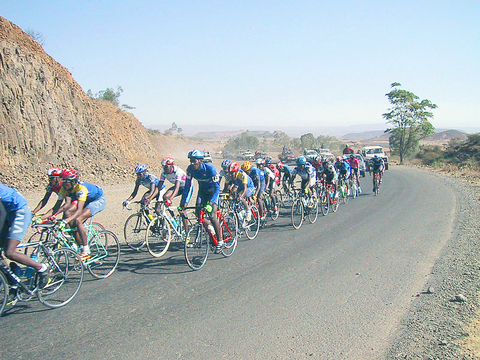
PHOTO: AFP
When the first race took place in 1946, Eritreans were not allowed to ride but cycling's popularity soared and it is now common to see groups peddling the roads in gear not unlike that worn by stars in the Tour de France.
Every weekend, close to 1,000 riders participate in races around the country and Eritrea's sole television channel broadcasts the Tour de France live every summer as it does the Tour of Eritrea to satisfy local interest.
"Many people follow these two tours on TV at home and in bars," said Aklilu Lijam, the president of the Eritrean Cycling Federation, which organizes the Tour of Eritrea.
There are about 100 professional Eritrean cyclists who belong to teams, some state-sponsored, who enjoy special privileges, allowances, housing and local popularity akin to that of Western sports stars, movie idols and singers.
"It was my dream to be a cyclist," said Matiwos Zeray, a 25-year-old professional rider who has competed in every tour since 2001. "People recognize me in the street."
Matiwos lives in a house in the capital with other members of his team and earns 1,200 nakfa (US$80) a month in a country where the average per capita income is US$130 a year.
Still, life is relatively spartan, with a training schedule that includes morning rides of 100km.
"I sleep every afternoon, go to bed at 9pm," Matiwos said. "I don't drink alcohol and I have no time for a girlfriend. My ambition is to participate in the Tour de France."
The Tour of Eritrea is a long way from its French cousin: this year's prize money is 150,000 nakfa to be shared among the top finishers.
It is not nearly as well-known as cycling's most famous event, but it may be as grueling, covering 1,100km through breathtaking hills and parched desert with some distinctly non-French features.
"Asmara to Barentu is a hard stage, you go across a desert under high temperatures," Matiwos said. "Sometimes camels cross the roads or baboons throw rocks at the cyclists."
David Asbridge, a 32-year-old Briton who teaches at Asmara University and was the only non-Eritrean to ride in the 2004 tour, agrees.
"The tour was agony, but I'm really glad I did it. I survived, even though on one stage I got seven punctures," he said, adding that the enthusiasm of spectators is unmatched.
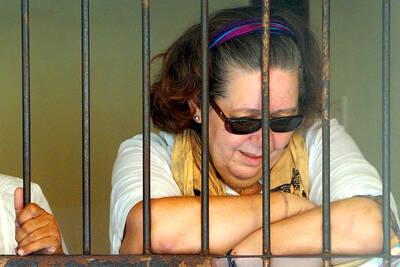
Indonesia was to sign an agreement to repatriate two British nationals, including a grandmother languishing on death row for drug-related crimes, an Indonesian government source said yesterday. “The practical arrangement will be signed today. The transfer will be done immediately after the technical side of the transfer is agreed,” the source said, identifying Lindsay Sandiford and 35-year-old Shahab Shahabadi as the people being transferred. Sandiford, a grandmother, was sentenced to death on the island of Bali in 2013 after she was convicted of trafficking drugs. Customs officers found cocaine worth an estimated US$2.14 million hidden in a false bottom in Sandiford’s suitcase when
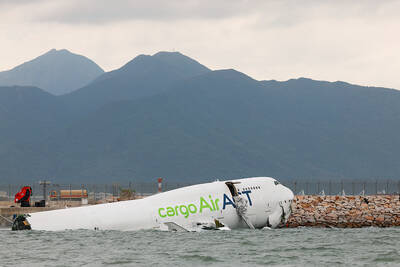
CAUSE UNKNOWN: Weather and runway conditions were suitable for flight operations at the time of the accident, and no distress signal was sent, authorities said A cargo aircraft skidded off the runway into the sea at Hong Kong International Airport early yesterday, killing two ground crew in a patrol car, in one of the worst accidents in the airport’s 27-year history. The incident occurred at about 3:50am, when the plane is suspected to have lost control upon landing, veering off the runway and crashing through a fence, the Airport Authority Hong Kong said. The jet hit a security patrol car on the perimeter road outside the runway zone, which then fell into the water, it said in a statement. The four crew members on the plane, which
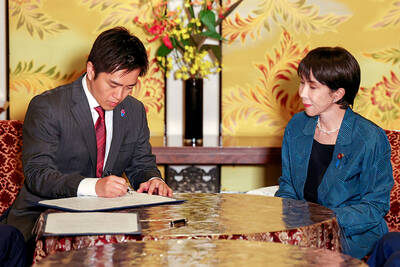
Japan’s ruling Liberal Democratic Party (LDP) and its junior partner yesterday signed a coalition deal, paving the way for Sanae Takaichi to become the nation’s first female prime minister. The 11th-hour agreement with the Japan Innovation Party (JIP) came just a day before the lower house was due to vote on Takaichi’s appointment as the fifth prime minister in as many years. If she wins, she will take office the same day. “I’m very much looking forward to working with you on efforts to make Japan’s economy stronger, and to reshape Japan as a country that can be responsible for future generations,”
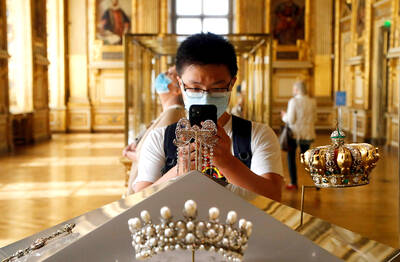
SEVEN-MINUTE HEIST: The masked thieves stole nine pieces of 19th-century jewelry, including a crown, which they dropped and damaged as they made their escape The hunt was on yesterday for the band of thieves who stole eight priceless royal pieces of jewelry from the Louvre Museum in the heart of Paris in broad daylight. Officials said a team of 60 investigators was working on the theory that the raid was planned and executed by an organized crime group. The heist reignited a row over a lack of security in France’s museums, with French Minister of Justice yesterday admitting to security flaws in protecting the Louvre. “What is certain is that we have failed, since people were able to park a furniture hoist in the middle of


 RSS
RSS