


Sympathy for al-Qaeda has surged after a US airstrike devastated a remote mountain hamlet in a border region sometimes as hostile toward the Pakistani government as it is to the US.
A week after the attack in Damadola, near the Afghan border, villagers insist no members of the terror network were anywhere near the border village when it was hit. But thousands of protesters flooded a nearby town chanting, "Long live Osama bin Laden!"
Pakistan's army, in charge of hunting militants, was nowhere to be seen.
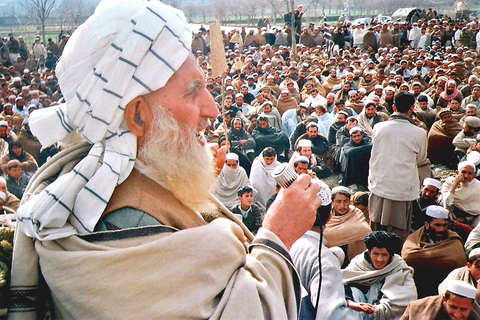
PHOTO: AP
The rally was the latest in a series of demonstrations across Pakistan against the Jan. 13 attack, which apparently targeted but missed al-Qaeda's No. 2, Ayman al-Zawahri.
The military still mans numerous checkpoints in the area, but it appears to be keeping a low profile so it will not inflame villagers still seething over the deaths of 13 civilians, including women and children, in the attack.
Pakistani intelligence officials believe that four top al-Qaeda operatives may have also been killed in the strike, including al-Qaeda's master bomb maker, Midhat Mursi.
The men had gathered for dinner on the Islamic holiday of Eid al-Adha to plan attacks for early this year in Afghanistan and Pakistan, a senior Pakistani intelligence official said.
"This attack has increased our hatred for Americans because they are killing innocent women and children,'' said Zakir Ullah, one of 5,000 demonstrators in Inayat Qala, a market town about 5km from Damadola.
"We support jihad. Jihad is the duty of every Muslim," he said.
The assault has caused friction between Islamabad and Washington and widespread outrage in this Islamic nation of 150 million, but few are as angry as the people who live in the virtually lawless tribal region that borders Afghanistan. The area is a hotbed of Taliban and al-Qaeda sympathizers.
Damadola residents deny any links to the militants.
"We don't have anything to do with al-Qaeda, and it was a cruel act of the Americans to attack my house without reason," said Bacha Khan, whose house was among the three destroyed.
A relative of Faqir Mohammed, a pro-Taliban cleric who intelligence officials believe hid the bodies of the four suspected al-Qaeda militants killed in the attack to prevent their identification, was arrested on Sunday in Damadola, a security official said on condition of anonymity because he was not authorized to talk to the media.
Pakistani authorities say they are looking for fighters who might have survived the attack, but they have not visibly stepped up maneuvers in the area.
Meanwhile, Pakistani authorities stopped a 2,000-strong convoy of hardline Islamists heading for the scene of a US missile attack, an official said yesterday.
Hundreds of armed tribal policemen erected barricades and told the protesters to return.
"We have instructions from the government that these political leaders should not be allowed to go Bajur," said Mohammed Jamil, the region's top government official.
There were no reports of violence,
but the supporters chanted slogans against Washington and the federal government.
Protesters stopped in front of the police line and began chanting "Down with America," "Down with [Pakistani President General Pervez] Musharraf," a close ally in Washington's war on terror.
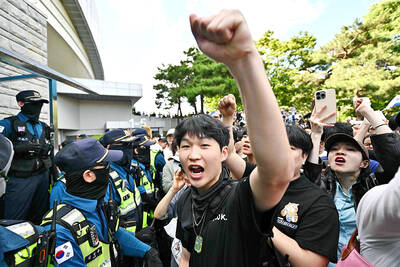
‘ABSURD MISTAKE’: The election commission said that there had been a failure to anticipate turnout after 14 polling stations ran short of ballot papers South Korean riot police yesterday cleared protesters from a Seoul polling station after a 35-hour blockade sparked by a shortage of ballot papers during local elections earlier this week. Wednesday’s election was the first nationwide vote since South Korean President Lee Jae-myung took office following the ouster of Yoon Suk-yeol over his short-lived martial law declaration. Lee’s ruling Democratic Party swept most races, but failed to flip the crucial Seoul mayoral seat. The South Korean National Election Commission apologized, blaming a failure to anticipate turnout after 14 polling stations in Seoul ran short of ballot papers. Some polling stations stayed open until 10pm to

France experienced its hottest spring on record, the French weather service said on Tuesday, after an exceptional early heat wave that also broke highs for the season in England and Wales. Meteo-France said the average nationwide temperature over March to May was 13.8°C — about 1.7°C above the norm, and surpassing records set in 2011 and 2020. “The warmest spring since records began in 1900,” it said in a bulletin. All three months were warmer than average, but the onset of an “unprecedented heatwave” late last month pushed the mercury to highs typically seen at the height of the summer. “Our country had never

A Sherpa guide was found crawling to base camp on Mount Everest a week after he went missing and was reunited with his family, who had given up hope he would return. Dawa Sherpa was last seen on Friday last week descending the mountain, but he did not reach base camp even though his client did. The pair were among the last climbers on the mountain as the climbing season came to an end and the route was dismantled. Dawa was located by a cleaning crew on Thursday morning as he was crawling down the snowy slopes around the Khumbu Icefall, just above
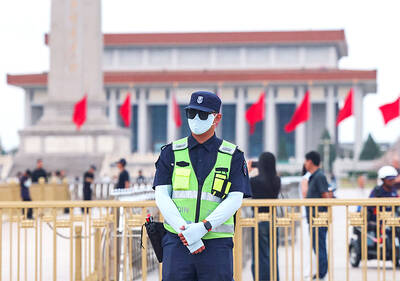
Chinese authorities are snuffing out any remembrance of the deadly 1989 military crackdown on student-led pro-democracy protests in Tiananmen Square, which happened 37 years ago yesterday, in a further tightening of a years-long campaign to erase what happened from public memory. Police told relatives of the victims they would not be allowed to visit a cemetery in Beijing on the anniversary of the crackdown, a person with knowledge of the matter said. Relatives of the victims visited the cemetery on the anniversary for more than 30 years to read memorial statements with police keeping watch, Amnesty International said. Hundreds of people,


 RSS
RSS