


Natalya Veresova has already put a gift for her 12-year-old daughter Katya under the small Christmas tree in their two-room apartment: a bottle of clean drinking water.
"I'm ready to meet the poison," the 36-year-old school teacher says, as she gestures around at the numerous urns, canisters, buckets and basins scattered around the apartment -- all filled with water.
In this city of about 580,000 people, anticipation is building as the holidays near but it is for an event far more sobering than Christmas and New Year's.
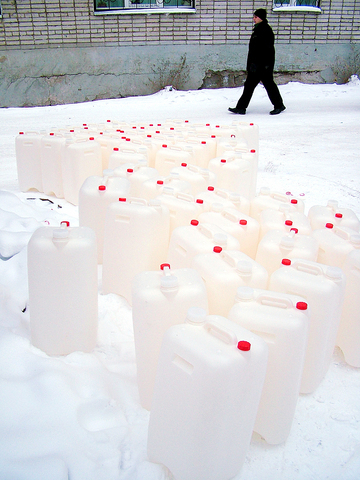
PHOTO: AFP
A toxic slick of chemicals that spewed last month from an explosion at a Chinese factory upriver is predicted to arrive in Khabarovsk sometime next week and authorities are scrambling to prepare for what some residents have called a catastrophe on the scale of the 1986 Chernobyl nuclear disaster.
The Nov. 13 spill, which disrupted water supplies to millions of Chinese and strained relations with Moscow, reached the Amur River, along the Russian border on Friday, and was expected to reach Khabarovsk later on this week, Russian emergency officials said.
Officials say the spill's concentration has dispersed somewhat and, combined with activated charcoal donated by the Chinese government, this means they will not have to shut down the city's water.
Still, all around this city perched on the high right bank of the Amur River, about 6,100km east of Moscow, residents are preparing for the worst -- buying up bottled water, filling canisters from the taps and from outdoor ground wells, a task made more complicated by the minus 30oC daytime temperatures.
"China wants to poison us so that they can take over the Far East," said 56-year-old Alexander Shvaiko as he filled a canister from an outdoor well.
Cafes in the city have posted signs reading "Our food is prepared from clean, bottled water," and the price for bottled water sold in stores has increased markedly, despite government efforts to prevent price gouging.
Shutting off water to Khabarovsk's systems could also prove disastrous for a city where apartments and homes are heated almost exclusively by radiators and forced hot-water. Many people have started buying electric heaters, which could overload the city's power grid, officials say.
Lyubov Kondratyeva, a water expert at the local branch of the Russian Academy of Sciences, accused China of deceiving Russia about the true extent of the spill and the exact nature of the chemicals, a view shared by many Khabarovsk residents.
The regional governor, Viktor Ishaev, said in televised comments recently, that residents were "China's hostages."
"China is not only hiding information, but they are misinforming us," Kondtratyeva said.
"I'm afraid to even think about the consequences if the poisonous materials nevertheless get into Khabarovsk's water," she said.

‘CROSSING THE LINE’: China’s embassy in Seoul criticized US Forces Korea Commander General Xavier Brunson, asking if his ‘hostile’ remarks were authorized by Washington South Korea and the US are in talks over recent public remarks by the commander of US Forces Korea, Seoul’s presidential office said yesterday, after the comments drew sharp criticism from China. In a recent podcast interview, US Forces Korea Commander General Xavier Brunson described South Korea as “the dagger in the heart of Asia” from China’s east coast, prompting the Chinese embassy in Seoul to say that he had “truly crossed the line.” The interview came amid growing speculation that Washington might seek to expand the role of US Forces Korea in countering the growing regional influence of China, a key

SEEKING ORDER: Rodrigo Paz said that ‘anyone who wants to destroy the nation will have to deal with this president and the full force of the constitution’ Bolivian President Rodrigo Paz on Wednesday said that the nation was at a “breaking point” after nearly a month of protests that have caused shortages of food, fuel and medicine. Paz, who took office six months ago amid the worst economic crisis there in four decades, is battling a groundswell of fury over his policies. The political capital, La Paz, has been besieged by low-income workers and members of the indigenous majority calling for his resignation. “The country needs order and is reaching breaking point,” the 58-year-old said at a public event in La Paz, renewing his appeal for dialogue. On Tuesday, the Bolivian

Through the noise of rushing papers and whirring belts at a print factory in Kyoto, two creators watch their photo essay come to life in broadsheet form — part of an effort to win new audiences in the age of artificial intelligence (AI). Despite the decline of the publishing industry, self-publication and handmade “zine” magazines are growing in popularity in Japan, reflecting the nation’s enduring love of paper in the digital era. While speaking to Agence France-Presse at the plant, his hands black with ink, one of the creators, Kazuma Obara, said: “I think [paper] is a medium that engages all five

Australian researchers have trained lab-grown brain cells on a silicon computer chip to play the 1990s shooter game Doom and said they are just scratching the surface of what the neurons could be capable of doing. It is the science-fiction work of biotech boffins at Cortical Labs, who researched and developed the technology that harnesses the workings of the brain’s networking system. Each so-called “biological computer” contains about 200,000 living human brain cells, grown from stem cells that were harvested from blood donations. Having mastered the simple computer game Pong, where a paddle is moved up and down to send a ball


 RSS
RSS