


An unprecedented audit of the oceans has discovered hordes of unusual creatures, forcing scientists to rethink their ideas about the world's wildest marine life.
Among the organisms to be identified are tiny carnivorous sea sponges that engulf passing prey with their mouths and single-celled animals that protect themselves by building football-like shells.
The species were spotted by two separate expeditions that set out to probe the little-known depths of the South Atlantic and Southern oceans.
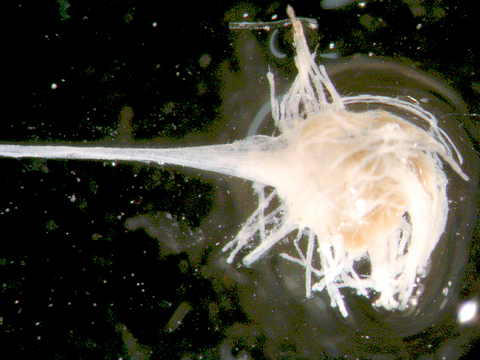
PHOTO: AP
Scientists aboard the vessels say that up to 90 percent of the creatures they encountered have never been seen before.
The expeditions were part of an attempt to draw up a census of life in the world's oceans, the most under-explored environment on Earth. Now at the halfway stage, the ?500 million (US$886.7 million) Census of Marine Life involves 1,700 scientists in 73 countries.
Each week, they add two new species of fish to a database that includes mammals, sea birds, corals, turtles and anemones. Along the mid-Atlantic ridge researchers spotted swimming red sea cucumbers, while in the Arctic ocean they discovered red jellyfish that grow up to 3m long.
Other creatures detected included a copepod, a shrimp-like crustacean and a jellyfish in the depths of the Canada basin far beyond its known range. The census now totals more than 40,000 species, including 15,717 fish, although researchers believe this is merely the tip of the iceberg.
"We estimate there are around 230,000 species down there and we want all of those documented by the end of the census in 2010. But that's a conservative estimate. We could well find a million new species by then," said Ron O'Dor of Dalhousie University in Canada and leading researcher on the census.
Biologists also looked for life near the epicenter of the earthquake that triggered the tsunami off Sumatra on Dec. 26 last year. Around the earthquake zone, there was little sign of any serious damage to wildlife, but closer by they found a dead zone where 11 hours of dives found no evidence of the large marine animals usually found in the region. Some smaller organisms such as the sea cucumber were also missing. According to the researchers, the absence of life was "unprecedented."
Key to the census is a silent-running vessel called GeoSars which carries the world's most sensitive sonar. The ship can detect creatures the size of a shrimp at a depth of 3km. The average depth of the oceans around the world is about 4km, giving the ship access to all but the deepest waters.
While some scientists focus on auditing species, others have implanted transmitters into fish and other creatures to track their movements. One bluefin tuna tagged with a transmitter stunned scientists by making three crossings of the Pacific Ocean in 600 days.

Chinese President Xi Jinping (習近平) is to visit Russia next month for a summit of the BRICS bloc of developing economies, Chinese Minister of Foreign Affairs Wang Yi (王毅) said on Thursday, a move that comes as Moscow and Beijing seek to counter the West’s global influence. Xi’s visit to Russia would be his second since the Kremlin sent troops into Ukraine in February 2022. China claims to take a neutral position in the conflict, but it has backed the Kremlin’s contentions that Russia’s action was provoked by the West, and it continues to supply key components needed by Moscow for

Japan scrambled fighter jets after Russian aircraft flew around the archipelago for the first time in five years, Tokyo said yesterday. From Thursday morning to afternoon, the Russian Tu-142 aircraft flew from the sea between Japan and South Korea toward the southern Okinawa region, the Japanese Ministry of Defense said in a statement. They then traveled north over the Pacific Ocean and finished their journey off the northern island of Hokkaido, it added. The planes did not enter Japanese airspace, but flew over an area subject to a territorial dispute between Japan and Russia, a ministry official said. “In response, we mobilized Air Self-Defense

CRITICISM: ‘One has to choose the lesser of two evils,’ Pope Francis said, as he criticized Trump’s anti-immigrant policies and Harris’ pro-choice position Pope Francis on Friday accused both former US president Donald Trump and US Vice President Kamala Harris of being “against life” as he returned to Rome from a 12-day tour of the Asia-Pacific region. The 87-year-old pontiff’s comments on the US presidential hopefuls came as he defied health concerns to connect with believers from the jungle of Papua New Guinea to the skyscrapers of Singapore. It was Francis’ longest trip in duration and distance since becoming head of the world’s nearly 1.4 billion Roman Catholics more than 11 years ago. Despite the marathon visit, he held a long and spirited

The pitch is a classic: A young celebrity with no climbing experience spends a year in hard training and scales Mount Everest, succeeding against some — if not all — odds. French YouTuber Ines Benazzouz, known as Inoxtag, brought the story to life with a two-hour-plus documentary about his year preparing for the ultimate challenge. The film, titled Kaizen, proved a smash hit on its release last weekend. Young fans queued around the block to get into a preview screening in Paris, with Inoxtag’s management on Monday saying the film had smashed the box office record for a special cinema


 RSS
RSS