


US President George W. Bush said on Monday that 30,000 Iraqis had died in the 1,000 days since the invasion in his first public acknowledgement of the war's total death toll. The president gave the estimate in answer to a question after a speech in Philadelphia to hail Iraq's political progress as early voting began for this week's election.
A Pentagon document in October estimated that Iraqis had been killed or wounded at the rate of about 50 a day over the past year, but this is the first time the administration has publicly addressed the Iraqi toll. Bush said "30,000 have died more or less" in the invasion and ensuing violence, together with 2,140 US soldiers.
His estimate appeared to include both Iraqi civilians and security forces. An independent watchdog group, Iraq Body Count, estimates that up to 30,892 Iraqi civilians have died. A Lancet article last year put the total death toll from the general "climate of violence" at 100,000.
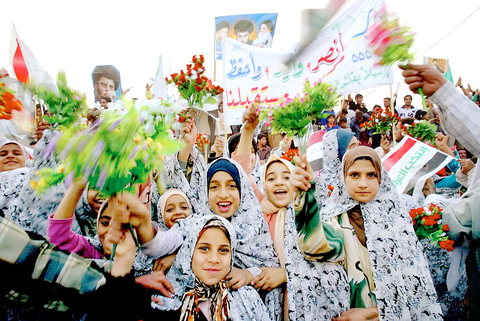
PHOTO: AFP
Nine Iraqis were killed by insurgent attacks on a day that Iraqi soldiers, hospital patients and prisoners cast their ballots ahead of tomorrow's election.
As voting began, a poll -- conducted by Oxford Research International for the BBC and other media organizations -- showed remarkable resilience among ordinary Iraqis. Nearly 71 percent of those questioned described their lives now as quite good or very good. Just over half said life was better than before the war, and 64 percent expected further improvements in the coming year.
The generally buoyant mood provided a boost for Bush, who compared Iraq's politicians to the US' founding fathers.
"It's a remarkable transformation for a country that has virtually no experience with democracy and which is struggling to overcome the legacy of one of the worst tyrannies the world has known," he said.
In the poll Baghdad, Shia and Kurdish areas were more upbeat than the Sunni center. That divide seemed likely to deepen after the discovery of a secret prison in Baghdad run by the Iraqi interior ministry.
More than 600 prisoners were found in cramped cells and 13 needed hospitalization. It was the second such center found by US forces in Baghdad in a month. Most prisoners in the first jail were Sunni and some had been tortured.
Bush on Monday called for those responsible to be "called to account."
The new poll showed widespread distrust of the occupation forces in Iraq, and a slim majority said the March 2003 invasion was wrong but only a quarter wanted an immediate troop withdrawal.
Most wanted the departure of US and British soldiers only after certain milestones had been reached: either the restoration of security, the establishment of a new Iraqi government after tomorrow's elections, or the development of Iraqi security forces capable of operating on their own.

Chinese President Xi Jinping (習近平) is to visit Russia next month for a summit of the BRICS bloc of developing economies, Chinese Minister of Foreign Affairs Wang Yi (王毅) said on Thursday, a move that comes as Moscow and Beijing seek to counter the West’s global influence. Xi’s visit to Russia would be his second since the Kremlin sent troops into Ukraine in February 2022. China claims to take a neutral position in the conflict, but it has backed the Kremlin’s contentions that Russia’s action was provoked by the West, and it continues to supply key components needed by Moscow for

Japan scrambled fighter jets after Russian aircraft flew around the archipelago for the first time in five years, Tokyo said yesterday. From Thursday morning to afternoon, the Russian Tu-142 aircraft flew from the sea between Japan and South Korea toward the southern Okinawa region, the Japanese Ministry of Defense said in a statement. They then traveled north over the Pacific Ocean and finished their journey off the northern island of Hokkaido, it added. The planes did not enter Japanese airspace, but flew over an area subject to a territorial dispute between Japan and Russia, a ministry official said. “In response, we mobilized Air Self-Defense

CRITICISM: ‘One has to choose the lesser of two evils,’ Pope Francis said, as he criticized Trump’s anti-immigrant policies and Harris’ pro-choice position Pope Francis on Friday accused both former US president Donald Trump and US Vice President Kamala Harris of being “against life” as he returned to Rome from a 12-day tour of the Asia-Pacific region. The 87-year-old pontiff’s comments on the US presidential hopefuls came as he defied health concerns to connect with believers from the jungle of Papua New Guinea to the skyscrapers of Singapore. It was Francis’ longest trip in duration and distance since becoming head of the world’s nearly 1.4 billion Roman Catholics more than 11 years ago. Despite the marathon visit, he held a long and spirited

China would train thousands of foreign law enforcement officers to see the world order “develop in a more fair, reasonable and efficient direction,” its minister for public security has said. “We will [also] send police consultants to countries in need to conduct training to help them quickly and effectively improve their law enforcement capabilities,” Chinese Minister of Public Security Wang Xiaohong (王小洪) told an annual global security forum. Wang made the announcement in the eastern city of Lianyungang on Monday in front of law enforcement representatives from 122 countries, regions and international organizations such as Interpol. The forum is part of ongoing


 RSS
RSS