


A man who admitted gunning down the American nun Dorothy Stang on Friday told the court in the Amazonian city of Belem he was ordered to "kill the old woman" by a local farmer.
Stang, a 74-year-old activist who dedicated her life to defending the rural workers of Para in northern Brazil, was shot six times in February near the town of Anapu.
About 1,000 rural workers crowded outside the court on Friday morning as two men accused of the murder went on trial. Rayfran das Neves Sales, accused of firing the shots that killed the nun, told a packed courtroom how Amair Feijoli da Cunha, a farmer also known as Tato, had pressured him into the execution.
Prosecutors believe the pistoleiro (hired gun) and his sidekick Clodoaldo Carlos Batista -- who yesterday appeared at the court wearing bullet-proof vests -- were offered 50,000 Brazilian reals (US$22,354) to assassinate the American nun. They say local farmers, who opposed the nun's attempts to claim land for impoverished rural workers, were behind the murder.
If found guilty by the seven jurors, Sales and Batista face up to 30 years in jail.
The verdict was expected yesterday.
Activists fear those the suspects allege were really responsible for the murder -- the powerful farmers said to have contracted the killers -- may never face justice.
Colleagues say Sister Dorothy constantly denounced the violence against rural workers and human rights activists to Brazil's public prosecutor and government officials. Two weeks before her death she told Nilmario Miranda, then Brazil's human rights minister, of the death threats activists were receiving in Para.
Jax Pinto, a coordinator from the Catholic church's Pastoral Land Commission (CPT) who had worked with Stang for the past six years, said: "We need to prove in this trial that it was a contract killing and that there was money involved."
"If we don't do this we will never manage to convict the [crime's] real authors," he said
He pointed out that over the past 30 years only six landowners have been brought to trial for similar crimes.
The trial comes amid growing concern over levels of rural violence in the region.
As the UN representative Hina Jilani arrived in Brazil this week to assess the situation of human-rights activism in the country, a new report claimed 772 rural workers and human-rights defenders were killed in Para over the past 30 years. The CPT study named 51 people on the hit-list of the region's landowners. Eighteen people have been killed in the region this year as a result of land disputes.
"Unfortunately nothing has changed [since Stang's death]," Pinto said.
"There are others who are now being threatened and as long as the question of land is not resolved this will continue," he added.
Pinto described parts of Para as a "no-man's land."

Swedish campaigner Greta Thunberg was deported from Israel yesterday, the Israeli Ministry of Foreign Affairs said, the day after the Israeli navy prevented her and a group of fellow pro-Palestinian activists from sailing to Gaza. Thunberg, 22, was put on a flight to France, the ministry said, adding that she would travel on to Sweden from there. Three other people who had been aboard the charity vessel also agreed to immediate repatriation. Eight other crew members are contesting their deportation order, Israeli rights group Adalah, which advised them, said in a statement. They are being held at a detention center ahead of a

A Chinese scientist was arrested while arriving in the US at Detroit airport, the second case in days involving the alleged smuggling of biological material, authorities said on Monday. The scientist is accused of shipping biological material months ago to staff at a laboratory at the University of Michigan. The FBI, in a court filing, described it as material related to certain worms and requires a government permit. “The guidelines for importing biological materials into the US for research purposes are stringent, but clear, and actions like this undermine the legitimate work of other visiting scholars,” said John Nowak, who leads field
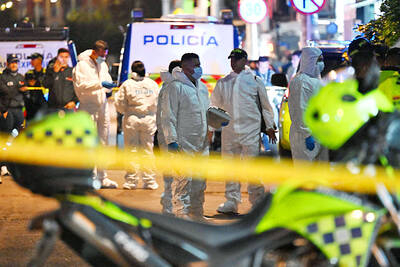
‘THE RED LINE’: Colombian President Gustavo Petro promised a thorough probe into the attack on the senator, who had announced his presidential bid in March Colombian Senator Miguel Uribe Turbay, a possible candidate in the country’s presidential election next year, was shot and wounded at a campaign rally in Bogota on Saturday, authorities said. His conservative Democratic Center party released a statement calling it “an unacceptable act of violence.” The attack took place in a park in the Fontibon neighborhood when armed assailants shot him from behind, said the right-wing Democratic Center, which was the party of former Colombian president Alvaro Uribe. The men are not related. Images circulating on social media showed Uribe Turbay, 39, covered in blood being held by several people. The Santa Fe Foundation

NUCLEAR WARNING: Elites are carelessly fomenting fear and tensions between nuclear powers, perhaps because they have access to shelters, Tulsi Gabbard said After a trip to Hiroshima, US Director of National Intelligence Tulsi Gabbard on Tuesday warned that “warmongers” were pushing the world to the brink of nuclear war. Gabbard did not specify her concerns. Gabbard posted on social media a video of grisly footage from the world’s first nuclear attack and of her staring reflectively at the Hiroshima Peace Memorial. On Aug. 6, 1945, the US obliterated Hiroshima, killing 140,000 people in the explosion and by the end of the year from the uranium bomb’s effects. Three days later, a US plane dropped a plutonium bomb on Nagasaki, leaving abut 74,000 people dead by the


 RSS
RSS