


Liu Binyan (
The cause of death was believed to be complications related to colon cancer, his wife, Zhu Hong, said.
A crusading investigative journalist and devoted socialist, Liu became a popular figure in China in the 1980s for his literary exposes in the official party newspaper, People's Daily, on greed, corruption, and rampant abuse of power within the CCP system.
But he was eventually expelled from the party in 1987, along with two other leading dissident intellectuals, Fang Lizhi (
The expulsions came shortly after the government had clamped down on pro-democracy student demonstrators in January 1987, and then dismissed the nation's reform-minded CCP secretary-general Hu Yaobang (
The three intellectuals were denounced by Deng Xiaoping (
Few intellectuals in modern China were so daring or so persistent as Liu in publicly attacking and exposing corruption in the party. What was perhaps most remarkable about his career was that he did it as something of an insider, as a party member and a writer for official party publications in a country that has a history of very little public dissent.
But for that he paid a heavy price. He was expelled from the party twice, denounced as a "rightist" in the 1950s, sent to forced-labor camps, pardoned, rehabilitated, then denounced, re-expelled from the party, and eventually exiled.
He had a knack for saying what was on his mind, and for stubbornly insisting that the party was heading in the wrong direction, betraying the people and Marxist principles.
"He was one of the first people to challenge the party," says Merle Goldman, a professor of Chinese history at Boston University.
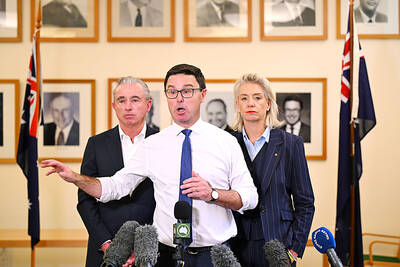
BACKLASH: The National Party quit its decades-long partnership with the Liberal Party after their election loss to center-left Labor, which won a historic third term Australia’s National Party has split from its conservative coalition partner of more than 60 years, the Liberal Party, citing policy differences over renewable energy and after a resounding loss at a national election this month. “Its time to have a break,” Nationals leader David Littleproud told reporters yesterday. The split shows the pressure on Australia’s conservative parties after Prime Minister Anthony Albanese’s center-left Labor party won a historic second term in the May 3 election, powered by a voter backlash against US President Donald Trump’s policies. Under the long-standing partnership in state and federal politics, the Liberal and National coalition had shared power
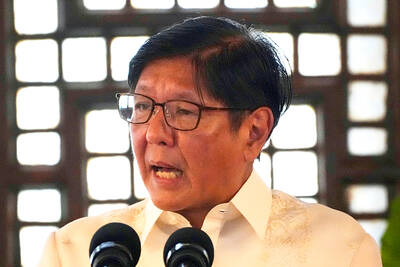
NO EXCUSES: Marcos said his administration was acting on voters’ demands, but an academic said the move was emotionally motivated after a poor midterm showing Philippine President Ferdinand Marcos Jr yesterday sought the resignation of all his Cabinet secretaries, in a move seen as an attempt to reset the political agenda and assert his authority over the second half of his single six-year term. The order came after the president’s allies failed to win a majority of Senate seats contested in the 12 polls on Monday last week, leaving Marcos facing a divided political and legislative landscape that could thwart his attempts to have an ally succeed him in 2028. “He’s talking to the people, trying to salvage whatever political capital he has left. I think it’s

CONTROVERSY: During the performance of Israel’s entrant Yuval Raphael’s song ‘New Day Will Rise,’ loud whistles were heard and two people tried to get on stage Austria’s JJ yesterday won the Eurovision Song Contest, with his operatic song Wasted Love triumphing at the world’s biggest live music television event. After votes from national juries around Europe and viewers from across the continent and beyond, JJ gave Austria its first victory since bearded drag performer Conchita Wurst’s 2014 triumph. After the nail-biting drama as the votes were revealed running into yesterday morning, Austria finished with 436 points, ahead of Israel — whose participation drew protests — on 357 and Estonia on 356. “Thank you to you, Europe, for making my dreams come true,” 24-year-old countertenor JJ, whose
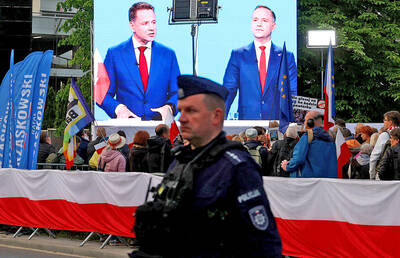
Polish presidential candidates offered different visions of Poland and its relations with Ukraine in a televised debate ahead of next week’s run-off, which remains on a knife-edge. During a head-to-head debate lasting two hours, centrist Warsaw Mayor Rafal Trzaskowski, from Polish Prime Minister Donald Tusk’s governing pro-European coalition, faced the Eurosceptic historian Karol Nawrocki, backed by the right-wing populist Law and Justice party (PiS). The two candidates, who qualified for the second round after coming in the top two places in the first vote on Sunday last week, clashed over Poland’s relations with Ukraine, EU policy and the track records of their


 RSS
RSS