


Running water was restored in a major Chinese city yesterday, five days after a shutdown caused by a chemical spill, the official Xinhua news agency said.
Water supplies resumed in Harbin at 6pm, Xinhua said in a short dispatch. It did not give any more details.
Resumption of service occurred five hours earlier than scheduled, but it was not immediately clear if it would continue or if it was for the whole city.
Xu Guangwei, a spokesman for the Harbin city government, could not confirm the Xinhua report.
Water service had been suspended since Tuesday after authorities feared that the Songhua River had been contaminated by toxins spewed into the water after a Nov. 13 chemical plant explosion.
`Safe' levels
Local authorities said yesterday that chemicals in the water had fallen back to safe levels.
"Testing of the water at the water company has reached the standard [for chemical levels], so there is no problem with resuming supplies," said a spokesman for the propaganda department in Heilongjiang Province, where Harbin is located.
He would give only his surname, Lu.
Work crews were installing more than 1,000 tonnes of carbon filters at water plants in preparation for treating supplies from the Songhua River, according to state media.
The Harbin Daily warned yesterday that the water would not be drinkable -- even if it is boiled -- after service is resumed
Meanwhile, authorities in southwest China where another chemical plant accident had sparked fears of a second chemical leak said contamination of a nearby river was under control, Xinhua reported yesterday on its Web site.
State media said the blast occurred on Thursday in Dianjiang, a county in the Chongqing region, killing one worker. Schools were closed and about 6,000 people were evacuated.
More than 800 residents and Chinese Communist Party cadres were helping to clean the contaminated portion of the Guixi River using screens made of straw and activated charcoal, Xinhua said yesterday.
Water samples are being tested every four hours, it said.
"The pollution index is going down and the water quality is improving," Xinhua said. "Further spread of pollutants is under control."
The report did not say what kind of chemicals had tainted the river but said water supplies were safe.
The Harbin disaster began with a Nov. 13 explosion at the chemical plant in Jilin, a city about 180km southeast. Five people were killed and 10,000 evacuated.
But it was only last week that the government announced that the Songhua had been poisoned with benzene.
Full investigation
Premier Wen Jiabao (
Pictures of Wen visiting a water treatment plant and Harbin residents were on the front pages of newspapers in an apparent effort to assure the public of Beijing's concern for their safety.
The spill is an embarrassment to President Hu Jintao's (胡錦濤) government, which has made a priority of repairing environmental damage from 25 years of sizzling economic growth and of looking after ordinary Chinese.
Apology to moscow
Also on Saturday, the Chinese foreign minister made an unusual public apology to Moscow's ambassador to Beijing for damage caused by the benzene spill, which is flowing toward a city in the Russian Far East.
Officials in Khabarovsk were preparing emergency plans including the possible shutdown of its water system.
A senior Russian official visited the city on Saturday and said its water purification system was being quickly upgraded.
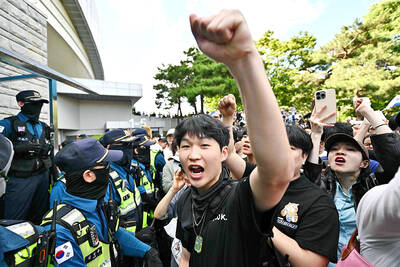
‘ABSURD MISTAKE’: The election commission said that there had been a failure to anticipate turnout after 14 polling stations ran short of ballot papers South Korean riot police yesterday cleared protesters from a Seoul polling station after a 35-hour blockade sparked by a shortage of ballot papers during local elections earlier this week. Wednesday’s election was the first nationwide vote since South Korean President Lee Jae-myung took office following the ouster of Yoon Suk-yeol over his short-lived martial law declaration. Lee’s ruling Democratic Party swept most races, but failed to flip the crucial Seoul mayoral seat. The South Korean National Election Commission apologized, blaming a failure to anticipate turnout after 14 polling stations in Seoul ran short of ballot papers. Some polling stations stayed open until 10pm to

France experienced its hottest spring on record, the French weather service said on Tuesday, after an exceptional early heat wave that also broke highs for the season in England and Wales. Meteo-France said the average nationwide temperature over March to May was 13.8°C — about 1.7°C above the norm, and surpassing records set in 2011 and 2020. “The warmest spring since records began in 1900,” it said in a bulletin. All three months were warmer than average, but the onset of an “unprecedented heatwave” late last month pushed the mercury to highs typically seen at the height of the summer. “Our country had never

A Sherpa guide was found crawling to base camp on Mount Everest a week after he went missing and was reunited with his family, who had given up hope he would return. Dawa Sherpa was last seen on Friday last week descending the mountain, but he did not reach base camp even though his client did. The pair were among the last climbers on the mountain as the climbing season came to an end and the route was dismantled. Dawa was located by a cleaning crew on Thursday morning as he was crawling down the snowy slopes around the Khumbu Icefall, just above
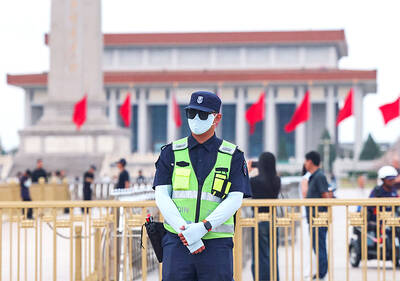
Chinese authorities are snuffing out any remembrance of the deadly 1989 military crackdown on student-led pro-democracy protests in Tiananmen Square, which happened 37 years ago yesterday, in a further tightening of a years-long campaign to erase what happened from public memory. Police told relatives of the victims they would not be allowed to visit a cemetery in Beijing on the anniversary of the crackdown, a person with knowledge of the matter said. Relatives of the victims visited the cemetery on the anniversary for more than 30 years to read memorial statements with police keeping watch, Amnesty International said. Hundreds of people,


 RSS
RSS