


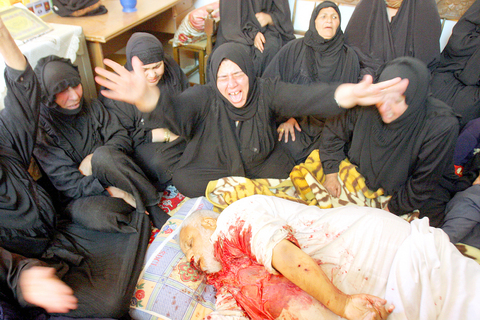
Gunmen wearing Iraqi army uniforms broke into the home of a senior Sunni leader yesterday and killed him, his three sons and his son-in-law on the outskirts of Baghdad, his brother and an interior ministry official said.
Khadim Sarhid al-Hemaiyem was the leader of the Sunni Batta tribe and the brother of a candidate in the Dec. 15 election, Major Falah al-Mohammedawi said. One of the slain man's brothers said the family has been attacked before.
"A group of gunmen with Iraqi army uniforms and vehicles broke into my brother's house in the Hurriyah area and sprayed them with machine gun fire, killing him along with three sons and his son-in-law," said his brother, Nima Sarhid Al-Hemaiyem. "His eldest son was assassinated one month ago in the Taji area, northern Baghdad, when unidentified men shot and killed him."
Investigation
Al-Mohammedawi said government forces were not involved in the slaying and that the investigation was focused on insurgents.
"Surely, they are outlaw insurgents. As for the military uniform, they can be bought from many shops in Baghdad," he said. "Also, we have several police and army vehicles stolen and they can be used in the raids."
The Batta tribe is one of Iraq's largest Sunni tribes from the area north of Baghdad, where they are influential. Dozens of people went to al-Hemaiyem's home, where the bodies were laid out, wrapped in blankets before the funeral.
The slaying follows a big push by US officials to encourage Sunni Muslim participation in the Dec. 15 election, which will install the first non-transitional government in Iraq since the 2003 invasion.
Some Sunni-led insurgent groups have declared a boycott of the election and have threatened politicians who choose to participate in it.
In the mostly Shiite neighborhood of Sadr City in Baghdad, a group of gunmen blocked the road leading to the Communist Party's branch office on Tuesday afternoon just after the party began its election campaign, a statement said.
The unidentified men broke into the party building and killed two activists in the reception area, it added.
"This cowardly act coincides with our preparations for the upcoming election and it targets the political process," the party said. "The government should bear the responsibility of providing the necessary protection in order to ensure a safe atmosphere for the elections."
US and Iraqi troops launched an operation in predominantly Sunni western Iraq on Tuesday to prevent insurgents from stopping the vote in that city, a US military statement said.
The operation in Ramadi, 115km west of Baghdad, is the third in the city since Nov. 16. The operations have resulted in 32 enemy killed, and the seizure of surface-to-air missiles, rocket-propelled grenades, mortar rounds, artillery rounds, hand grenades, small arms and bomb making equipment, the statement said.
US Marines also announced on Tuesday the end of a major operation to secure towns along the Syrian border used by al-Qaeda to smuggle foreign fighters into Iraq. Ten US Marines and 139 insurgents were killed in "Operation Steel Curtain," which began Nov. 5 with about 2,500 US troops and 1,000 Iraqi soldiers, a military statement said.
US commanders plan to establish a long-term presence in the area to prevent al-Qaeda and its Iraqi allies from re-establishing themselves in the towns of Husaybah, Karabilah and Obeidi along the Euphrates River.
Positive development
In a positive development, a senior government official said a representative of an unidentified insurgent group responded to an offer by President Jalal Talabani to talk with those willing to lay down their arms.
Presidential adviser Lieutenant General Wafiq al-Samaraei told Qatar's Al-Jazeera television that he had received a call from someone "who claimed to be a senior official of the resistance."
"I informed him that I would welcome him in a meeting to hear from him, but this doesn't indicate our acceptance of their demands," he said.
Al-Samaraei, a former head of military intelligence under Saddam, did not identify the caller, and it was unclear whether the overture represented a breakthrough.
On Tuesday, a suicide bomber struck a busy commercial street in Kirkuk, leaving 22 dead, another 23 people were wounded, after insurgents lured police to the scene by shooting an officer, officials said.
Half the dead were police who rushed to the scene after gunmen killed a fellow officer, according to police Brigadier General Sarhad Qader. The blast was just the latest of many in Kirkuk, a mixed Arab, Kurdish and Turkoman city in an oil-producing region 290km north of Baghdad.
More than 160 Iraqis, most of them Shiites, have died in a wave of suicide operations across Iraq.
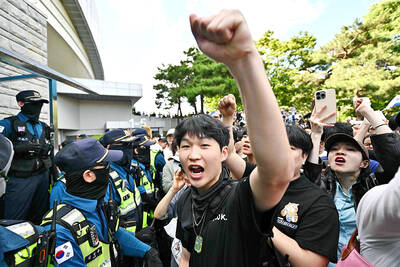
‘ABSURD MISTAKE’: The election commission said that there had been a failure to anticipate turnout after 14 polling stations ran short of ballot papers South Korean riot police yesterday cleared protesters from a Seoul polling station after a 35-hour blockade sparked by a shortage of ballot papers during local elections earlier this week. Wednesday’s election was the first nationwide vote since South Korean President Lee Jae-myung took office following the ouster of Yoon Suk-yeol over his short-lived martial law declaration. Lee’s ruling Democratic Party swept most races, but failed to flip the crucial Seoul mayoral seat. The South Korean National Election Commission apologized, blaming a failure to anticipate turnout after 14 polling stations in Seoul ran short of ballot papers. Some polling stations stayed open until 10pm to

France experienced its hottest spring on record, the French weather service said on Tuesday, after an exceptional early heat wave that also broke highs for the season in England and Wales. Meteo-France said the average nationwide temperature over March to May was 13.8°C — about 1.7°C above the norm, and surpassing records set in 2011 and 2020. “The warmest spring since records began in 1900,” it said in a bulletin. All three months were warmer than average, but the onset of an “unprecedented heatwave” late last month pushed the mercury to highs typically seen at the height of the summer. “Our country had never
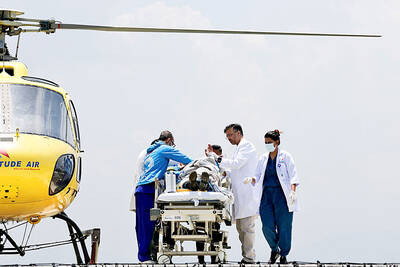
A Sherpa guide was found crawling to base camp on Mount Everest a week after he went missing and was reunited with his family, who had given up hope he would return. Dawa Sherpa was last seen on Friday last week descending the mountain, but he did not reach base camp even though his client did. The pair were among the last climbers on the mountain as the climbing season came to an end and the route was dismantled. Dawa was located by a cleaning crew on Thursday morning as he was crawling down the snowy slopes around the Khumbu Icefall, just above
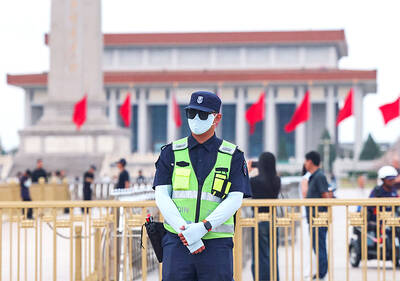
Chinese authorities are snuffing out any remembrance of the deadly 1989 military crackdown on student-led pro-democracy protests in Tiananmen Square, which happened 37 years ago yesterday, in a further tightening of a years-long campaign to erase what happened from public memory. Police told relatives of the victims they would not be allowed to visit a cemetery in Beijing on the anniversary of the crackdown, a person with knowledge of the matter said. Relatives of the victims visited the cemetery on the anniversary for more than 30 years to read memorial statements with police keeping watch, Amnesty International said. Hundreds of people,


 RSS
RSS