


The US on Tuesday named China, North Korea, Vietnam and Myanmar as serious violators of religious freedom in the annual State Department report to the US Congress.
China and its neighbors joined Iran, Saudi Arabia, Sudan and Eritrea as nations designated "countries of particular concern," the State Department said.
"These are countries where governments have engaged in or tolerated particularly severe violations of religious freedom over the past year," Secretary of State Condoleezza Rice told reporters as she unveiled the report, covering 197 countries.
Still, she held up Vietnam, which remained on the worst violators list, as an example of a country that had made progress this year, including signing a pact with Washington over how the Southeast Asian state would improve religious rights.
Vietnam improves
"If Vietnam's record of improvement continues, it would enable us to eventually remove Vietnam from our list of countries of particular concern," Rice said.
John Hanford, the US envoy for international religious freedom, said Hanoi had made some "very significant efforts to improve religious freedom," including passing new laws, releasing 14 prisoners and opening some closed churches.
The report placed China, North Korea and Myanmar on a list of authoritarian states which "regard some or all religious groups as enemies of the state because of their religious beliefs or their independence from central authority."
In China, where those wanting to worship are restricted to state-sanctioned groups, "religious leaders and adherents, including those in official churches, were detained, arrested or sentenced to prison or re-education-through-labor camps," the report said.
China had no immediate comment yesterday on the criticism, though it regularly says its Constitution guarantees religious freedom and that the US should not interfere in its affairs.
The report said Beijing seeks to control all religious activity, especially when it could be linked to political goals such as in the independence-minded regions of Tibet, which is mostly Buddhist, and Xinjiang, which is largely Muslim.
China requires Roman Catholics and Protestants to worship in state-controlled churches, though enforcement varies widely, the report said. It said officials in some areas work with both official and independent religious groups to accomplish social goals.
Threats and extortion
But ``in some areas, security authorities used threats, demolition of unregistered property, extortion, interrogation, detention, and at times beatings and torture to harass leaders of unauthorized groups and their followers,'' it said.
Despite the controls, religious activity is on the rise in China, it said.
China singles out Falun Gong for extra scrutiny, and "there have been credible reports of deaths due to torture and abuse," the report said.
China bans Falun Gong as an "evil cult." Imprisoned followers who refuse to recant their beliefs are sometimes treated harshly, the report said.
"While the Falun Gong are not officially a religion, more a spiritual movement, the suffering that they've endured is unspeakable," Hanford said.
Hanford said Beijing had, however, demonstrated a willingness to engage with Washington to improve religious freedom.
"My hope is that we will be able to turn a corner with China," he said, noting that US President George W. Bush would likely re-inforce that message in a visit to China next week.
In North Korea, "religious freedom does not exist," the report said.
It cited refugee accounts of executions of underground Christians and unconfirmed claims that Christians were tortured for reading the Bible.
`Chilling'
"Some of these reports are chilling in terms of arrests and torture and imprisonment, large numbers of people of faith in prison camps in North Korea," Hanford said.
Traditionally Buddhist Myanmar, run by various forms of military junta since 1962, "continued to engage in particularly severe violations of religious freedom," the report said.
The Myanmar government curbed efforts by Buddhist clergy to promote human rights while actively restricting non-Buddhist faiths and promoting Buddhism over other religions, particularly among ethnic minorities, the report said.
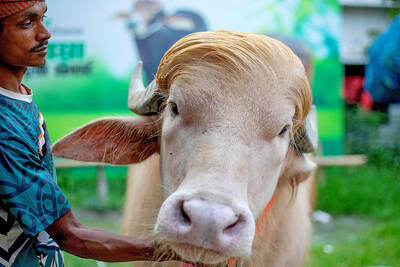
Crowds in Bangladesh are flocking to snap photographs with an unlikely social media star — an albino buffalo with flowing blond hair nicknamed “Donald Trump” that is due to be sacrificed within days. Owner Zia Uddin Mridha, 38, said his brother named the 700kg bull over its flowing helmet of hair resembling the signature look of the US president. “My younger brother picked this name because of the buffalo’s extraordinary hair,” he said at his farm in Narayanganj, just outside the capital, Dhaka. Mridha said that a constant stream of curious visitors — social media fans, onlookers and children — have come throughout
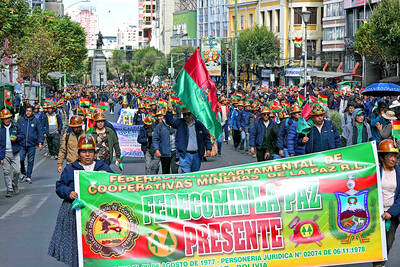
The Bolivian government on Friday struck a deal with protesting miners, but was still grappling with blockades and demonstrations by other workers across La Paz. Other groups are still blocking access roads into the city, which is also the seat of the government. Police on Thursday prevented the miners from entering the main square by using tear gas, while the demonstrators hurled stones and explosives with slingshots. Protests against the policies of Bolivian President Rodrigo Paz have convulsed the Andean nation since early this month, and roadblocks were choking routes into La Paz throughout Friday, the national road authority said. Miners demanded that Paz
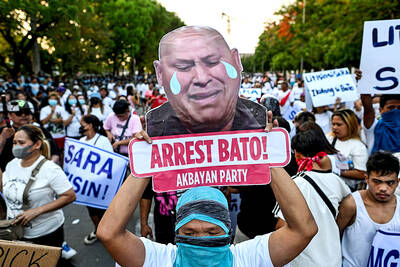
The Philippines said it has asked the country’s Supreme Court to allow it to arrest former Philippine president Rodrigo Duterte’s chief drug war enforcer to stand trial in an international tribunal. The International Criminal Court (ICC) last week unsealed an arrest warrant against Philippine Senator Ronald dela Rosa, accusing him along with Duterte and other “coperpetrators” of the “crime against humanity of murder.” Dela Rosa briefly sought refuge in the Philippine Senate last week while asking the Philippine Supreme Court to stop an ongoing attempt by government agents to arrest him. “By his own conduct, he has placed himself outside the protection of
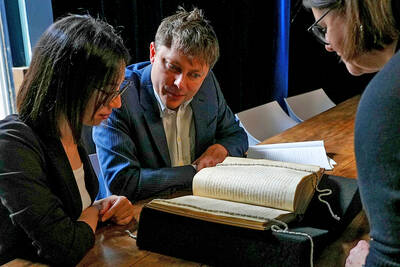
The researchers in Ireland looked at their computer screen, marveling at a medieval book tracked down in a Roman library. They flipped through its digitized pages and found their sought-after treasure: the oldest surviving English poem. “We were extremely surprised. We were speechless. We couldn’t believe our eyes when we first saw that,” said Elisabetta Magnanti, a visiting research fellow at Trinity College Dublin’s school of English. The poem was also within the main body of Latin text, she said, calling it “extraordinary.” Composed in Old English by a Northumbrian agricultural worker in the 7th century, Caedmon’s Hymn appears within some copies of


 RSS
RSS