


The prosecution's conclusion: US Vice President Dick Cheney's chief of staff zealously pursued information about a critic who said the Bush administration manipulated intelligence to make the case for war.
The view of the president and vice president: I. Lewis "Scooter" Libby is a dedicated public servant who has worked tirelessly on behalf of his country.
Is Libby an influential White House adviser who lied? Or is he a man with a hectic schedule who happens to remember events differently from the reporters and administration figures who will eventually be called to testify against him?
"As lawyers, we recognize that a person's recollection and memory of events will not always match those of other people, particularly when they are asked to testify months after the events occurred," Libby's lawyer, Joseph Tate, said in a statement.
The prosecutor, Special Counsel Patrick Fitzgerald drew his detailed portrait of Libby based on a two-year investigation that pulled dozens of witnesses in for questioning, including US President George W. Bush and Cheney.
Libby, the indictment against him concludes, received information from Cheney, the State Department and the CIA about covert CIA officer Valerie Plame, whose husband was attacking an administration unable to find any weapons of mass destruction in Iraq. Libby then spread the information to reporters and later concocted a story that his information had come from reporters, the indictment says.
The other portrait of Libby, the favorable version, shows a deeply committed conservative who has been a player on the Washington scene since the early days of the Reagan administration.
Libby left the White House for the last time on Friday, departing after seeing some of the ideas he and others championed become administration policy.
In 1992, Libby and former Pentagon deputy Paul Wolfowitz wrote a paper favoring the use of pre-emptive force to prevent countries from developing weapons of mass destruction. The paper later won praise from the neoconservative Project for the New American Century, which called it "a blueprint for maintaining US pre-eminence, precluding the rise of a great power rival."
Notwithstanding Fitzgerald's insistence on Friday that the criminal case is not about Iraq, he probably will seek to cast Libby as an architect of the US-led invasion, said Scott Fredericksen, a former prosecutor.
The prosecution will call Libby "a very bright guy at the highest levels of government with motivation to prevent Fitzgerald and the grand jury from learning the true source" of Libby's information about administration critic Joseph Wilson.
If he were representing Libby, lawyer David Schertler said he would present character witnesses to testify about Libby's dedication to public service.
"This guy, every day, deals with some of the most important issues facing the American people," said Schertler, a former federal prosecutor.
"You're asking him to recollect conversations, some fairly short, and he's giving his best recollections. Maybe he didn't remember correctly, but he didn't have the intent to deceive the special prosecutor or grand jury," he said.
Fitzgerald's probe initially sought to determine whether anyone in the administration violated the law by knowingly disclosing the identity of a covert CIA employee.
"You didn't have that, so why did you charge him?" Schertler suggested Libby's defense would assert.
Fitzgerald spent 22 months on the investigation at a cost of more than US$1 million. In the end, Libby was charged with five felonies alleging obstruction of justice, perjury to a grand jury and making false statements to FBI agents. If convicted, he could face a maximum of 30 years in prison and US$1.25 million in fines.
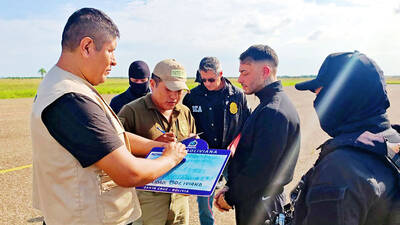
KINGPIN: Marset allegedly laundered the proceeds of his drug enterprise by purchasing and sponsoring professional soccer teams and even put himself in the starting lineups Notorious Latin American narco trafficker Sebastian Marset, who eluded police for years, was handed over to US authorities after his arrest on Friday in Bolivia. Marset, a Uruguayan national who was on the US most-wanted list, was passed to agents of the US Drug Enforcement Administration at Santa Cruz airport in Bolivia, then put on a US airplane, Bolivian state television showed. “The arrest and deportation were carried out pursuant to a court order issued by the US justice system,” Bolivian Minister of Government Marco Antonio Oviedo told reporters. The alleged kingpin was arrested in an upscale neighborhood of Santa
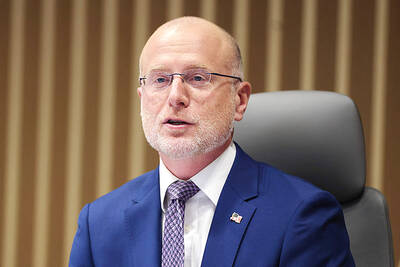
FAKE NEWS? ‘When the government demands the press become a state mouthpiece under the threat of punishment, something has gone very wrong,’ a civic group said The top US broadcast regulator on Saturday threatened media outlets over negative coverage of the Middle East war, after US President Donald Trump slammed critical headlines from the “Fake News Media.” The US president since his first term has derided mainstream media as “fake news” and has sued major outlets over what he sees as unfair coverage. Brendan Carr, head of the US Federal Communications Commission — which oversees the nation’s radio, television and Internet media — said broadcasters risked losing their licenses over news coverage. “The law is clear. Broadcasters must operate in the public interest, and they will
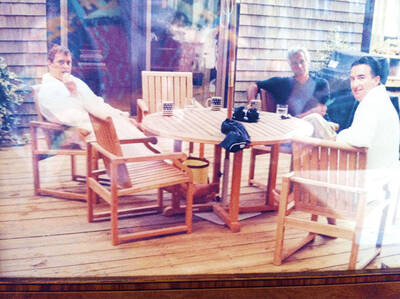
SCANDAL: Other images discovered earlier show Andrew bent over a female and lying across the laps of a number of women, while Mandelson is pictured in his underpants A photograph of former British prince Andrew and veteran politician Peter Mandelson sitting in bathrobes alongside late sex offender Jeffrey Epstein was unearthed on Friday in previously published documents. The image is believed to be the first known photograph of the two men with Epstein. They are currently engulfed in scandal in the UK over their ties to their mutual friend. The undated photograph, first reported by ITV News, shows King Charles III’s disgraced brother and former British ambassador to the US sitting barefoot outside on a wooden deck. They appear to have mugs with a US flag on them
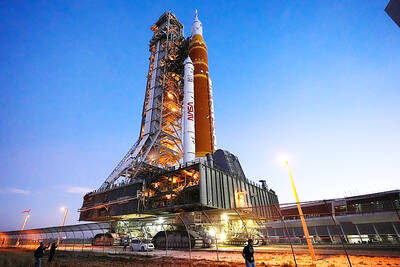
NASA on Thursday said that the long-delayed launch of Artemis 2, the first crewed flyby mission to the moon in more than 50 years, could come as soon as April 1. “We are on track for a launch as early as April 1, and we are working toward that date,” Lori Glaze, a senior NASA official, told a news conference, after technical difficulties delayed a launch originally expected last month. “It’s a test flight, and it is not without risk, but our team and our hardware are ready,” she said. “Just keep in mind we still have work” to do. The US space


 RSS
RSS