


Iran said on Saturday it stood by its UN commitments not to use violence against another country, responding to international criticism over remarks by President Mahmoud Ahmadinejad vowing to destroy Israel.
"The Islamic Republic of Iran is committed to its UN charter commitments," a Foreign Ministry statement read. "It has never used force against a second country or threatened the use of force."
Ahmadinejad on Friday stood by his controversial stand that Israel should be "wiped off the map."
Ahmadinejad's remarks were condemned by the UN Security Council and capitals across the world summoned Iranian ambassadors to explain the president's comment.
The US said Ahmadinejad's remarks underscored its fears that Tehran is pursuing nuclear arms. Tehran denies the charge.
defiance
But Iran also said yesterday the Security Council's condemnation of Ahmadinejad's anti-Israel remarks was "unacceptable" and dictated by the "Zionist regime," the Iranian news agency IRNA reported.
"The declaration published by the Security Council -- proposed by the Zionist regime to cover its crimes and give an image at odds with reality -- is unacceptable," the foreign ministry said in a statement quoted by the agency.
The ministry expressed surprise that the Security Council did not condemn the threats of military action that were made against Tehran by the US and Israel or the "crimes" of the Israeli regime.
"How many times has the Security Council met to examine the threats made against one member of the United Nations and how many declarations has it made condemning them," it asked.
possible ally
Meanwhile, Iran is counting Venezuela as a friend and ally, an Iranian government official said on Friday, amid a diplomatic storm set off by Ahmadinejad's comments.
"We are two friendly countries, Iran and Venezuela ... When one is in need the other supports," Saeed Jalili, Iran's Vice Minister of Foreign Relations for Europe and America, said during a visit to Caracas.
Venezuela and Iran, both members of the oil exporters' cartel OPEC, have strengthened ties since President Hugo Chavez first won office in 1998 and tightened relations with other crude producing nations.
But Venezuela's Foreign Minister Ali Rodriguez appealed for caution on Friday and said that the South American nation would have to consider the comments of the Islamic Republic.
"For us to fix a position we need the official versions of the respective countries," Rodriguez told journalists.
Jalili, who spoke at a conference on the scientific aspects of Iran's nuclear program, plans to meet with Chavez and officials from Venezuela's Ministry of Energy and Petroleum's nuclear division during his visit.
defending rights
The Iranian official called on the nations of the region to defend their right to use nuclear technology toward peaceful ends, as he said Iran has done.
"We consider it a legitimate right. We defend these rights because to defend our rights is to defend the rights of all people, to defend the right of Venezuela and the rights of all the people of the South," Jalili said.
Chavez, a self-described socialist revolutionary fiercely opposed to the US administration, has raised concerns among some neighbors after announcing plans to develop a nuclear energy program.
Energy experts estimate it will take Venezuela at least five years of studies, training and investment to develop a sustainable nuclear energy project in the world's No. 5 oil exporter.
Venezuela's open support for Tehran in its clash with the US and Europe over its nuclear program has left Washington wondering about the motives behind Chavez's quest for atomic energy.
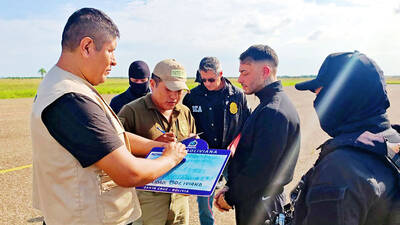
KINGPIN: Marset allegedly laundered the proceeds of his drug enterprise by purchasing and sponsoring professional soccer teams and even put himself in the starting lineups Notorious Latin American narco trafficker Sebastian Marset, who eluded police for years, was handed over to US authorities after his arrest on Friday in Bolivia. Marset, a Uruguayan national who was on the US most-wanted list, was passed to agents of the US Drug Enforcement Administration at Santa Cruz airport in Bolivia, then put on a US airplane, Bolivian state television showed. “The arrest and deportation were carried out pursuant to a court order issued by the US justice system,” Bolivian Minister of Government Marco Antonio Oviedo told reporters. The alleged kingpin was arrested in an upscale neighborhood of Santa
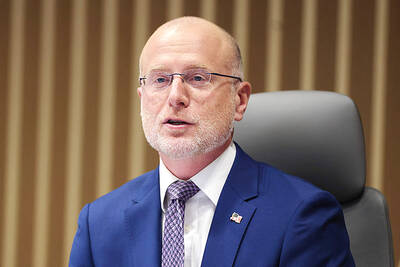
FAKE NEWS? ‘When the government demands the press become a state mouthpiece under the threat of punishment, something has gone very wrong,’ a civic group said The top US broadcast regulator on Saturday threatened media outlets over negative coverage of the Middle East war, after US President Donald Trump slammed critical headlines from the “Fake News Media.” The US president since his first term has derided mainstream media as “fake news” and has sued major outlets over what he sees as unfair coverage. Brendan Carr, head of the US Federal Communications Commission — which oversees the nation’s radio, television and Internet media — said broadcasters risked losing their licenses over news coverage. “The law is clear. Broadcasters must operate in the public interest, and they will
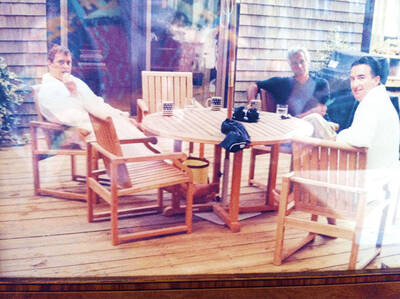
SCANDAL: Other images discovered earlier show Andrew bent over a female and lying across the laps of a number of women, while Mandelson is pictured in his underpants A photograph of former British prince Andrew and veteran politician Peter Mandelson sitting in bathrobes alongside late sex offender Jeffrey Epstein was unearthed on Friday in previously published documents. The image is believed to be the first known photograph of the two men with Epstein. They are currently engulfed in scandal in the UK over their ties to their mutual friend. The undated photograph, first reported by ITV News, shows King Charles III’s disgraced brother and former British ambassador to the US sitting barefoot outside on a wooden deck. They appear to have mugs with a US flag on them
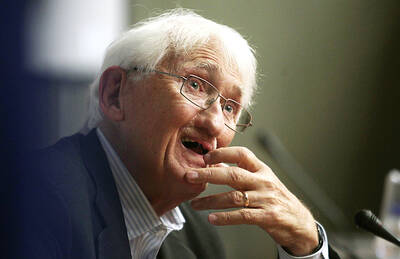
INFLUTENTIAL THEORIST: Habermas was particularly critical of the ‘limited interest’ shown by German politicians in ‘shaping a politically effective Europe Jurgen Habermas, whose work on communication, rationality and sociology made him one of the world’s most influential philosophers and a key intellectual figure in his native Germany, has died. He was 96. Habermas’ publisher, Suhrkamp, said he died on Saturday in Starnberg, near Munich. Habermas frequently weighed in on political matters over several decades. His extensive writing crossed the boundaries of academic and philosophical disciplines, providing a vision of modern society and social interaction. His best-known works included the two-volume Theory of Communicative Action. Habermas, who was 15 at the time of Nazi Germany’s defeat, later recalled the dawn of


 RSS
RSS