


Authorities investigating the deaths of about 1,000 chickens in eastern Turkey said that initial lab tests showed no signs of bird flu, and that an outbreak in the western village of Kiziksa had been contained.
Veterinarians from the Agriculture Ministry said on Sunday that nearly 10,000 birds had been killed in Kiziksa following a mandatory order to deliver them for destruction. Authorities are on alert across Turkey, however, and have warned that migratory birds could still spread the flu elsewhere.
Inital lab results found no traces of bird flu from samples taken after about 1,000 chickens died in a flock of about 6,000 in the town of Patnos in Agri Province near the border with Iran.

PHOTO: AP
Ufuk Dinler, head of a Veterinary Research Institute, told the Anatolia news agency that according to early test results, it did not "resemble" bird flu, saying final results would be available in five or six days.
Still, authorities in Agri Province banned the entry of poultry into the province from other cities. The dead chickens were brought in for sale from the western province of Bursa and the central province of Corum. CHA news agency showed footage of people in Patnos hurling hundreds of dead chickens onto a truck using shovels or their bare hands, and not using any protective gear. The area had not been placed under quarantine.
"We've seen dead chickens in the streets of Patnos for more than a week," teacher Mahmut Sahin said. "The municipality workers were collecting them."
Meanwhile, the country's military informed its members about safety measures to be taken against bird flu on its Web site.
Up to 1,000 chickens were also reported to have died in the past 15 days in a village near Halfeti, a town in the southeastern province of Sanliurfa. Halfeti Governor Ahmet Odabas said that the chickens may have been poisoned from pesticides, adding that tests would determine the cause of death.
The virus found on a farm near the western Turkish village of Kiziksa, some 120km from Istanbul, was the deadly H5N1 strain that has decimated flocks in Asia and killed dozens of people there. Although H5N1 is highly contagious among birds, it is difficult for humans to contract. Still, it has killed about 60 people in Asia, mostly poultry farmers infected by birds.
Results on Saturday of tests on wild birds found dead in Romania's Danube delta confirmed they had died of the H5N1 strain.
Turkish officials insist the virus has been contained and a Health Ministry official said on Saturday there was no longer a danger that the virus detected at the farm could spread.
"As the diseased appeared a week ago, the incubation period is over," Health Ministry official Ramazan Uzun said. "Had there been a new infection it would have manifested itself by now."
But experts believe the disease was brought by wild birds migrating through Turkey from the Ural Mountains in Russia to Africa. Mustafa Altuntas, the head of an association of Turkish veterinarians, said there was a risk of new outbreaks in other parts of Turkey, especially near wetlands.
After the disease was found on the farm in Kiziksa, authorities ordered all poultry within a 3km radius of the village to be delivered to authorities to be gassed, disinfected and buried. Throughout the week, farmers could be seen marching across the village with sacks full of birds, pulling them out with their bare hands and insisting that their animals were "perfectly healthy."
Meanwhile, Swiss pharmaceuticals company Roche is donating 20,000 packs of its anti-influenza drug Tamiflu to Turkey and 2,400 packs to Romania, the Wall Street Journal newspaper reported yesterday. Roche, which has said it is increasing production of Tamiflu as quickly as possible, has also given three million packs to the WHO, the paper said. Tamiflu is the most effective anti-viral drug available for avian flu, and governments are rushing to build up stocks.

With the midday sun blazing, an experimental orange and white F-16 fighter jet launched with a familiar roar that is a hallmark of US airpower, but the aerial combat that followed was unlike any other: This F-16 was controlled by artificial intelligence (AI), not a human pilot, and riding in the front seat was US Secretary of the Air Force Frank Kendall. AI marks one of the biggest advances in military aviation since the introduction of stealth in the early 1990s, and the US Air Force has aggressively leaned in. Even though the technology is not fully developed, the service is planning
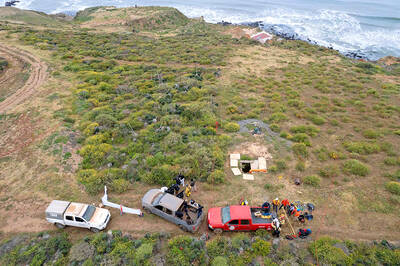
INTERNATIONAL PROBE: Australian and US authorities were helping coordinate the investigation of the case, which follows the 2015 murder of Australian surfers in Mexico Three bodies were found in Mexico’s Baja California state, the FBI said on Friday, days after two Australians and an American went missing during a surfing trip in an area hit by cartel violence. Authorities used a pulley system to hoist what appeared to be lifeless bodies covered in mud from a shaft on a cliff high above the Pacific. “We confirm there were three individuals found deceased in Santo Tomas, Baja California,” a statement from the FBI’s office in San Diego, California, said without providing the identities of the victims. Australian brothers Jake and Callum Robinson and their American friend Jack Carter

Le Tuan Binh keeps his Moroccan soldier father’s tombstone at his village home north of Hanoi, a treasured reminder of a man whose community in Vietnam has been largely forgotten. Mzid Ben Ali, or “Mohammed” as Binh calls him, was one of tens of thousands of North Africans who served in the French army as it battled to maintain its colonial rule of Indochina. He fought for France against the Viet Minh independence movement in the 1950s, before leaving the military — as either a defector or a captive — and making a life for himself in Vietnam. “It’s very emotional for me,”

UNDER INVESTIGATION: Members of the local Muslim community had raised concerns with the police about the boy, who officials said might have been radicalized online A 16-year-old boy armed with a knife was shot dead by police after he stabbed a man in the Australian west coast city of Perth, officials said yesterday. The incident occurred in the parking lot of a hardware store in suburban Willetton on Saturday night. The teen attacked the man and then rushed at police officers before he was shot, Western Australian Premier Roger Cook told reporters. “There are indications he had been radicalized online,” Cook told a news conference, adding that it appeared he acted alone. A man in his 30s was found at the scene with a stab wound to his back.


 RSS
RSS