


Syrian Interior Minister Ghazi Kanaan committed suicide at his office yesterday, the official Syrian News Agency SANA said.
Kanaan, who was Syria's top official in Lebanon for two decades until 2002, had been interviewed two weeks earlier by UN investigators probing the assassination of former Lebanese prime minister Rafik al-Hariri.
"The minister of interior died in his office this afternoon after committing suicide and the authorities are investigating the incident," SANA said in a report.
Hours before the news broke, Kanaan spoke to a Lebanese radio station, denying reports in Lebanese media that he showed the UN investigators checks paid to him by the late Hariri.
"I think this is the last statement I might give," Kanaan said at the end of the phone interview with Voice of Lebanon.
UN probe
The suicide comes as Syria is quietly preparing for the possibility that the UN investigation will implicate it in Hariri's murder. The regime is consolidating its power, preparing a public relations counteroffensive and even taking steps to guard against possible tough sanctions.
The moves are viewed by many opposition figures and analysts as a sign that the regime, while not very popular, is determined to stay in power even if the UN probe's outcome is unfavorable to it.
Many Syrians, however, wonder how long the regime can last, especially if the probe's findings, due to be released by Oct. 21, hit close to home.
Some believe President Bashar Assad would turn over officers who served in Lebanon during Syria's 29-year military presence there -- if the report offers irrefutable evidence of their involvement. But most believe he would stop at handing over family members.
"The family is a red line," said Joshua Landis, a University of Oklahoma professor who is spending the year in Damascus as a Fulbright scholar.
Despite gloating by some Syrians about the regime's current troubles, most believe it can survive, whatever happens. A weak opposition, and the fact that any revolt would likely be seen as spearheaded by the US, lead many Syrians and analysts to believe the regime is safe for now.
Many Syrians feel the US caused a disaster when it invaded neighboring Iraq to topple Saddam Hussein, leading to a bloody insurgency.
Iraq a deterrant
"Syrians do not want to have the same fate as Iraqis," said Yassin Haj Saleh, an outspoken dissident. "One of the regime's strongest points is the weakness of the Iraq model."
"Had that model succeeded," he added, "there would have been less hostility toward America and what it could offer."
But some say the danger to the regime could come from within -- from someone seizing power in a bloodless palace coup that would keep the minority Alawites in power.
Visitors who have seen Assad recently report he is relaxed, upbeat and confident the investigation will not find any criminal evidence against his country in the Feb. 14 Beirut bombing that killed Hariri and 20 others.
But he recently told Jihad al-Khazen, a senior columnist for the London-based, pan-Arab daily Al Hayat, that some countries may try to "politicize" the probe to step up the pressure on Syria.
He said if that happens, Syria will be targeted because the ultimate aim of those nations -- which he didn't name but are believed to include the US -- is Iran. Syria is Iran's closest Arab ally.
Analysts say that, mindful of the sensitivity of the next few weeks, Damascus is working on two tracks. On the first track, it projects a facade of confidence and nonchalance. On the other track, the regime is preparing for the possibility the report will implicate Syria.
Syria is reportedly planning a diplomatic offensive to discredit the report, which would include reaching out to China, India and Russia to help block a UN resolution and possible sanctions against it.
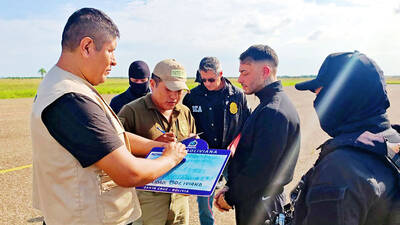
KINGPIN: Marset allegedly laundered the proceeds of his drug enterprise by purchasing and sponsoring professional soccer teams and even put himself in the starting lineups Notorious Latin American narco trafficker Sebastian Marset, who eluded police for years, was handed over to US authorities after his arrest on Friday in Bolivia. Marset, a Uruguayan national who was on the US most-wanted list, was passed to agents of the US Drug Enforcement Administration at Santa Cruz airport in Bolivia, then put on a US airplane, Bolivian state television showed. “The arrest and deportation were carried out pursuant to a court order issued by the US justice system,” Bolivian Minister of Government Marco Antonio Oviedo told reporters. The alleged kingpin was arrested in an upscale neighborhood of Santa
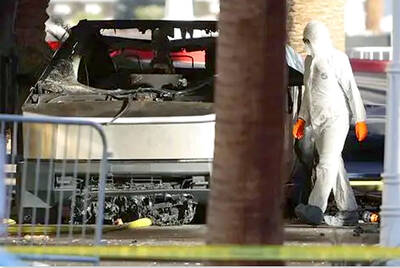
ACTIONABLE ADVICE: The majority of chatbots tested provided guidance on weapons, tactics and target selections, with Perplexity and Meta AI deemed to be the least safe From school shootings to synagogue bombings, leading artificial intelligence (AI) chatbots helped researchers plot violent attacks, according to a study published on Wednesday that highlighted the technology’s potential for real-world harm. Researchers from the nonprofit watchdog Center for Countering Digital Hate and CNN posed as 13-year-old boys in the US and Ireland to test 10 chatbots, including ChatGPT, Google Gemini, Perplexity, Deepseek and Meta AI. Eight of the chatbots assisted the make-believe attackers in more than half the responses, providing advice on “locations to target” and “weapons to use” in an attack, the study said. The chatbots had become a “powerful accelerant for
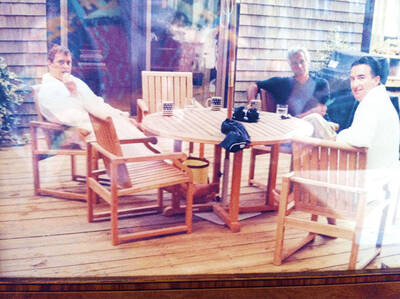
SCANDAL: Other images discovered earlier show Andrew bent over a female and lying across the laps of a number of women, while Mandelson is pictured in his underpants A photograph of former British prince Andrew and veteran politician Peter Mandelson sitting in bathrobes alongside late sex offender Jeffrey Epstein was unearthed on Friday in previously published documents. The image is believed to be the first known photograph of the two men with Epstein. They are currently engulfed in scandal in the UK over their ties to their mutual friend. The undated photograph, first reported by ITV News, shows King Charles III’s disgraced brother and former British ambassador to the US sitting barefoot outside on a wooden deck. They appear to have mugs with a US flag on them
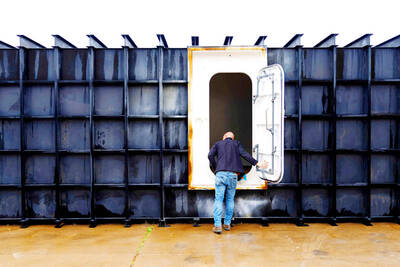
Since the war in the Middle East began nearly two weeks ago, the telephone at Ron Hubbard’s bomb shelter company in Texas has not stopped ringing. Foreign and US clients are rushing to buy his bunkers, seeking refuge in case of air raids, nuclear fallout or apocalypse. With the US and Israel pounding Iran, and Tehran retaliating with strikes across the region, Hubbard has seen demand for his product soar, mostly from Gulf nation customers in Bahrain, Qatar, Kuwait and the United Arab Emirates. “You can imagine how many people are thinking: ‘I wish I had a bomb shelter,’” Hubbard, 63, said in


 RSS
RSS