


A nationwide one-day strike gripped France yesterday, spreading transport woes and dealing Prime Minister Dominique de Villepin his first major test in implementing labor and economic reforms.
In the capital only around a third of suburban train services were running, and there were some cancelations on the bus and metro system -- but overall there was less disruption than expected.
The capital's transport authority last year put in place a system of "guaranteed service" in case of strikes, which appeared to be working.
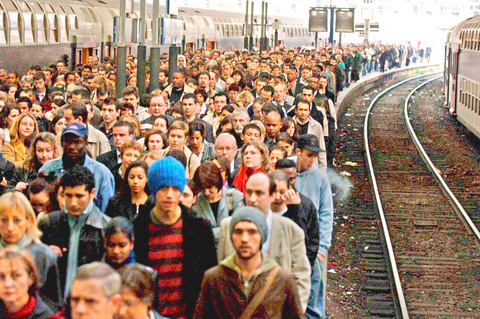
PHOTO: EPA
France's civil aviation authority predicted that 175 short and medium-haul flights would be canceled from Orly airport south of Paris and 212 from Roissy Charles de Gaulle. No disruptions were expected on long-haul flights.
The situation was worse in other cities such as Marseille and Bordeaux, however, where most public transport was out of action.
The SNCF national rail company said that 40 percent of regional services were up and running as well as 60 percent of high-speed TGV intercity lines.
As well as transport workers, around half of teachers were also striking, and most post offices and government buildings and some banks remained shut. Most national newspapers failed to appear.
Five of the country's biggest trade unions called the stoppage to protest policies Villepin's center-right government has brought in to invigorate France's sluggish economy and to push for public sector pay rises.
Demonstrations were planned in more than 140 towns and cities, with the largest leaving the Place de la Republique in Paris during the afternoon.
The unions behind the day of action were boosted by a poll showing they have the support of most of the French, who have already showed their dissatisfaction with President Jacques Chirac by rejecting a referendum in May to adopt a European constitution.
Villepin, 51, a suave and popular politician who gained an international profile during his time as foreign minister during the build-up to the Iraq War, was named by Chirac to lead the government following the referendum's failure.
Given the tough task of reducing 10-percent unemployment, he soon earned criticism from unions and left-wing parties for pushing through by decree a series of measures designed to make France's sclerotic labor market more flexible.
One of those -- a new job contract which gives small businesses a freer hand to hire and fire -- is the focus of much of the protesters' ire amid fears that it might bring an end to France's job-for-life culture.
The strike comes at a sensitive time for Villepin, who has been rocked onto the back foot by a crisis over the privatization of the state-owned SNCM ferry company serving Corsica and north Africa from ports on the Mediterranean coast.
Plans to sell off the heavily-indebted concern sparked days of violence in Corsica, a near-blockade of the island, and the shut-down of France's largest port of Marseille. Though action was taken over the weekend to re-open communications, the situation remained highly volatile.

KINGPIN: Marset allegedly laundered the proceeds of his drug enterprise by purchasing and sponsoring professional soccer teams and even put himself in the starting lineups Notorious Latin American narco trafficker Sebastian Marset, who eluded police for years, was handed over to US authorities after his arrest on Friday in Bolivia. Marset, a Uruguayan national who was on the US most-wanted list, was passed to agents of the US Drug Enforcement Administration at Santa Cruz airport in Bolivia, then put on a US airplane, Bolivian state television showed. “The arrest and deportation were carried out pursuant to a court order issued by the US justice system,” Bolivian Minister of Government Marco Antonio Oviedo told reporters. The alleged kingpin was arrested in an upscale neighborhood of Santa
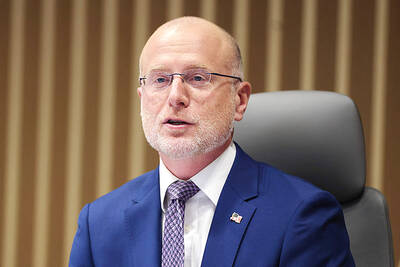
FAKE NEWS? ‘When the government demands the press become a state mouthpiece under the threat of punishment, something has gone very wrong,’ a civic group said The top US broadcast regulator on Saturday threatened media outlets over negative coverage of the Middle East war, after US President Donald Trump slammed critical headlines from the “Fake News Media.” The US president since his first term has derided mainstream media as “fake news” and has sued major outlets over what he sees as unfair coverage. Brendan Carr, head of the US Federal Communications Commission — which oversees the nation’s radio, television and Internet media — said broadcasters risked losing their licenses over news coverage. “The law is clear. Broadcasters must operate in the public interest, and they will
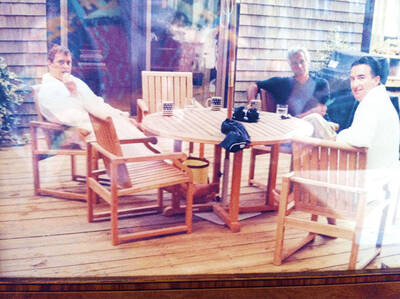
SCANDAL: Other images discovered earlier show Andrew bent over a female and lying across the laps of a number of women, while Mandelson is pictured in his underpants A photograph of former British prince Andrew and veteran politician Peter Mandelson sitting in bathrobes alongside late sex offender Jeffrey Epstein was unearthed on Friday in previously published documents. The image is believed to be the first known photograph of the two men with Epstein. They are currently engulfed in scandal in the UK over their ties to their mutual friend. The undated photograph, first reported by ITV News, shows King Charles III’s disgraced brother and former British ambassador to the US sitting barefoot outside on a wooden deck. They appear to have mugs with a US flag on them
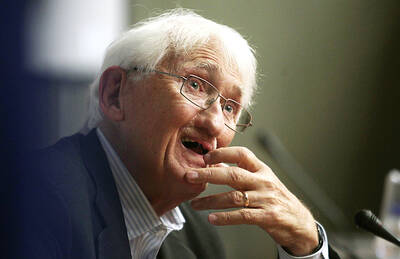
INFLUTENTIAL THEORIST: Habermas was particularly critical of the ‘limited interest’ shown by German politicians in ‘shaping a politically effective Europe Jurgen Habermas, whose work on communication, rationality and sociology made him one of the world’s most influential philosophers and a key intellectual figure in his native Germany, has died. He was 96. Habermas’ publisher, Suhrkamp, said he died on Saturday in Starnberg, near Munich. Habermas frequently weighed in on political matters over several decades. His extensive writing crossed the boundaries of academic and philosophical disciplines, providing a vision of modern society and social interaction. His best-known works included the two-volume Theory of Communicative Action. Habermas, who was 15 at the time of Nazi Germany’s defeat, later recalled the dawn of


 RSS
RSS