


The US Congress is considering an emergency aid package that would spend well over US$1 billion a day during the next month on housing, clothing and other recovery needs for Hurricane Katrina victims.
The House of Representatives, as early as yesterday, was expected to approve the US$51.8 billion spending bill that the Bush administration, under attack for its response to the devastating Gulf Coast storm, described as the latest installment in the costly relief effort.
"We will in fact need substantially more" money, said White House budget director Josh Bolten, estimating the funds would cover expenses for "a few weeks."
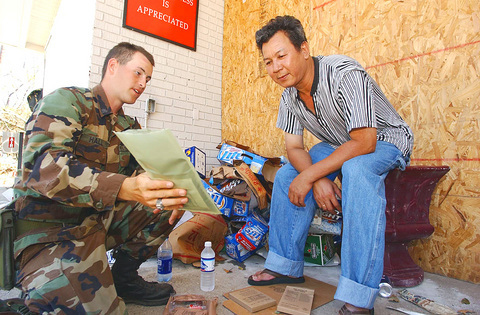
PHOTO: AP
Prospects were more uncertain in the Senate, where Democratic Senator Mary Landrieu of hurricane-ravaged Louisiana threatened to hold out for more funding. Republicans said that any attempt to amend the bill could lead to delays in getting the measure to President George W. Bush for his signature before current funds run out.
The US$10.5 billion aid hurricane relief that Bush signed into law last Friday was expected to run out yesterday evening, budget aides said.
Meanwhile, Vice President Dick Cheney and his wife, Lynne Cheney, were headed to the Gulf Coast to talk to local officials, meet with emergency first responders and tour disaster sites in Gulfport, Mississippi, New Orleans and Baton Rouge, Louisiana.
The spending bill was being debated against the backdrop of partisan sparring over an unusual joint House-Senate congressional committee to investigate the government's readiness and response to Katrina's devastation that covers what Republican Senator Ted Stevens of Alaska described as twice the size as Europe.
The panel, which will be chaired by Senator Susan Collins, a Republican for Maine, and a Republican House lawmaker yet to be named, must issue a report by Feb. 15.
"Americans deserve answers," Senate Majority Leader Bill Frist, a Tennessee Republican, told reporters.
Democrats pushed for an independent panel to investigate the disaster, similar to the 9/11 Commission that examined government missteps leading to the Sept. 11, 2001, terror attacks.
"An investigation of the Republican administration by a Republican-controlled Congress is like having a pitcher call his own balls and strikes," said Senate Democratic leader Harry Reid of Nevada.
House Ways and Means Committee Chairman Bill Thomas, a California Republican, said the House could act as soon as Thursday to help get money and other assistance to hurricane evacuees by cutting through federal red tape, including relaxing rules for welfare funds. In recent days, the government spent more than US$2 billion a day as it paid out several big-ticket items such as contracts to provide housing.
A sliver of the new funding -- US$1.4 billion -- would help the Pentagon pay for the deployment of military personnel to the storm-damaged region. More than 63,000 military active duty and National Guard troops so far have been sent to the Gulf Coast.
But the bulk of the money would go into a Federal Emergency Management Agency disaster relief fund that is offering debit cards of US$2,000 per household to victims evacuated from homes in Louisiana and Mississippi. FEMA anticipates handing out 320,000 cards, at a cost of US$640 million.

SPEAKING OUT: After Siranudh Scott’s allegations surfaced, celebrities and public figures took to social media to share their own experiences of sexual misconduct and abuse A high-profile alleged sexual abuse case within a wealthy Thai beer brewing family has prompted a wave of painful accounts from survivors of unconnected abuse in the conservative nation. Siranudh Scott, a member of the billionaire Thai family that founded the ubiquitous Singha beer brand, posted an emotional video this month accusing his elder brother Sunit of repeatedly abusing him when he was a teenager. Sunit, who is in his 30s, later denied the allegations in a video posted online, but Singha parent Boonrawd dismissed him from his executive role with the company on Tuesday last week. “I felt I needed to speak

SEEKING ORDER: Rodrigo Paz said that ‘anyone who wants to destroy the nation will have to deal with this president and the full force of the constitution’ Bolivian President Rodrigo Paz on Wednesday said that the nation was at a “breaking point” after nearly a month of protests that have caused shortages of food, fuel and medicine. Paz, who took office six months ago amid the worst economic crisis there in four decades, is battling a groundswell of fury over his policies. The political capital, La Paz, has been besieged by low-income workers and members of the indigenous majority calling for his resignation. “The country needs order and is reaching breaking point,” the 58-year-old said at a public event in La Paz, renewing his appeal for dialogue. On Tuesday, the Bolivian
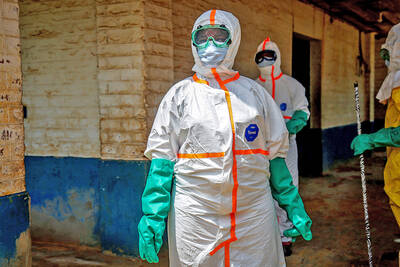
COMMUNITY CONFLICT: Concerns about disease spread from corpses has run up against friends and families’ desire to bury their dead as infection spreads in the area Angry residents of a town at the epicenter of the Ebola outbreak in the Democratic Republic of the Congo (DR Congo) attacked and burned a tent that was part of a health center where people are being treated for the virus, the staff there said Saturday. It was the second such attack in the region in a week. No one was hurt in the attack, according to reports but as patients ran out to escape the fire, 18 people with suspected Ebola infections fled the facility and are unaccounted for, a hospital director said. Angry residents arrived at the clinic in the

Forecasters in Europe yesterday warned of exceptional heat as record temperatures driven by a “heat dome” push temperatures well above seasonal norms across the continent. The surge follows a record-breaking Monday, with France logging its hottest day in the month of May on record, its weather agency said, and the UK also posting unprecedented highs. A so-called “heat dome” of warm air from northern Africa trapped under a high-pressure system over western Europe is behind the high temperatures not usually seen until high summer. Restrictions on outdoor work were imposed in parts of Italy, beaches in southwest France filled earlier than usual and


 RSS
RSS