


Under a blistering Himalayan sun, 500 workers are completing the Lhasa River Bridge, part of a 1,142km project that will link Tibet by rail to the outside world for the first time.
Remarkably for a project that will supposedly bring new hope and opportunity to the local economy once it becomes operational in 2007, only a tiny number of the 500 people toiling on the 929m bridge are Tibetan.
Hiring practices
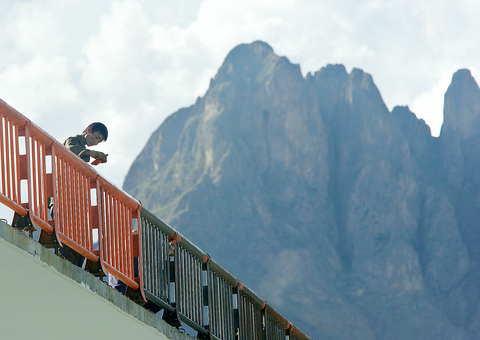
PHOTO: AFP
"Very few of the people employed here are ethnic Tibetans," said Wang Weidao, chief engineer on the bridge. "They don't have the technical training needed for the task."
While Wang was speaking, workers from as far away as China's Hubei Province were pushing wheelbarrows, sweeping dust and performing other non-specialized or technically undemanding tasks.
Foreign observers have long criticized the rail project, begun in 2001, for favoring members of China's Han majority over Tibetans.
But they also fear that once the railroad has connected Tibet with neighboring Qinghai Province in two years' time, it will continue to benefit the Han Chinese first and local Tibetans last.
Officials in Lhasa, by contrast, emphasize the advantages they say the rail line will bring to the Tibetans, such as greatly reduced transportation costs for Tibetan products.
"Tibet is rich in water resources, but if we want to sell water to other provinces, now we have to use trucks or buses," said Xu Jianchang, deputy director general of the Tibetan Development and Reform Commission.
"After the rail is constructed, the local resources can be transported at much lower fees," he said.
But what worries pro-Tibet advocates overseas is that when the rail link is completed, a train ride from Beijing to Lhasa will take just 48 hours, and Tibet will suddenly be within much easier reach for millions of job hunters.
Immigration
The Tibetans, who are already under pressure from massive Han immigration, could end up becoming even more marginalized, said Kate Saunders, the Washington-based spokeswoman for the International Campaign for Tibet.
"Population movements will be encouraged by the shorter travel times, lower transportation costs, and enhanced connections to an increasingly Chinese cultural and economic network," she said. "These movements represent a significant threat to the livelihoods and culture of the Tibetan people as well as to their prospects for achieving genuine political autonomy."
Local officials acknowledge that the rail will make it easier for Han Chinese to go to Tibet, but deny that Tibetans have so far lost jobs to migrant workers.
Currently, about 50,000 migrants arrive annually in Lhasa, a city of about 250,000, said Zhang Jianbo, a senior macroeconomist with the development and reform commission. Most of them leave after a few months of employment, he said.
But some do decide to stay on, and gradually they succeed in pushing Tibetans out of entire industries at a time, critics argue.
In one high-profile instance, taxi drivers were mostly Tibetan until a few years ago, but are now mainly Han Chinese.
"That's because the taxi business has become less lucrative and many Tibetans have decided to change jobs," said Zhang, the economist.

Chinese President Xi Jinping (習近平) is to visit Russia next month for a summit of the BRICS bloc of developing economies, Chinese Minister of Foreign Affairs Wang Yi (王毅) said on Thursday, a move that comes as Moscow and Beijing seek to counter the West’s global influence. Xi’s visit to Russia would be his second since the Kremlin sent troops into Ukraine in February 2022. China claims to take a neutral position in the conflict, but it has backed the Kremlin’s contentions that Russia’s action was provoked by the West, and it continues to supply key components needed by Moscow for

Japan scrambled fighter jets after Russian aircraft flew around the archipelago for the first time in five years, Tokyo said yesterday. From Thursday morning to afternoon, the Russian Tu-142 aircraft flew from the sea between Japan and South Korea toward the southern Okinawa region, the Japanese Ministry of Defense said in a statement. They then traveled north over the Pacific Ocean and finished their journey off the northern island of Hokkaido, it added. The planes did not enter Japanese airspace, but flew over an area subject to a territorial dispute between Japan and Russia, a ministry official said. “In response, we mobilized Air Self-Defense

CRITICISM: ‘One has to choose the lesser of two evils,’ Pope Francis said, as he criticized Trump’s anti-immigrant policies and Harris’ pro-choice position Pope Francis on Friday accused both former US president Donald Trump and US Vice President Kamala Harris of being “against life” as he returned to Rome from a 12-day tour of the Asia-Pacific region. The 87-year-old pontiff’s comments on the US presidential hopefuls came as he defied health concerns to connect with believers from the jungle of Papua New Guinea to the skyscrapers of Singapore. It was Francis’ longest trip in duration and distance since becoming head of the world’s nearly 1.4 billion Roman Catholics more than 11 years ago. Despite the marathon visit, he held a long and spirited

The pitch is a classic: A young celebrity with no climbing experience spends a year in hard training and scales Mount Everest, succeeding against some — if not all — odds. French YouTuber Ines Benazzouz, known as Inoxtag, brought the story to life with a two-hour-plus documentary about his year preparing for the ultimate challenge. The film, titled Kaizen, proved a smash hit on its release last weekend. Young fans queued around the block to get into a preview screening in Paris, with Inoxtag’s management on Monday saying the film had smashed the box office record for a special cinema


 RSS
RSS