


Even the ATM machines were suspect at this year's Defcon conference, where hackers play intrusion games at the bleeding edge of computer security.
With some of the world's best digital break-in artists pecking away at their laptops, sending e-mails or answering cellphones could also be risky.
Defcon is a no-man's land where customary adversaries -- federal agents against digital mavericks -- are supposed to share ideas about making the Internet a safer place. But it's really a showcase for flexing hacker muscle.
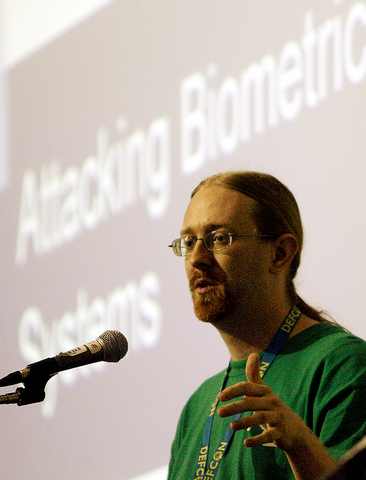
PHOTO: AP
This year's hot topics included a demonstration of just how easy it may be to attack supposedly foolproof biometric safeguards, which determine a person's identity by scanning such things as thumb prints, irises and voice patterns.
Banks, supermarkets and even some airports have begun to rely on such systems, but a security analyst who goes by the name Zamboni challenged hackers to bypass biometrics by attacking their backend systems networks. "Attack it like you would Microsoft or Linux," he advised.
An annual highlight is the "Meet the Feds" panel, which this year included representatives from the FBI, NSA and the Treasury and Defense departments.
Radio frequency identification (RFID) tags that send wireless signals and are used to track a growing list of items including animals and US military shipments -- also came under scrutiny.
A group of twentysomethings from Southern California climbed onto the hotel roof to show that RFID tags could be read from as far as 21 meters. That's important because the tags have been proposed for such things as US passports, and critics have raised fears that kidnappers could use RFID readers to pick traveling US citizens out of a crowd.
RFID companies had said the signals didn't reach more than 6m, said John Hering, one of the founders of Flexilis, the company that conducted the experiment.
Also on hand at the conference was Robert Morris, former chief scientist for the National Security Agency (NSA), to lecture on the vulnerabilities of bank ATMs, which he predicted would become the next "pot of gold" for hackers.
Morris said thieves have been able to dupe people out of their bank cards and passwords by changing the software in old ATM machines bought off eBay for as little as US$1,000 and placing the machines out in public venues.

Chinese President Xi Jinping (習近平) is to visit Russia next month for a summit of the BRICS bloc of developing economies, Chinese Minister of Foreign Affairs Wang Yi (王毅) said on Thursday, a move that comes as Moscow and Beijing seek to counter the West’s global influence. Xi’s visit to Russia would be his second since the Kremlin sent troops into Ukraine in February 2022. China claims to take a neutral position in the conflict, but it has backed the Kremlin’s contentions that Russia’s action was provoked by the West, and it continues to supply key components needed by Moscow for

Japan scrambled fighter jets after Russian aircraft flew around the archipelago for the first time in five years, Tokyo said yesterday. From Thursday morning to afternoon, the Russian Tu-142 aircraft flew from the sea between Japan and South Korea toward the southern Okinawa region, the Japanese Ministry of Defense said in a statement. They then traveled north over the Pacific Ocean and finished their journey off the northern island of Hokkaido, it added. The planes did not enter Japanese airspace, but flew over an area subject to a territorial dispute between Japan and Russia, a ministry official said. “In response, we mobilized Air Self-Defense

CRITICISM: ‘One has to choose the lesser of two evils,’ Pope Francis said, as he criticized Trump’s anti-immigrant policies and Harris’ pro-choice position Pope Francis on Friday accused both former US president Donald Trump and US Vice President Kamala Harris of being “against life” as he returned to Rome from a 12-day tour of the Asia-Pacific region. The 87-year-old pontiff’s comments on the US presidential hopefuls came as he defied health concerns to connect with believers from the jungle of Papua New Guinea to the skyscrapers of Singapore. It was Francis’ longest trip in duration and distance since becoming head of the world’s nearly 1.4 billion Roman Catholics more than 11 years ago. Despite the marathon visit, he held a long and spirited

The pitch is a classic: A young celebrity with no climbing experience spends a year in hard training and scales Mount Everest, succeeding against some — if not all — odds. French YouTuber Ines Benazzouz, known as Inoxtag, brought the story to life with a two-hour-plus documentary about his year preparing for the ultimate challenge. The film, titled Kaizen, proved a smash hit on its release last weekend. Young fans queued around the block to get into a preview screening in Paris, with Inoxtag’s management on Monday saying the film had smashed the box office record for a special cinema


 RSS
RSS