


The wife of fugitive Radovan Karadzic appealed to her husband to surrender to the UN war crimes tribunal "for the sake of the family."
Ljiljana Karadzic, who has always backed her husband during his flight from justice over the last 10 years, was speaking at her home on Thursday in an exclusive interview.
"Our family is under constant pressure from all over. Our life and our existence is jeopardized," she said in apparent reference to raids by NATO troops on her home and those of her son and daughter in recent months.
In early July, troops detained the couple's son, Aleksandar, and questioned him for 10 days before releasing him. The family has always claimed it has had no contact with Karadzic and should be left alone.
A UN war crimes tribunal in 1995 indicted the wartime Bosnian Serb leader for genocide and other war crimes during Bosnia's 1992 to 1995 war, including the 1995 massacre of as many as 8,000 Muslim men and boys in the eastern Bosnian enclave of Srebrenica.
He remains one of the tribunal's most wanted fugitives, sought by NATO and EU peacekeepers. It is believed that his Bosnian Serb supporters have helped him elude capture despite a US-sponsored US$5 million reward for information leading to his arrest.
His wife struggled to hold back tears during the interview and said her decision had not been an easy one.
"In hope that you are alive and that you can make decisions by yourself, I'm begging you to make this decision," she said.
"I'm now doing the only thing I can -- I'm begging you," she said.
"Between loyalty to you and to the children and grandchildren, I had to choose and I have chosen. ... It will be your sacrifice for us, for the sake of your family," she said.
She said she was hoping the message will reach him wherever he is.
In Serbia, Karadzic's brother and longtime supporter, Luka Karadzic, said his sister-in-law's appeal was the "result of tremendous pressure" on the family and that he personally "disagrees" with it.
"She loves Radovan more than God himself and yet has called on him to surrender," Luka Karadzic told the Beta news agency in Belgrade. "But what if Radovan cannot hear her appeal, or is not in a position to make a decision on his own?"
UN war crimes prosecutors believe Karadzic is hiding in the Serb-controlled half of Bosnia and that he often crosses over to neighboring Serbia, using the mountainous border area -- and the popularity he still enjoys among Serb nationalists.
Former US envoy Richard Holbrooke, the architect of the 1995 Bosnian peace agreement, said recently that Karadzic is being sheltered by the ruling Serb Democratic Party, SDS, which he once established as well as by the Serbian Orthodox Church.
"Elements of the SDS are in on this. I think the SDS is a criminal organization sheltering him," said Holbrooke, adding: "I'd guess he is in a monastery, having shaved his hair and having his beard grow."
Former associates of the fugitive have said Karadzic has often slipped into Pale, the Bosnian Serb wartime capital, for nighttime visits to his wife, Ljiljana, daughter, Sonja, and son, Aleksandar-Sasa.
However, Mrs. Karadzic told Serbian media recently that none of them had seen Karadzic since 1998 when he went into hiding and that NATO knows well the family does not know where he is "because they follow us all the time. We have also found various listening and tracking devices on our cars."
"It's better that we don't know because we would be the weakest link," she said.

SPEAKING OUT: After Siranudh Scott’s allegations surfaced, celebrities and public figures took to social media to share their own experiences of sexual misconduct and abuse A high-profile alleged sexual abuse case within a wealthy Thai beer brewing family has prompted a wave of painful accounts from survivors of unconnected abuse in the conservative nation. Siranudh Scott, a member of the billionaire Thai family that founded the ubiquitous Singha beer brand, posted an emotional video this month accusing his elder brother Sunit of repeatedly abusing him when he was a teenager. Sunit, who is in his 30s, later denied the allegations in a video posted online, but Singha parent Boonrawd dismissed him from his executive role with the company on Tuesday last week. “I felt I needed to speak
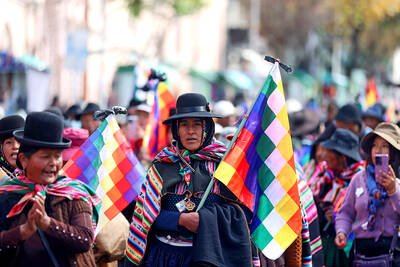
SEEKING ORDER: Rodrigo Paz said that ‘anyone who wants to destroy the nation will have to deal with this president and the full force of the constitution’ Bolivian President Rodrigo Paz on Wednesday said that the nation was at a “breaking point” after nearly a month of protests that have caused shortages of food, fuel and medicine. Paz, who took office six months ago amid the worst economic crisis there in four decades, is battling a groundswell of fury over his policies. The political capital, La Paz, has been besieged by low-income workers and members of the indigenous majority calling for his resignation. “The country needs order and is reaching breaking point,” the 58-year-old said at a public event in La Paz, renewing his appeal for dialogue. On Tuesday, the Bolivian
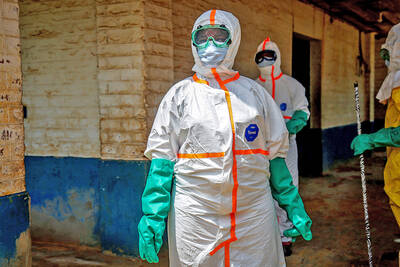
COMMUNITY CONFLICT: Concerns about disease spread from corpses has run up against friends and families’ desire to bury their dead as infection spreads in the area Angry residents of a town at the epicenter of the Ebola outbreak in the Democratic Republic of the Congo (DR Congo) attacked and burned a tent that was part of a health center where people are being treated for the virus, the staff there said Saturday. It was the second such attack in the region in a week. No one was hurt in the attack, according to reports but as patients ran out to escape the fire, 18 people with suspected Ebola infections fled the facility and are unaccounted for, a hospital director said. Angry residents arrived at the clinic in the

Forecasters in Europe yesterday warned of exceptional heat as record temperatures driven by a “heat dome” push temperatures well above seasonal norms across the continent. The surge follows a record-breaking Monday, with France logging its hottest day in the month of May on record, its weather agency said, and the UK also posting unprecedented highs. A so-called “heat dome” of warm air from northern Africa trapped under a high-pressure system over western Europe is behind the high temperatures not usually seen until high summer. Restrictions on outdoor work were imposed in parts of Italy, beaches in southwest France filled earlier than usual and


 RSS
RSS