


President Hosni Mubarak, Egypt's leader for almost a quarter of a century, announced his bid yesterday to contest the country's first ever elections in September open to more than one candidate.
Mubarak, 77, made the widely expected announcement during a nationally televised speech delivered in Shibin el Kom, the capital of the Nile delta province of Menoufia where he was born.
"I announce in front of you from here, the province of Menoufia, that I have decided to nominate myself for the presidential elections," Mubarak said, whose speech was immediately interrupted by wild applause from hundreds of supporters, including his wife, Suzanne, and son, Gamal.
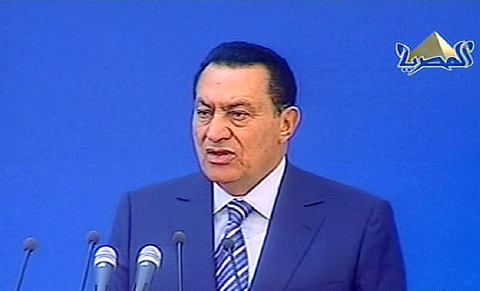
PHOTO: AFP
After stepping off the podium, the president was swarmed by hugging and kissing supporters who cheered throughout his hour-long speech delivered at the secondary school he graduated from in 1946.
Scores of bodyguards surrounded Mubarak as he waded into the crowd to accept the greetings of some of his most fervent supporters and members of his ruling National Democratic Party.
In a wide-ranging address that started with his upbringing in this region north of Cairo and role as Egypt's air force commander during the October 1973 war with Israel, Mubarak also laid out his vision for the future following his likely Sept. 7 election win.
Days after Egypt's deadliest ever terrorist attacks in the Sinai Peninsula resort of Sharm el-Sheik, Mubarak also proposed introducing a new anti-terrorism law to replace highly criticized emergency laws in place since the 1981 assassination of his predecessor, Anwar Sadat, by Islamic extremists during a Cairo military parade.
"The time has come to create decisive role to fight terrorism ... [by introducing] a law that would be a legislative replacement for the emergency law in combating terrorism," Mubarak said.
Political activists and human rights groups have long criticized Egypt's emergency laws for giving authorities wide powers to arrest, detain people for extended periods of time without formal charges and bring civilians before military courts, from which appeals are limited.
Mubarak also called for an Arab leaders summit to be held on Wednesday in Sharm, where three pre-dawn bombings killed up to 88 people, according to hospital officials. Egypt's Health Ministry said 64 people died, but numerous body parts have not been identified, while several tourists -- including 10 Britons -- have not been accounted for.
In four previous presidential referendums, Mubarak has won each with landslide results as the sole candidate offered to the public.
But amid local and US-led calls for democratic freedoms in the Middle East, Mubarak directed the parliament to amend Egypt's constitution to allow for direct presidential elections open to more than one candidate.

PHISHING: The con might appear convincing, as the scam e-mails can coincide with genuine messages from Apple saying you have run out of storage For a while you have been getting messages from Apple saying “your iCloud storage is full.” They say you have exceeded your storage plan, so documents are no longer being backed up, and photos you take are not being uploaded. You have been resisting Apple’s efforts to get you to pay a minimum of £0.99 (US$1.33) a month for more storage, but it seems that you cannot keep putting off the inevitable: You have received an e-mail which says your iCloud account has been blocked, and your photos and videos would be deleted very soon. To keep them you need
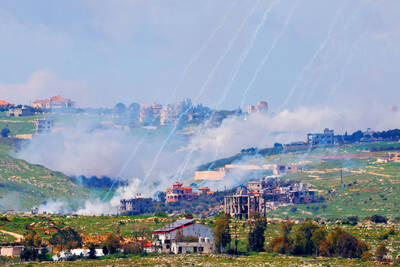
The Israeli military has demolished entire villages as part of its invasion of south Lebanon, rigging homes with explosives and razing them to the ground in massive remote detonations. The Guardian reviewed three videos posted by the Israeli military and on social media, which showed Israel carrying out mass detonations in the villages of Taybeh, Naqoura and Deir Seryan along the Israel-Lebanon border. Lebanese media has reported more mass detonations in other border villages, but satellite imagery was not readily available to verify these claims. The demolitions came after Israeli Minister of Defense Israel Katz called for the destruction of

A US YouTuber who caused outrage for filming himself kissing a statue commemorating Korean wartime sex slaves has been sentenced to six months in prison, a court in Seoul said yesterday. Johnny Somali, 25, gained notoriety several years ago for recording himself doing a series of provocative stunts in South Korea and Japan, and streaming them on platforms such as YouTube and Twitch. South Korean authorities indicted Somali — whose real name is Ramsey Khalid Ismael — in 2024 on public order violations and obstruction of business, and banned him from leaving the country. “The court has sentenced him to six months in
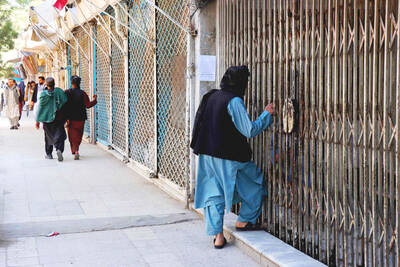
The death toll from a shooting in western Afghanistan rose to 11 on Saturday, after gunmen targeted civilians at a picnic spot in Herat, the provincial authority said. Bullet marks were visible on a wall of the Sayed Mohammad Agha Shia shrine, while bloodstains marked a blanket abandoned at the scene. “Eleven people have been recorded dead and eight others wounded from Friday’s incident, with the condition of two of the wounded reported as critical,” Herat’s information office said in a statement. The update raises a toll of seven killed provided on Friday by the Afghan Ministry of Interior Affairs


 RSS
RSS