


Archeologists at Mexico City's Templo Mayor ruins announced on Friday the discovery of a rare child sacrifice to the Aztec war god, a deity normally honored with the hearts or skulls of adult warriors.
Archaeologist Ximena Chavez said there was no reference to child sacrifices to the war god Huitzilopochtli in accounts written by the Spaniards after the 1521 Conquest, showing the need for exhaustive digs to discover more about the long-controversial subject.
Some researchers say the Spaniards exaggerated accounts of human sacrifices by the Aztecs to justify their own brutal conquest; others defend the old accounts, but archeologists now say Mexico needs hard physical evidence to decide the truth.
"We are finding things here that writers of the earliest accounts did not mention, possibly because they were writing about things they didn't personally witness," said Chavez, of the National Institute of History and Anthropology.
"This child is unique," said Chavez, "because it is the first child dedicated to Huitzilopochtli."
Warriors captured during battles with opposing cities were often sacrificed to the war god; in contrast, children have sometimes been found sacrificed to Tlaloc, the rain god.
The discovery announced Friday was also unusual because the child's body was found whole, and accompanied by whistles, collars, ankle bracelets of shells and copper bells -- details normally reserved for honorific burials.
Many sacrifice victims were decapitated or had their hearts ripped out, and their bodies dumped willy-nilly into pits.
Researchers are still working to determine with certainty the sex, age and cause of death of the child whose skeletal remains were found in the test trench.
What they do know is that some time around 1450, the child was killed in a sort of grim cornerstone ceremony intended to dedicate a new layer of building on one of Mexico City's main temples. The Aztecs added a new layer to their temples about once every 52 years.
Priests propped the child in a sitting position, his legs splayed out in front of him, and workers packed sand and clay around his body, which was then covered beneath a flight of stone temple steps.
The find came almost by accident last month, as archeologists dug a test trench at the edge of a temple on the crossroads of two major thoroughfares in the ancient city of Tenochtitlan, the name the Aztecs gave to the city they founded in 1325.
About a meter below the surface, they saw the top of a tiny skull, and began digging more slowly.


Kehinde Sanni spends his days smoothing out dents and repainting scratched bumpers in a modest autobody shop in Lagos. He has never left Nigeria, yet he speaks glowingly of Burkina Faso military leader Ibrahim Traore. “Nigeria needs someone like Ibrahim Traore of Burkina Faso. He is doing well for his country,” Sanni said. His admiration is shaped by a steady stream of viral videos, memes and social media posts — many misleading or outright false — portraying Traore as a fearless reformer who defied Western powers and reclaimed his country’s dignity. The Burkinabe strongman swept into power following a coup in September 2022

‘FRAGMENTING’: British politics have for a long time been dominated by the Labor Party and the Tories, but polls suggest that Reform now poses a significant challenge Hard-right upstarts Reform UK snatched a parliamentary seat from British Prime Minister Keir Starmer’s Labor Party yesterday in local elections that dealt a blow to the UK’s two establishment parties. Reform, led by anti-immigrant firebrand Nigel Farage, won the by-election in Runcorn and Helsby in northwest England by just six votes, as it picked up gains in other localities, including one mayoralty. The group’s strong showing continues momentum it built up at last year’s general election and appears to confirm a trend that the UK is entering an era of multi-party politics. “For the movement, for the party it’s a very, very big
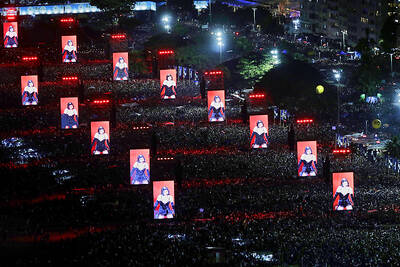
ENTERTAINMENT: Rio officials have a history of organizing massive concerts on Copacabana Beach, with Madonna’s show drawing about 1.6 million fans last year Lady Gaga on Saturday night gave a free concert in front of 2 million fans who poured onto Copacabana Beach in Rio de Janeiro for the biggest show of her career. “Tonight, we’re making history... Thank you for making history with me,” Lady Gaga told a screaming crowd. The Mother Monster, as she is known, started the show at about 10:10pm local time with her 2011 song Bloody Mary. Cries of joy rose from the tightly packed fans who sang and danced shoulder-to-shoulder on the vast stretch of sand. Concert organizers said 2.1 million people attended the show. Lady Gaga

SUPPORT: The Australian prime minister promised to back Kyiv against Russia’s invasion, saying: ‘That’s my government’s position. It was yesterday. It still is’ Left-leaning Australian Prime Minister Anthony Albanese yesterday basked in his landslide election win, promising a “disciplined, orderly” government to confront cost-of-living pain and tariff turmoil. People clapped as the 62-year-old and his fiancee, Jodie Haydon, who visited his old inner Sydney haunt, Cafe Italia, surrounded by a crowd of jostling photographers and journalists. Albanese’s Labor Party is on course to win at least 83 seats in the 150-member parliament, partial results showed. Opposition leader Peter Dutton’s conservative Liberal-National coalition had just 38 seats, and other parties 12. Another 17 seats were still in doubt. “We will be a disciplined, orderly


 RSS
RSS