


If French agents who blew up the Rainbow Warrior in Auckland harbor 20 years ago were trying to sink the Greenpeace movement along with its protest ship, they couldn't have done a worse job.
Instead of scuttling the environmental group in what New Zealand considers its only terrorist attack, the French strike gave Greenpeace a rallying point and a sharper focus.
"It was the end of our youthful, exuberant innocence," Steve Sawyer, leader of the Rainbow Warrior's anti-nuclear protests 20 years ago, told reporters in an interview ahead of today's anniversary of the blast on July 10, 1985.
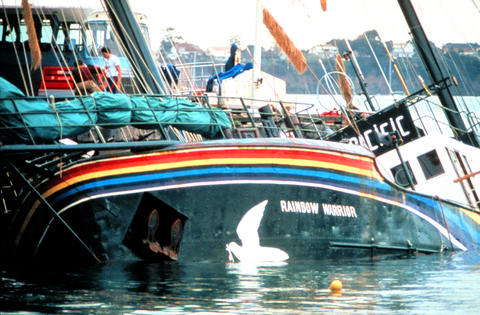
PHOTO: AP
"We suddenly became very, very deadly serious," he said, because "democratic governments were willing to kill us."
In the years since, the organization formed in 1971 has grown into an environmental powerhouse with 2.8 million supporters worldwide.
The blast, which killed a Greenpeace photographer, Dutchman Fernando Pereira, gave the group "an aura of credibility and respectability we hadn't had previously. We were in the center of some pretty big politics ... [with] a lot more access," Sawyer added.
mines planted
As Greenpeace commemorates the attack, the group remains angry over the French operation. Today, the sunken ship's replacement, Rainbow Warrior II, will visit New Zealand's Matauri Bay, where the original Rainbow Warrior was scuttled after being refloated during an investigation. Divers will lay a marble sculpture of a dove with an olive branch on the sea bed near the sunken vessel.
In July 1985, two mines planted by French secret service frogmen tore apart Rainbow Warrior's hull as the ship was readying to sail to France's South Pacific nuclear test site at Mururoa Atoll as part of a campaign for a "Nuclear Free Pacific."
The first device tore a hole big enough "to drive a Volkswagen through" said the vessel's skipper, Pete Willcox.
Willcox, then 32, was asleep in his bunk when the ship shuddered under the first blast and water gushed into its engine room. Pereira ran below to grab some of his camera gear while Willcox was checking whether people had escaped from their cabins. Then a second high-powered mine detonated "right under us ... on the propeller shaft," Willcox said, adding that the blast "trapped Fernando Pereira in his cabin and drowned him."
Police divers confirmed the blasts were sabotage. Within two days, the "finger was pointing at France ... but we didn't believe it at first," said Alan Galbraith, the retired detective who headed the investigation. The evidence became overwhelming: diving tanks with French markings; a French yacht which delivered the explosives and saboteurs; seized computer phone logs with direct dial numbers to the French secret service in Paris.
agents arrested
Two of nine French agents who entered New Zealand were arrested within days. Instead of fleeing the country, agents Alain Mafart and Dominique Prieur were waiting for a refund due for returning a rented van early.
"To our surprise they were still waiting for their check refund" when detectives tracking the vehicle walked into the rental office, said Maurice Whitham, one of the investigators.
Said Galbraith: "It wasn't the best spy technique -- receipts were kept. It was a significant paper trail" for detectives to follow.
New Zealand branded the attack "an act of state-sponsored terrorism" and after years of open hostility with France it won a multimillion dollar reparations payment and what Greenpeace has called an "unconvincing apology." Pierre Lacoste, who headed France's counter-espionage agency at the time, said in an interview last week with the New Zealand Herald that the drowning of photographer Pereira was an accident that weighed heavily on his conscience.
"I would perfectly understand it if New Zealanders considered this act to be an act of terrorism, to sink a boat in a port where there are just yachtsmen, peaceful people," he told the newspaper.
"It does not really deserve to be called that, but if it is felt in that way, that is reality," he said.
After the attack, Lacoste was fired and then-Defense Minister Charles Hernu resigned. The two arrested French agents, each sentenced to 10 years for manslaughter, were freed within two years after France threatened trade and other sanctions against New Zealand.
Willcox said the attack raised the hostility over French nuclear testing "to a much higher level than it ever would have been if they hadn't blown up the boat."
"I don't hold any anger toward the French people," he said. "I just hold anger toward members of their government who made these really stupid decisions."

Chinese President Xi Jinping (習近平) is to visit Russia next month for a summit of the BRICS bloc of developing economies, Chinese Minister of Foreign Affairs Wang Yi (王毅) said on Thursday, a move that comes as Moscow and Beijing seek to counter the West’s global influence. Xi’s visit to Russia would be his second since the Kremlin sent troops into Ukraine in February 2022. China claims to take a neutral position in the conflict, but it has backed the Kremlin’s contentions that Russia’s action was provoked by the West, and it continues to supply key components needed by Moscow for

Japan scrambled fighter jets after Russian aircraft flew around the archipelago for the first time in five years, Tokyo said yesterday. From Thursday morning to afternoon, the Russian Tu-142 aircraft flew from the sea between Japan and South Korea toward the southern Okinawa region, the Japanese Ministry of Defense said in a statement. They then traveled north over the Pacific Ocean and finished their journey off the northern island of Hokkaido, it added. The planes did not enter Japanese airspace, but flew over an area subject to a territorial dispute between Japan and Russia, a ministry official said. “In response, we mobilized Air Self-Defense

CRITICISM: ‘One has to choose the lesser of two evils,’ Pope Francis said, as he criticized Trump’s anti-immigrant policies and Harris’ pro-choice position Pope Francis on Friday accused both former US president Donald Trump and US Vice President Kamala Harris of being “against life” as he returned to Rome from a 12-day tour of the Asia-Pacific region. The 87-year-old pontiff’s comments on the US presidential hopefuls came as he defied health concerns to connect with believers from the jungle of Papua New Guinea to the skyscrapers of Singapore. It was Francis’ longest trip in duration and distance since becoming head of the world’s nearly 1.4 billion Roman Catholics more than 11 years ago. Despite the marathon visit, he held a long and spirited

The pitch is a classic: A young celebrity with no climbing experience spends a year in hard training and scales Mount Everest, succeeding against some — if not all — odds. French YouTuber Ines Benazzouz, known as Inoxtag, brought the story to life with a two-hour-plus documentary about his year preparing for the ultimate challenge. The film, titled Kaizen, proved a smash hit on its release last weekend. Young fans queued around the block to get into a preview screening in Paris, with Inoxtag’s management on Monday saying the film had smashed the box office record for a special cinema


 RSS
RSS