


Two years ago, the Bill and Melinda Gates Foundation posed a series of questions to scientists around the world: How can we improve public health in developing countries? Can we develop vaccines that don't require refrigeration or needles? Are there better ways to stop insects from spreading malaria and other diseases?
The scientists answered by proposing more than 1,500 research projects. The Gates Foundation announced Monday that it is funding 43 of the proposals with grants totaling US$436.6 million. That will pay for research ranging from finding AIDS vaccines to boosting the nutritional content of bananas.
"It's shocking how little research is directed toward the diseases of the world's poorest countries," Microsoft Corp. co-founder Bill Gates said in a statement. "By harnessing the world's capacity for scientific innovation, I believe we can transform health in the developing world and save millions of lives."
The funding will help re-searchers prove the feasibility of several potentially brilliant ideas. Among them:
-- A team headed by Abraham Sonenshein, of the Tufts University School of Medicine in Boston, will get US$5 million to create childhood vaccines that don't need refrigeration. Sonenshein's plan is to encapsulate the vaccines in harmless -- but naturally heat-resistant -- bacterial spores. The vaccines could be distributed in packets for people to mix with water and drink.
-- An international team headed by Scott O'Neill, of the University of Queensland in Australia, will get US$6.7 million to introduce a bacterial parasite to a mosquito population in a laboratory; the par-asite, which occurs naturally in other insects, should cause the mosquitoes to die before they are old enough to transmit dengue fever, which infects up to 100 million people every year. Mosquitoes have become resistant to some insecticides.
-- Four grants totaling US$47 million are being given to researchers fighting malnutrition by genetically altering the nutritional content of bananas, cassava, rice and sorghum. For example, bananas with more vitamin A and E and iron could improve health in Uganda, where 38 percent of children under 5 are stunted from malnourishment.
-- Paul Yager of the University of Washington, whose team is receiving US$15.4 million, will attempt to develop an inexpensive handheld device that can test blood for a wide range of conditions, including bacterial infections, nutritional status and HIV-related illnesses.
The Gates Foundation has committed US$450 million to the program, which it calls its "Grand Challenges in Global Health" initiative, and more grants are expected to be announced later. The Wellcome Trust, a British charity that funds medical research, has contributed US$27.1 million, and the Canadian Institutes of Health have committed US$4.5 million.
The grants are administered by those organizations as well as the Foundation for the National Institutes of Health in the US.
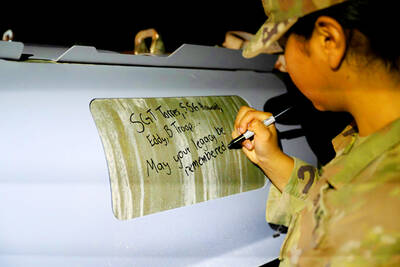
REVENGE: Trump said he had the support of the Syrian government for the strikes, which took place in response to an Islamic State attack on US soldiers last week The US launched large-scale airstrikes on more than 70 targets across Syria, the Pentagon said on Friday, fulfilling US President Donald Trump’s vow to strike back after the killing of two US soldiers. “This is not the beginning of a war — it is a declaration of vengeance,” US Secretary of Defense Pete Hegseth wrote on social media. “Today, we hunted and we killed our enemies. Lots of them. And we will continue.” The US Central Command said that fighter jets, attack helicopters and artillery targeted ISIS infrastructure and weapon sites. “All terrorists who are evil enough to attack Americans are hereby warned

Seven wild Asiatic elephants were killed and a calf was injured when a high-speed passenger train collided with a herd crossing the tracks in India’s northeastern state of Assam early yesterday, local authorities said. The train driver spotted the herd of about 100 elephants and used the emergency brakes, but the train still hit some of the animals, Indian Railways spokesman Kapinjal Kishore Sharma told reporters. Five train coaches and the engine derailed following the impact, but there were no human casualties, Sharma said. Veterinarians carried out autopsies on the dead elephants, which were to be buried later in the day. The accident site

‘POLITICAL LOYALTY’: The move breaks with decades of precedent among US administrations, which have tended to leave career ambassadors in their posts US President Donald Trump’s administration has ordered dozens of US ambassadors to step down, people familiar with the matter said, a precedent-breaking recall that would leave embassies abroad without US Senate-confirmed leadership. The envoys, career diplomats who were almost all named to their jobs under former US president Joe Biden, were told over the phone in the past few days they needed to depart in the next few weeks, the people said. They would not be fired, but finding new roles would be a challenge given that many are far along in their careers and opportunities for senior diplomats can

RUSHED: The US pushed for the October deal to be ready for a ceremony with Trump, but sometimes it takes time to create an agreement that can hold, a Thai official said Defense officials from Thailand and Cambodia are to meet tomorrow to discuss the possibility of resuming a ceasefire between the two countries, Thailand’s top diplomat said yesterday, as border fighting entered a third week. A ceasefire agreement in October was rushed to ensure it could be witnessed by US President Donald Trump and lacked sufficient details to ensure the deal to end the armed conflict would hold, Thai Minister of Foreign Affairs Sihasak Phuangketkeow said after an ASEAN foreign ministers’ meeting in Kuala Lumpur. The two countries agreed to hold talks using their General Border Committee, an established bilateral mechanism, with Thailand


 RSS
RSS