


Myanmar's National League for Democracy (NLD) yesterday prepared to celebrate the 60th birthday of their detained leader, Nobel laureate Aung San Suu Kyi, as international pressure mounted for the democracy leader's release from house arrest.
Events around the world have highlighted Suu Kyi's and her country's plight -- from a small celebration of Myanmar culture in Thailand, to anti-regime protests outside Myanmar embassies, to calls for her freedom from world leaders, including US President George W. Bush.
Bush issued a statement saying that "only a return to democracy and reintegration with the international community can bring the freedom and prosperity that the people of Burma deserve."
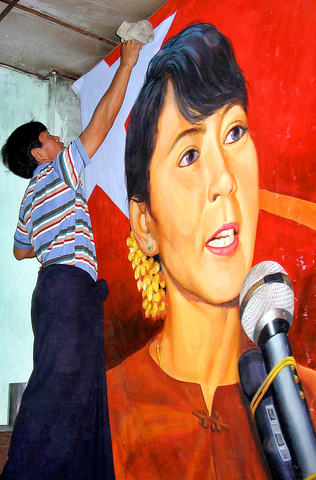
PHOTO: AFP
Suu Kyi, the daughter of the country's independence hero, is under her third term of house arrest since the junta ignored the NLD's sweeping victory in 1990 elections. She has no communication with the outside world, save for her shortwave radio.
Her latest detention began in May 2003, after she and NLD members travelling in a convoy were attacked in northern Myanmar by thugs in what was believed to be a botched assassination attempt ordered by the junta.
To mark her birthday, NLD members in Yangon planned to release 10 doves, representing peace, and 60 balloons, one for each year of Suu Kyi's life, as well as issue a letter urging dialogue with the ruling generals.
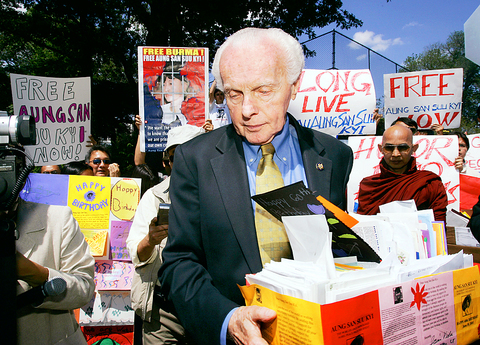
PHOTO: AP
One balloon would feature a card with the words "may Daw Aung San Suu Kyi be freed," and anyone returning both items to the NLD's headquarters would receive 10,000 kyats (US$11), NLD women's committee member Lai Lai said.
The NLD has invited diplomats, officials from political parties allied with the NLD, former student leaders and veterans to attend the celebrations. Ten Buddhist monks were scheduled to perform religious rites at dawn before offering food alms.
"The number 10 in Burmese also means either `save' or `salvage' and conveys our desire to have all political prisoners, including Daw Suu Kyi, saved from their present predicament," Lai Lai said.
"Whether or not Daw Suu is freed ultimately depends on the whims and fancies of the military leaders. We can but hope and pray for her freedom," Lai Lai said.
During the celebrations stationary and other school materials would be given to the children of political prisoners, of whom, watchdog group Amnesty International estimates, at least 1,350 remain in Myanmar's prisons.
Suu Kyi remains in good health, NLD spokesman U Lwin said.
"Her personal doctor, who gets to see her but once a month, assured us that her health is generally good," he said, without adding when the last visit was.
Meanwhile, the Norwegian Nobel Committee has taken the rare step of making a public statement about a past Nobel Peace Prize winner, asking Myanmar's military regime to free Suu Kyi.
The five-member committee on Friday expressed its continuing admiration for Suu Ky.
``We ask that she be set free immediately. We look forward to the day that democracy again rules her country,'' said a statement issued by committee chairman Ole Mjoes.
Suu Kyi won the coveted prize for her nonviolent efforts to bring democracy and human rights to her country. She was unable to attend her 1991 Nobel Peace Prize ceremony in Oslo.
Fellow Noble laureates, South African Archbishop Desmond Tutu and the Dalai Lama have sent messages.
Meanwhile, at the Myanmar Embassy in Washington on Friday, Democratic Representative Tom Lantos hailed Suu Kyi as "one of the greats of our age" and delivered a box containing hundreds of birthday cards sent from from 20 countries and each of the 50 US states. The mission appeared shut and no one accepted the cards.
The gesture by Lantos, the only Holocaust survivor to serve in the US Congress, capped a protest of about 100 Myanmar exiles and US activists.

‘CROSSING THE LINE’: China’s embassy in Seoul criticized US Forces Korea Commander General Xavier Brunson, asking if his ‘hostile’ remarks were authorized by Washington South Korea and the US are in talks over recent public remarks by the commander of US Forces Korea, Seoul’s presidential office said yesterday, after the comments drew sharp criticism from China. In a recent podcast interview, US Forces Korea Commander General Xavier Brunson described South Korea as “the dagger in the heart of Asia” from China’s east coast, prompting the Chinese embassy in Seoul to say that he had “truly crossed the line.” The interview came amid growing speculation that Washington might seek to expand the role of US Forces Korea in countering the growing regional influence of China, a key

SEEKING ORDER: Rodrigo Paz said that ‘anyone who wants to destroy the nation will have to deal with this president and the full force of the constitution’ Bolivian President Rodrigo Paz on Wednesday said that the nation was at a “breaking point” after nearly a month of protests that have caused shortages of food, fuel and medicine. Paz, who took office six months ago amid the worst economic crisis there in four decades, is battling a groundswell of fury over his policies. The political capital, La Paz, has been besieged by low-income workers and members of the indigenous majority calling for his resignation. “The country needs order and is reaching breaking point,” the 58-year-old said at a public event in La Paz, renewing his appeal for dialogue. On Tuesday, the Bolivian

Through the noise of rushing papers and whirring belts at a print factory in Kyoto, two creators watch their photo essay come to life in broadsheet form — part of an effort to win new audiences in the age of artificial intelligence (AI). Despite the decline of the publishing industry, self-publication and handmade “zine” magazines are growing in popularity in Japan, reflecting the nation’s enduring love of paper in the digital era. While speaking to Agence France-Presse at the plant, his hands black with ink, one of the creators, Kazuma Obara, said: “I think [paper] is a medium that engages all five

Australian researchers have trained lab-grown brain cells on a silicon computer chip to play the 1990s shooter game Doom and said they are just scratching the surface of what the neurons could be capable of doing. It is the science-fiction work of biotech boffins at Cortical Labs, who researched and developed the technology that harnesses the workings of the brain’s networking system. Each so-called “biological computer” contains about 200,000 living human brain cells, grown from stem cells that were harvested from blood donations. Having mastered the simple computer game Pong, where a paddle is moved up and down to send a ball


 RSS
RSS