


The US accused 14 nations of failing to do enough to stop the modern-day trade in prostitutes, child sex slaves and forced laborers. The countries include Saudi Arabia, Washington's closest Arab ally in the war on terror.
Three other US allies in the Middle East -- Kuwait, the United Arab Emirates and Qatar -- were newly listed this year as nations failing to deal adequately with the illegal trafficking of people. The State Department said Friday that the 14 countries could be subject to sanctions if they do not crack down.
As many as 800,000 people are bought and sold across national borders annually or lured to other countries with false promises of work or other benefits, the State Department said in its annual survey of international human trafficking. Most are women and children.
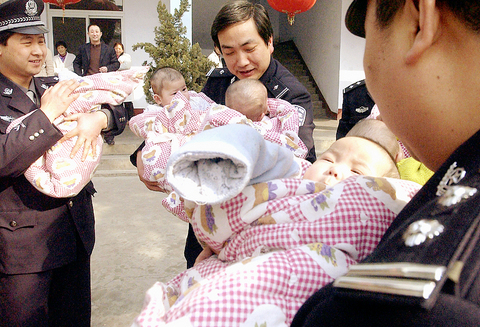
PHOTO: AFP
"Trafficking in human beings is nothing less than a modern form of slavery," Secretary of State Condoleezza Rice said. "The US has a particular duty to fight this scourge because trafficking in persons is an affront to the principles of human dignity and liberty upon which this nation was founded."
The other countries listed as poor performers in stopping trafficking are Bolivia, Cambodia, Cuba, Ecuador, Jamaica, Myanmar, North Korea, Sudan, Togo and Venezuela.
`politicizing rights'
Venezuela, which has had a tense relationship with the US in recent months, denied that it was ignoring the trafficking problem. A written statement from the Venezuelan Embassy called the country's inclusion in the list "a sad demonstration of how the administration has politicized its work on human rights."
The State Department report placed China, South Africa and 25 other countries on a watch list. Those nations have trafficking problems, but their governments are making what the State Department calls significant efforts to combat them.
Saudi Arabia has turned a blind eye to the problem of poor or low-skilled workers brought into the country and exploited or who go there voluntarily but find themselves in "involuntary servitude," the report said.
Saudi employers physically and sexually abuse migrants from South Asia, Africa and other places, withhold pay and travel documents or use migrant children as forced beggars, the report said. Some migrants work as domestics in the homes of wealthy Saudis.
"The government of Saudi Arabia does not comply with the minimum standards for the elimination of trafficking and is not making significant efforts to do so," the 2005 Trafficking in Persons report said.
The report said the Saudis apparently prosecuted only one employer during the period covered by the report, from March last year to March of this year.
Despite periodic differences, Saudi Arabia and the US have a tight alliance built on economic and military cooperation. Saudi Crown Prince Abdullah, the kingdom's de facto ruler since his half brother King Fahd suffered a stroke in 1995, visited President George W. Bush at his Texas ranch in April.
The US spends US$96 million to help other countries combat trafficking, Rice said. The US is not included on the list, although Miller said the country is far from immune.
"Modern-day slavery plagues every country, including the US," Miller said.
The Justice Department is due to issue a separate report this month on trafficking in the US.
Congress began requiring the international ranking reports in 2000. This is the fifth report, and it covers trafficking to and from 150 countries. Miller said the goal "is not to punish but to stimulate government action to eliminate" human trafficking. Countries that fail to crack down can be subject to a variety of sanctions, including the withholding of some kinds of US foreign aid. The US will not cut off trade and humanitarian aid, the report said.
Countries that receive no such assistance can be declared ineligible to take part in cultural and educational exchange programs.
Two countries have been sanctioned since the reports began, Equatorial Guinea and Venezuela.

Crowds in Bangladesh are flocking to snap photographs with an unlikely social media star — an albino buffalo with flowing blond hair nicknamed “Donald Trump” that is due to be sacrificed within days. Owner Zia Uddin Mridha, 38, said his brother named the 700kg bull over its flowing helmet of hair resembling the signature look of the US president. “My younger brother picked this name because of the buffalo’s extraordinary hair,” he said at his farm in Narayanganj, just outside the capital, Dhaka. Mridha said that a constant stream of curious visitors — social media fans, onlookers and children — have come throughout

It began as a satirical online project. Now millions of young people in India are flocking to it as an outlet for their frustration. A parody political party called the Cockroach Janta Party, with the insect as its symbol, has exploded across India’s social media by turning absurdist humor into protest. Memes and short videos mocking corruption, joblessness and political dysfunction have flooded social media sites, where millions of users are embracing the cockroach — known for its ability to survive harsh conditions — as a tongue-in-cheek symbol of endurance. The online movement’s rise has been unusually rapid. The Cockroach Janta Party (CJP)
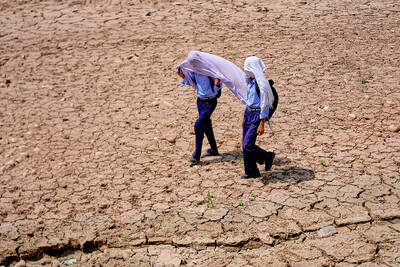
HOTTER: While Indians are accustomed to summer heat, climate change has caused northwestern India to warm faster than other parts of the country, an academic said Roads and markets have emptied during afternoons and some farmers have switched to nighttime work to avoid scorching temperatures as a heat wave grips large parts of India. The India Meteorological Department forecast maximum temperatures for yesterday of about 45°C in the capital, New Delhi, where authorities have opened temporary “cooling zones” to help people cope. The weather department warned that conditions would likely persist across several northern regions in the coming days, with temperatures staying well above seasonal averages. Authorities urged people to stay indoors during the hottest hours and take precautions against heat-related illnesses. India declares a heat wave whenever maximum temperatures

A Hong Kong astronaut is to join a Chinese space mission for the first time as part of a three-person crew launching today, as Beijing edges closer to its goal of landing people on the moon. The Tiangong space station — crewed by teams of three astronauts that are typically rotated every six months — is the crown jewel of China’s space program, boosted by billions in state investment in a bid to catch up with the US and Russia. The Shenzhou-23 mission is to blast off at 11:08pm from the Jiuquan Satellite Launch Center in northwestern China, carrying three astronauts to


 RSS
RSS