

Iraqi authorities pressed yesterday with Operation Lightning in Baghdad after presenting an initial tally of the dragnet's success, following a surge of violence in the north of the country.
Iraqi authorities arrested 20 "terrorists" in Baghdad yesterday as part of an ongoing military operation, a spokesman for the interior ministry said.
The arrests brought to 720 the number of suspected insurgents detained since Operation Lighting was launched last Sunday, the spokesman, Colonel Adnan Abdul-Rahman said.
The national television channel al-Iraqiya reported that another 136 arrests occurred in Hillah, south of Baghdad.
Quanties of weapons were also seized.
At least 28 people have been killed in the five-day operation.
However, 10 Iraqis were killed in an overnight suicide bombing in a remote village north of Baghdad, officials said yesterday, taking the number of people killed during a bloody day of violence in the north to almost 50.
Thursday's carnage claimed the lives of at least 49 people, including more than 30 in four suicide bombings across the north and a Shiite cleric in the southern city of Basra.
Police and relatives said yesterday that Ali Abdul-Hussein, the imam of a Shiite mosque in Basra, was shot outside his house on Thursday night by two gunmen who then escaped in a car.
At least 825 people, including U.S. forces, have been killed since the new Shiite-led government was announced April 28.
Dozens of Shiite and Sunni clerics have been assassinated in recent months, and some religious groups say the killings are an attempt to provoke sectarian civil war in Iraq.
Baghdad residents reported some additional mobile checkpoints by interior ministry commandos and combined patrols of Iraqi and US special forces have searched suspected insurgent areas while Apache attack helicopters flew sorties over several parts of the city.
But while the aircraft occasionally dropped flares to protect against ground attacks, there was little evidence of major US participation in the offensive, and in many areas of the city, life carried on as usual.
Up to 40,000 army troops and police personnel were to take part in the sweep, but Baghdad streets were filled more often with a motley collection of dusty foreign-built cars than with armored Humvees or heavily-armed personnel carriers.
"There is no limit to its duration. It will track terrorists, and eliminate their hideouts and car bomb workshops to halt the attacks and murders," an interior ministry official said.
Arrests were reported elsewhere in the country as well.
In the southern city of Nasiriyah, police reportedly arrested Anwar Abdel Karim al-Saadun, the brother of a former regional Baath party chief along with three other suspects.
His brother, Abdel Baqi Abdel Karim, is on the US list of 55 most-wanted former regime figures and is still on the run.
Police also captured two former Baath party members accused of killing 43 Shiites during the 1991 revolt against former president Saddam Hussein, the police chief in the southern city of Karbala said.
In a another development, two Iraqi civilians were killed when their vehicle was in collision with a US armored personnel carrier near Khalis in Diyala Province, bordering Baghdad, the US military said yesterday.

A Chinese artificial intelligence (AI) cybersecurity tool called ARTEX was used in a spate of recent hacks of Japanese companies, the subsidiary of a major Tokyo-based Internet company yesterday. Dozens of Japanese companies, from restaurant chains to a car hire operator, have disclosed unauthorized access or data breaches in the past weeks — potentially impacting millions of customers. The information security arm of GMO Internet Group Inc said it had “confirmed ARTEX was used” having investigated the attacks in collaboration with external organizations. “It also became clear ... the attacks were almost exclusively targeting Japan,” GMO cybersecurity center director Daiki

China’s first fully artificial intelligence (AI)-generated feature film opened in cinemas yesterday in what promised to be a tough box-office test for the country’s booming tech industry as advance ticket sales lag. More than 10,000 screenings of the sci-fi thriller Sanxingdui: Future Past were scheduled yesterday, according to ticketing platform Maoyan. However, public reception has been less than enthusiastic. Presale revenue as of yesterday morning was 80,000 yuan (US$11,992), while total box-office takings were forecast to remain below 150,000 yuan, only a fraction of the reported production cost, Maoyan said. Ticket prices range from 20 to 90 yuan, bringing the number sold to a
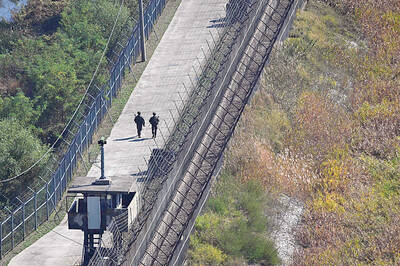
A STEP UP: The moving of small military positions forward should be taken seriously amid the North’s recent demonstrations of its firepower, an analyst said North Korea has moved new units into “firing positions,” the sister of leader Kim Jong-un said yesterday, days after Pyongyang warned it was considering deploying additional strike means to its border with South Korea. Tensions between Seoul and Pyongyang have soared since the South last month blamed an explosion inside the heavily fortified demilitarized zone (DMZ) separating the two countries on landmines laid by North Korea, an accusation it has rejected. “Our military leadership underlined the need to make those rogues aware that our new firepower units have taken their firing positions,” state media cited Kim Yo-jong as saying. Her statement came a
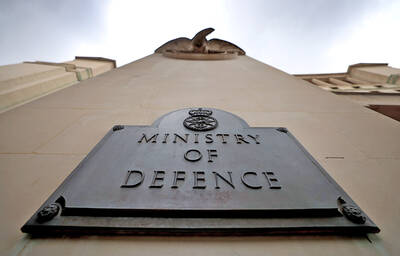
Thousands of British and French troops have taken part in a military training exercise that included one of Britain’s largest airborne operations in two decades, the British government said yesterday. The war game is designed to show how NATO countries could be defended against a modern-day attack and comes during fears about Russian aggression in Europe amid Moscow’s war against Ukraine. About 2,500 troops were involved in the seven-week exercise, in which 600 British and French paratroopers dropped from four RAF A400M Atlas transport aircraft over Germany. The exercise called Rhino Titan, held at the Sennelager military training center in


 RSS
RSS