


A Web site statement posted yesterday and signed in the name of al-Qaeda in Iraq said the militant group has appointed a deputy to take the lead until Abu Musab al-Zarqawi, who's purportedly been wounded, returns. But a subsequent statement by the group's spokesman denied any replacement had been named.
"The leaders met after the injury of our sheik, Abu Musab al-Zarqawi ... and decided to appoint a deputy to take the lead until the return of our sheik," said the statement, which was posted on a militant Web site that two days earlier announced al-Zarqawi had been injured.
The latest statements, the authenticity of which could not be verified, follow recent rumors and claims that al-Zarqawi has been wounded, possibly by a bullet penetrating his lung, may have been taken out of Iraq for medical care, or had possibly died.
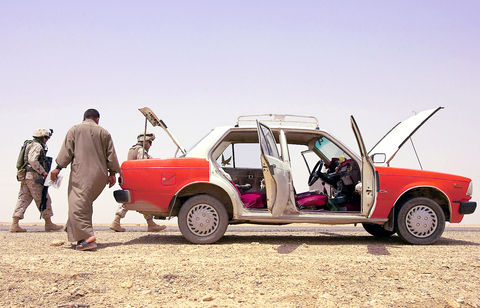
PHOTO: AP
It identified Abu Hafs al-Gerni as "deputy of the holy warriors."
Al-Gerni's identity was not immediately clear, but the new statement said he "was known for carrying out the hardest operations, and our sheik would choose him and his group for the tough operations."
Another Web site statement signed in the name of al-Qaeda in Iraq's so-called spokesman, Abu Maysara al-Iraqi, denied the militant group had appointed a deputy to fill in for al-Zarqawi.
"We deny all that has been said about appointing the so-called Abu Hafs or anyone by any other name," said the statement, the authenticity of which could not be verified.
The latest statement again urged Muslims to pray for al-Zarqawi, saying: "We will go on in our way of jihad until victory or martyrdom and we call upon Muslims to pray for the Mujahedeen and for the safety of our sheik."
security forces.
Meanwhile, more than 1,000 US troops swept into this city on the road to Syria to root out insurgents -- including those loyal to al-Zarqawi -- after rebels damaged the hospital, knocked out the electricity and prevented police from entering.
The US troops killed at least 10 suspected militants Wednesday in Haditha, a Euphrates River city of 90,000 people -- one of whom told the Marines that insurgents had recently killed her husband.
Speaking inside her home through a military interpreter, the woman moved her finger across her throat as she begged that her name not be used, indicating she could be killed for talking to US forces. She later helped cook a breakfast of eggs and bread for the handful of Iraqi soldiers helping guard the street.
Wednesday's offensive, the second on a road to Damascus in less than a month, came as the Iraqi government demanded that Syria block insurgents from crossing the border.
The violence continued yesterday, when a car bomb exploded in Baghdad near an Iraqi police patrol, killing three policemen and two civilians and wounding 17 bystanders, officials said. Separately, gunmen fired on a group of people walking to work in Baghdad, killing four Iraqis, including a translator working for the US military, said police Lieutenant Hussam Noori.
US Marines, sailors and soldiers have encircled Haditha, 225km northwest of Baghdad in the troubled Anbar province, and set up observation and sniper positions throughout the city.
Helicopters swept down near palm tree groves to drop off Marines who blocked off one side of Haditha before dawn Wednesday, while other troops on foot and in armored vehicles established checkpoints and moved toward the city center. US warplanes circled overhead.
Marines walked down city streets in neat lines, whispering instructions to each other. Except for dogs baying in the pre-dawn darkness, the city was quiet -- until a large explosion shook the neighborhood.
Marines crouched with guns pointed, while others ran for cover, their ears still ringing from the explosion. One group ran through a front yard, rushing by a porch swing and a grove of trees. Sounds of battle and gunfire broke out around the city.

‘CROSSING THE LINE’: China’s embassy in Seoul criticized US Forces Korea Commander General Xavier Brunson, asking if his ‘hostile’ remarks were authorized by Washington South Korea and the US are in talks over recent public remarks by the commander of US Forces Korea, Seoul’s presidential office said yesterday, after the comments drew sharp criticism from China. In a recent podcast interview, US Forces Korea Commander General Xavier Brunson described South Korea as “the dagger in the heart of Asia” from China’s east coast, prompting the Chinese embassy in Seoul to say that he had “truly crossed the line.” The interview came amid growing speculation that Washington might seek to expand the role of US Forces Korea in countering the growing regional influence of China, a key

SEEKING ORDER: Rodrigo Paz said that ‘anyone who wants to destroy the nation will have to deal with this president and the full force of the constitution’ Bolivian President Rodrigo Paz on Wednesday said that the nation was at a “breaking point” after nearly a month of protests that have caused shortages of food, fuel and medicine. Paz, who took office six months ago amid the worst economic crisis there in four decades, is battling a groundswell of fury over his policies. The political capital, La Paz, has been besieged by low-income workers and members of the indigenous majority calling for his resignation. “The country needs order and is reaching breaking point,” the 58-year-old said at a public event in La Paz, renewing his appeal for dialogue. On Tuesday, the Bolivian

Through the noise of rushing papers and whirring belts at a print factory in Kyoto, two creators watch their photo essay come to life in broadsheet form — part of an effort to win new audiences in the age of artificial intelligence (AI). Despite the decline of the publishing industry, self-publication and handmade “zine” magazines are growing in popularity in Japan, reflecting the nation’s enduring love of paper in the digital era. While speaking to Agence France-Presse at the plant, his hands black with ink, one of the creators, Kazuma Obara, said: “I think [paper] is a medium that engages all five

Australian researchers have trained lab-grown brain cells on a silicon computer chip to play the 1990s shooter game Doom and said they are just scratching the surface of what the neurons could be capable of doing. It is the science-fiction work of biotech boffins at Cortical Labs, who researched and developed the technology that harnesses the workings of the brain’s networking system. Each so-called “biological computer” contains about 200,000 living human brain cells, grown from stem cells that were harvested from blood donations. Having mastered the simple computer game Pong, where a paddle is moved up and down to send a ball


 RSS
RSS