


Large numbers of US forces supported by helicopters gathered outside this Euphrates River village yesterday as a region-wide operation to wipe out supporters of Iraq's most wanted militant continued into its seventh day.
An AP reporter saw a large convoy of mainly US Marines, backed by tanks, redeploy several kilometers from Rommana to Obeidi, on the river's northern bank, in a massive troop buildup that forced scared residents indoors.
The Obeidi operation appeared to signal a continuation of the high-profile Operation Matador, launched last Saturday in several villages close to the Syrian border known as major routes for foreign fighters entering Iraq to battle coalition forces.
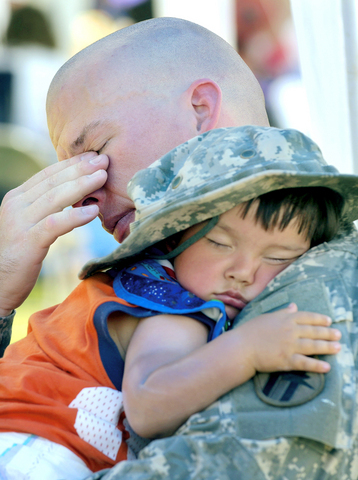
PHOTO: AP
Residents said US troops blocked the main road linking Obeidi with safer areas to the east outside the field of operations.
``There is fear among the residents of Obeidi, but we don't think it [the village] has any military importance. There are no fighters in the village,'' said Obeidi resident Khalaf Ali, 35.
The campaign, the largest since insurgents were forced from Fallujah six months ago, has killed more than 100 suspected foreign fighters allied with Jordanian-born militant Abu Musab al-Zarqawi, the military has said. Scores have also been captured.
Al-Zarqawi, a Sunni Muslim terror mastermind, has claimed responsibility for scores of bombings, assassinations and kidnappings in a bid to derail the US-backed, Shiite-led government.
Operation Matador came amid a surge of militant attacks that have killed at least 430 people across Iraq since the government was announced April 28.
Violence continued yesterday with three Iraqi street cleaners being killed and four injured when a roadside bomb exploded apparently prematurely in Dora, a southern Baghdad neighborhood, said Dr. Zaid Adil of Yarmouk Hospital.
A suicide car bomber detonated his vehicle near an Iraqi police patrol in central Baqouba, north of the capital, wounding three policemen and a civilian, said police colonel Mudhafar Muhammed.
Seven mortar rounds slammed into Baghdad's international airport at 9am, but no casualties or damages were reported, police Captain Talib Thamir said.
At least nine more Iraqis were killed and 19 wounded Friday in a series of bombings, ambushes and other attacks.
Also Friday, a gunfire exchange with US forces in Mosul, 362km northwest of Baghdad killed five Iraqi civilians and three suspected insurgents, the American military said.
US Marines on Friday characterized the violence in Iraq's vast Anbar region, which includes Obeidi and Qaim, as intertribal fighting, adding Marines have not conducted operations inside Qaim, a town of 50,000 people, since the campaign's opening days.
During the past few days in Qaim and nearby smaller villages, Iraqi fighters have been brazenly swaggering through rubble-strewn streets, toting machine guns and grenade launchers and setting up checkpoints in preparation to do battle.
But in Obeidi, the streets were virtually empty yesterday as residents bolted doors, remained inside and waited for a possible US offensive.
Overnight, US warplanes streaked noisily overhead and several loud explosions were heard in various locations throughout the region, but the source of the blasts nor details on possible casualties were not immediately clear.
This remote desert region is a haven for foreign combatants who slip across the border along ancient smuggling routes and collect weapons to use in some of Iraq's deadliest attacks, according to the US military. But fighters in the Sunni town of Qaim, some 200km west of Baghdad, insist there are no foreigners among them.
The US military has confirmed five Marine deaths so far and says about 100 insurgents have been killed in the Qaim operation. But a Washington Post reporter embedded with US forces put the American death toll Thursday at seven -- six of them from one squad.
On Friday, an American soldier was killed and four others wounded when a car bomb exploded in Beiji, 250km north of Baghdad, the military said in a statement.
At least 1,613 members of the US military have died since the beginning of the Iraq war in March 2003, according to an Associated Press count.
New interim prime minister, Ibrahim al-Jaafari, extended Iraq's state of emergency for another 30 days Friday throughout Iraq, except the northern Kurdish-run areas.
The state of emergency, renewed monthly since being first imposed Nov. 7 -- hours before the Fallujah offensive, includes a nighttime curfew and gives security forces powers of arrest without warrants.

‘CROSSING THE LINE’: China’s embassy in Seoul criticized US Forces Korea Commander General Xavier Brunson, asking if his ‘hostile’ remarks were authorized by Washington South Korea and the US are in talks over recent public remarks by the commander of US Forces Korea, Seoul’s presidential office said yesterday, after the comments drew sharp criticism from China. In a recent podcast interview, US Forces Korea Commander General Xavier Brunson described South Korea as “the dagger in the heart of Asia” from China’s east coast, prompting the Chinese embassy in Seoul to say that he had “truly crossed the line.” The interview came amid growing speculation that Washington might seek to expand the role of US Forces Korea in countering the growing regional influence of China, a key

SEEKING ORDER: Rodrigo Paz said that ‘anyone who wants to destroy the nation will have to deal with this president and the full force of the constitution’ Bolivian President Rodrigo Paz on Wednesday said that the nation was at a “breaking point” after nearly a month of protests that have caused shortages of food, fuel and medicine. Paz, who took office six months ago amid the worst economic crisis there in four decades, is battling a groundswell of fury over his policies. The political capital, La Paz, has been besieged by low-income workers and members of the indigenous majority calling for his resignation. “The country needs order and is reaching breaking point,” the 58-year-old said at a public event in La Paz, renewing his appeal for dialogue. On Tuesday, the Bolivian

Through the noise of rushing papers and whirring belts at a print factory in Kyoto, two creators watch their photo essay come to life in broadsheet form — part of an effort to win new audiences in the age of artificial intelligence (AI). Despite the decline of the publishing industry, self-publication and handmade “zine” magazines are growing in popularity in Japan, reflecting the nation’s enduring love of paper in the digital era. While speaking to Agence France-Presse at the plant, his hands black with ink, one of the creators, Kazuma Obara, said: “I think [paper] is a medium that engages all five

Australian researchers have trained lab-grown brain cells on a silicon computer chip to play the 1990s shooter game Doom and said they are just scratching the surface of what the neurons could be capable of doing. It is the science-fiction work of biotech boffins at Cortical Labs, who researched and developed the technology that harnesses the workings of the brain’s networking system. Each so-called “biological computer” contains about 200,000 living human brain cells, grown from stem cells that were harvested from blood donations. Having mastered the simple computer game Pong, where a paddle is moved up and down to send a ball


 RSS
RSS