


Despite US pressure to end a crippling political stalemate, bickering over different ministerial candidates threatened to delay the announcement of the new Iraqi government for another day, Shiite officials said yesterday.
Iraq's prime minister-designate has proposed appointing a broad-based 36-member Cabinet -- including a deputy premier from each of Iraq's main Shiite, Sunni and Kurdish factions, but discord among the factions persisted.
Among the main points of contention was the winning Shiite alliance's opposition to some Sunni Arab candidates who they believe were former members of Saddam Hussein's Baath Party, which brutally repressed the majority Shiites and the Kurds.
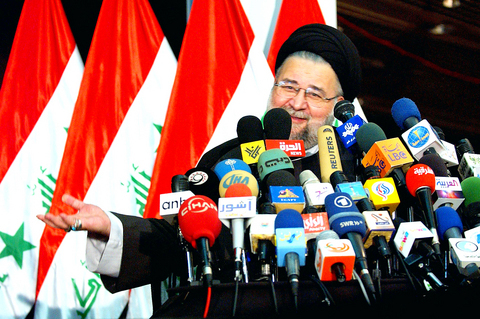
PHOTO: AP
The impasse is worrying Iraqis, many of whom feel months of wrangling over the new government has emboldened insurgents to step up deadly attacks on US and Iraqi security forces in recent weeks.
Meanwhile, an Iraqi lawmaker was shot and killed by militants who stormed into her house yesterday, Iraqi police said.
Lamia Abed Khadouri al-Sagri, a National Assembly legislator and member of outgoing premier Ayad Allawi's Iraqi List party, was killed in her house in the Hay Aour neighborhood in eastern Baghdad, police Captain Ali al-Obeidi said.
Also in Baghdad yesterday, unknown gunmen opened fire on the convoy of a senior Iraqi police officer, wounding him and killing two of his bodyguards, Iraqi police said.
Brigadier General Jihad Luaibi, in charge of civil defense at the Interior Ministry, was on his way to work when the attack occurred in the Salam neighborhood, said a police officer who asked not to be named in fear of his safety.
Luaibi and another bodyguard wounded in the attack were taken to a hospital for treatment.
In Saddam's hometown of Tikrit, US soldiers detained four suspects in connection with an attack on a coalition forces base, the US military said in a statement yesterday.
The military first found a vehicle suspected of being used in the attack, before detaining one suspect, who then led them to a house where three others were also detained on Tuesday.
Infighting within the majority-winning United Iraqi Alliance over who would be oil minister was also stalling progress, said Sami al-Askari, a Shiite lawmaker.
The Fadilah Party, a member of the alliance, wanted its candidate for the position, but other alliance members claimed the person lacked the credentials and experience to run one of Iraq's most important ministries.
Incoming premier Ibrahim al-Jaafari was supposed to present a list of ministers to the presidency council later in the day, announcing that in addition to the prime minister and three deputies, the Cabinet would have 17 Shiite Arab ministers, eight Kurds, six Sunni Arabs and one Christian, fulfilling promises by leaders of the Shiite majority to share power among ethnic and religious groups.
Al-Jaafari discussed his proposal with President Jalal Talabani on Tuesday, the premier's spokesman, Abdul Razak al-Kadhimi, said. Late on Tuesday other Shiite officials had said the meeting did not occur, but senior spokesmen from al-Jaafari's office Shiite alliance confirmed yesterday that the meeting did in fact take place.

‘CROSSING THE LINE’: China’s embassy in Seoul criticized US Forces Korea Commander General Xavier Brunson, asking if his ‘hostile’ remarks were authorized by Washington South Korea and the US are in talks over recent public remarks by the commander of US Forces Korea, Seoul’s presidential office said yesterday, after the comments drew sharp criticism from China. In a recent podcast interview, US Forces Korea Commander General Xavier Brunson described South Korea as “the dagger in the heart of Asia” from China’s east coast, prompting the Chinese embassy in Seoul to say that he had “truly crossed the line.” The interview came amid growing speculation that Washington might seek to expand the role of US Forces Korea in countering the growing regional influence of China, a key

SEEKING ORDER: Rodrigo Paz said that ‘anyone who wants to destroy the nation will have to deal with this president and the full force of the constitution’ Bolivian President Rodrigo Paz on Wednesday said that the nation was at a “breaking point” after nearly a month of protests that have caused shortages of food, fuel and medicine. Paz, who took office six months ago amid the worst economic crisis there in four decades, is battling a groundswell of fury over his policies. The political capital, La Paz, has been besieged by low-income workers and members of the indigenous majority calling for his resignation. “The country needs order and is reaching breaking point,” the 58-year-old said at a public event in La Paz, renewing his appeal for dialogue. On Tuesday, the Bolivian

Through the noise of rushing papers and whirring belts at a print factory in Kyoto, two creators watch their photo essay come to life in broadsheet form — part of an effort to win new audiences in the age of artificial intelligence (AI). Despite the decline of the publishing industry, self-publication and handmade “zine” magazines are growing in popularity in Japan, reflecting the nation’s enduring love of paper in the digital era. While speaking to Agence France-Presse at the plant, his hands black with ink, one of the creators, Kazuma Obara, said: “I think [paper] is a medium that engages all five

Australian researchers have trained lab-grown brain cells on a silicon computer chip to play the 1990s shooter game Doom and said they are just scratching the surface of what the neurons could be capable of doing. It is the science-fiction work of biotech boffins at Cortical Labs, who researched and developed the technology that harnesses the workings of the brain’s networking system. Each so-called “biological computer” contains about 200,000 living human brain cells, grown from stem cells that were harvested from blood donations. Having mastered the simple computer game Pong, where a paddle is moved up and down to send a ball


 RSS
RSS