


A search and recovery operation was under way yesterday to find the bodies of two missing US servicemen after the worst American military helicopter crash in Afghanistan left at least 16 people dead.
Thirteen of the confirmed fatalities on the Chinook were members of the US military while three others were civilians employed by US government contractors, US military spokesman Lieutenant Cindy Moore.
She would not confirm the nationalities of the three civilians, but a Western security source said on condition of anonymity that all the victims were Americans.
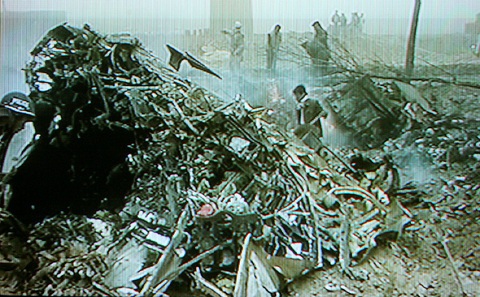
PHOTO: AP
Two US service members who were listed on the flight manifest were missing, presumed dead, Moore added. There were no survivors at the crash site in Ghazni province, around 100km south of the capital Kabul.
Bad weather
The US blamed bad weather and said the crash had been an accident. "There was no indication of hostile fire," Moore said.
However, the ultra-Islamic Taliban militia, which continues to wage an insurgency in the war-torn country, later said it had shot down the helicopter.
There was no way to independently verify the claim.
"This is the worst record for a crash in Operation Enduring Freedom," said US military spokesman Lieutenant Cindy Moore, referring to the operation launched in late 2001 to topple the Taliban regime.
Recovery operations were ongoing yesterday and a mortuary team would arrive on-site later yesterday to "care for the remains of the dead" and confirm what had happened, Moore said.
Chinooks are a mainstay of the US-led coalition force in rugged Afghanistan, where they are used for transport duties.
They have also been employed for relief work during recent spring floods.
Moore said the helicopter was one of two Chinooks returning from a patrol in southern Afghanistan. The second helicopter returned safely to Bagram, the main US air base which is just north of Kabul.
Taliban spokesman Latif Hakimi said militants had shot down the crashed helicopter with an 82mm gun.
Responsibility
Taliban insurgents regularly claim responsibility for incidents involving coalition casualties.
Around 18,000 US-led coalition troops are hunting down remnants of the Taliban regime and their Al-Qaeda allies in Afghanistan. They are also helping with anti-drug operations.
US forces flying missions above Afghanistan's difficult, mountainous terrain have now suffered eight helicopter crashes since the end of 2001, Moore said.
The seven previous crashes before Wednesday's accident claimed 21 lives, she added.
The last victim was the pilot of a Black Hawk helicopter which came down near the western city of Herat in October.
Six people -- three US military personnel and three American civilians -- were killed last November when their rented civilian transport plane crashed in central Afghanistan's Bamiyan province.

‘CROSSING THE LINE’: China’s embassy in Seoul criticized US Forces Korea Commander General Xavier Brunson, asking if his ‘hostile’ remarks were authorized by Washington South Korea and the US are in talks over recent public remarks by the commander of US Forces Korea, Seoul’s presidential office said yesterday, after the comments drew sharp criticism from China. In a recent podcast interview, US Forces Korea Commander General Xavier Brunson described South Korea as “the dagger in the heart of Asia” from China’s east coast, prompting the Chinese embassy in Seoul to say that he had “truly crossed the line.” The interview came amid growing speculation that Washington might seek to expand the role of US Forces Korea in countering the growing regional influence of China, a key

SEEKING ORDER: Rodrigo Paz said that ‘anyone who wants to destroy the nation will have to deal with this president and the full force of the constitution’ Bolivian President Rodrigo Paz on Wednesday said that the nation was at a “breaking point” after nearly a month of protests that have caused shortages of food, fuel and medicine. Paz, who took office six months ago amid the worst economic crisis there in four decades, is battling a groundswell of fury over his policies. The political capital, La Paz, has been besieged by low-income workers and members of the indigenous majority calling for his resignation. “The country needs order and is reaching breaking point,” the 58-year-old said at a public event in La Paz, renewing his appeal for dialogue. On Tuesday, the Bolivian

Through the noise of rushing papers and whirring belts at a print factory in Kyoto, two creators watch their photo essay come to life in broadsheet form — part of an effort to win new audiences in the age of artificial intelligence (AI). Despite the decline of the publishing industry, self-publication and handmade “zine” magazines are growing in popularity in Japan, reflecting the nation’s enduring love of paper in the digital era. While speaking to Agence France-Presse at the plant, his hands black with ink, one of the creators, Kazuma Obara, said: “I think [paper] is a medium that engages all five

Australian researchers have trained lab-grown brain cells on a silicon computer chip to play the 1990s shooter game Doom and said they are just scratching the surface of what the neurons could be capable of doing. It is the science-fiction work of biotech boffins at Cortical Labs, who researched and developed the technology that harnesses the workings of the brain’s networking system. Each so-called “biological computer” contains about 200,000 living human brain cells, grown from stem cells that were harvested from blood donations. Having mastered the simple computer game Pong, where a paddle is moved up and down to send a ball


 RSS
RSS