


Gunfire, wailing sirens, dark deserted streets and groups of young men with armbands helping police confront looters: so began the Kyrgyz capital's second night after the country's sudden shift of power.
Hundreds of pillagers wandered the rain-slick streets in mobs, throwing stones at cars and seemingly seeking a repeat of the previous night, when the city was theirs.
But this night, police were back on duty -- cruising the streets in marked cars and barking shouts for order through megaphones. Groups of stick-wielding young men hovered outside shops and offices -- this time to guard them.
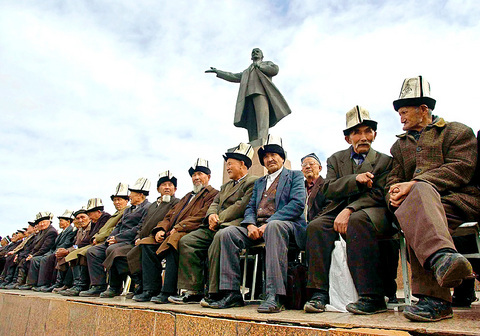
PHOTO: AP
Police appeared to be trying to determine the location of groups of looters, then rush to the area in several cars and go after them in vehicles and on foot, firing into the air.
One such operation played out beneath our second-floor office windows for some 10 minutes, the quiet street breaking out into shouts and shots that filled the air with the smell of gunpowder.
The only major department store that survived Thursday night's plundering, TsUM, was guarded by about 100 volunteers. Standing in the rain, they said they would defend the store all night long.
One of the volunteers tore a piece of yellow cloth in two, using one strip as an armband and another to wrap it around an iron bar gripped in his hand.
I asked him if he would really hit anyone with it. He smiled broadly and said: "Yes."
Earlier in the day, hundreds of poor treasure-hunters wandered up and down the five floors of a shopping mall that stood bare, its windows smashed and their frames charred.
All the goods in this Turkish-owned Beta Stores mall were swept away in a rampage the previous night, but people sifting through the remaining trash still found things to take away: metal scrap, empty boxes, broken mannequins.
Almazbek Abdykadyrov was mounting several wooden boards on his bicycle.
"I want to build a house; I don't have any material myself. Others are taking, so I'm taking, too," he said.
Two teenagers carried a sink, saying it was "a present from Beta Stores."
The area was littered with pieces of cardboard boxes and cloth, empty bottles.
Shops that escaped damaged Thursday night were closed, or their owners hung signs reading "we are with the people" in hopes of warding off attacks.
Bishkek residents were frightened and shocked.
An elderly woman told me she was shaking as she watched the looting overnight and cars passing by her windows until 3 am stuffed with carpets and other goods, some even hauling refrigerators and other large appliances or pieces of furniture on the roof.
"I've never seen anything as horrible as this in my entire life. Nobody was stopping them," she said, overwhelmed.
Meanwhile, Felix Kulov, an opposition leader and former interior minister, released from jail immediately after the fall of President Askar Akayev, was trying to restore order, holding meetings with police and security officials and trying to convince them to return to work.
Put in charge of law enforcement by the new government, Kulov pledged to "give a big battle to the pillagers."
Some police were back on the streets Friday -- but without their uniforms. They still appeared shocked by the storming of the government building the previous day.
About a dozen of them were guarding TsUM, the department store.
One of them, a senior police lieutenant who would not give his name, said police were ready to resume service.
But when asked if they would work under Kulov, he said: "We could, but how legitimate is he at the moment?"

An American scientist convicted of lying to US authorities about payments from China while he was at Harvard University has rebuilt his research lab in Shenzhen, China, to pursue technology the Chinese government has identified as a national priority: embedding electronics into the human brain. Charles Lieber, 67, is among the world’s leading researchers in brain-computer interfaces. The technology has shown promise in treating conditions such as amyotrophic lateral sclerosis and restoring movement in paralyzed people. It also has potential military applications: Scientists at the Chinese People’s Liberation Army have investigated brain interfaces as a way to engineer super soldiers by boosting

Indonesian police have arrested 13 people after shocking images of alleged abuse against small children at a daycare center went viral, sparking outrage across the nation, officials said on Monday. Police on Friday last week raided Little Aresha, a daycare center in Yogyakarta on Java island, following a report from a former employee. CCTV footage circulating on social media showed children, most younger than two, lying on the floor wearing only diapers, their hands and feet bound with rags. The police have confirmed that the footage is authentic. Police said they also found 20 children crammed into a room just 3m by 3m. “So
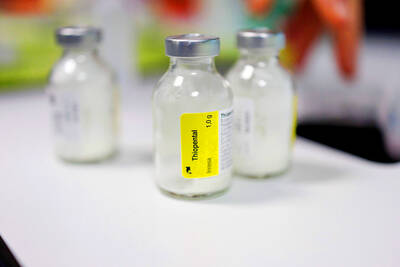
A grieving mother has ended her life at a clinic in Switzerland four years after the death of her only child. Wendy Duffy, 56, a physically healthy woman, died at the Pegasos clinic in Basel after struggling to cope with the death of her 23-year-old son, Marcus. The former care worker, from the West Midlands, England, had previously attempted to take her own life. The case comes as assisted dying would not become law in England and Wales after proposed legislation, branded “hopelessly flawed” by opponents, ran out of time. Ruedi Habegger, the founder of Pegasos, described Duffy’s death as
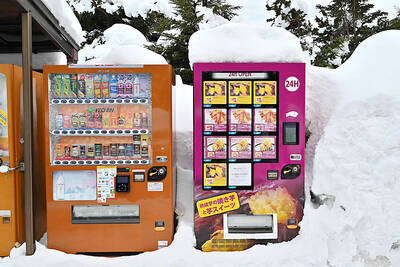
From post offices and parks to stations and even the summit of Mount Fuji, Japan’s vending machines are ubiquitous, but with the rapid pace of inflation cooling demand for their drinks, operators are being forced to rethink the business. Last month beverage giant DyDo Group Holdings announced it would remove about 20,000 vending machines — about 7 percent of their stock nationwide — by January next year, to “reconstruct a profitable network.” Pokka Sapporo Food & Beverage, based in Nagoya, also said last month it would sell its 40,000-machine operation to Osaka-based Lifedrink Co. “The strength of the vending machine


 RSS
RSS