


Sabawi Ibrahim Hasan, a half brother of Saddam Hussein and one of the remaining fugitives on the US list of most-wanted Iraqis, has been captured, officials in the prime minister's office said yesterday.
Officials in interim Prime Minister Ayad Allawi's office, speaking on condition of anonymity, confirmed the capture but gave no details on where it took place or when. It was also not immediately known whether Iraqi forces or US troops had detained Hasan.
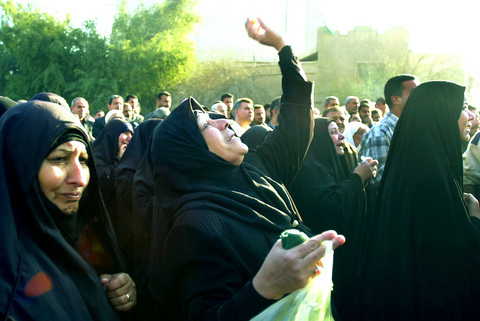
PHOTO: AP
Hasan is No. 36 on the list of 55 most-wanted Iraqis released by US authorities after US troops invaded Iraq in March 2003.
According to the US Central Command, only 12 of those 55 most-wanted remain at large. With Hasan's capture, the count would be 11 still at large.
According to the US Central Command, Hasan is also among the 29 most-wanted supporters of insurgent groups in Iraq. The US has put a US$1 million bounty on his head, and he is believed to be a financier of insurgents.
Under Saddam, Hasan served as head of intelligence and security before taking up his last post of presidential adviser in the former regime.
He is also known as Sabawi Ibrahim al-Hasan al-Tikriti, aka Thafir Alsemak.
Saddam's two other half brothers, Barzan and Watban, were captured in April 2003 and are expected to stand trial along with Saddam at the Iraqi Special Tribunal. Both appeared before the special court in Baghdad with Saddam and a handful of others to hear preliminary accusations against them.
Violence continued around the country.
In northern Iraq, major oil fire raged after insurgents blew up a pipeline, while the family of an anchorwoman for a US-funded state television station -- a mother of four who was repeatedly shot in the head -- found her body dumped on a street in the city of Mosul.
Around Baghdad, insurgents killed two civilians in a roadside bombing to the west of the city. To the southwest of the capital, a suicide car bomber killed an Iraqi national guardsman and injured seven people. The US military, meanwhile, announced the death on Saturday of a US Marine during military operations in Babil, just south of Baghdad.
Earlier, the military had announced the death of a soldier killed on Friday in a massive security sweep in the Sunni Triangle.
As part of the offensive, residents in Ramadi, the Sunni-dominated city 112km west of Baghdad, reported clashes between insurgents and US forces, but the military provided no details. US troops have been conducting an offensive in the region for nearly a week.
The US military said an insurgent was killed and another was injured trying to build a bomb in an abandoned house in Tikrit, Saddam Hussein's hometown and the site of a Thursday suicide bombing that killed 15 Iraqi police.
The body of Raiedah Mohammed Wageh Wazan, the 35-year-old news presenter for the US-funded Nineveh TV, was found dumped along a Mosul street, six days after she was kidnapped by masked gunmen, according to her husband, who said she had been shot four times in the head.
"This is a criminal act. She was an innocent woman who did not hurt anybody in all her life. I asked her several times to quit for the sake of her safety, but she refused," said Salim Saad-Allah, the husband.
The mother of three boys and a girl had been threatened with death several times by insurgents who demanded she quit her job, Saad-Allah said. The US military confirmed insurgents had threatened station employees.
It was unclear what prompted the kidnapping, but Nineveh TV was attacked last week with mortar rounds that wounded three technicians. An Arabic-language Internet bulletin board recently carried a statement from al-Qaeda In Iraq claiming responsibility for the mortar strike.
Attackers hit the oil pipeline late on Friday, setting fire to the line running about 32km from fields in Dibis to the Kirkuk, which is 240km north of Baghdad. As the line continued to blaze on Saturday night, an official with the state-run North Oil Co said it would take at least four days to repair the line.
Insurgents have regularly targeted Iraq's oil infrastructure, cutting exports and denying the country funds badly needed for reconstruction. Three pipelines were been blown up last week.
Acts of sabotage have blocked exports to Turkey's Mediterranean port of Ceyhan, a major outlet for Iraqi crude, for nearly two weeks.
Political activity moved apace on Saturday as Shiite political dissenters switched course and rallied behind the prime minister candidacy of conservative Islamic Dawa party leader Ibrahim al-Jaafari. The change of heart apparently was linked to Friday's endorsement of al-Jaafari by Iranian-born Grand Ayatollah Ali al-Sistani, the country's most powerful Shiite cleric.
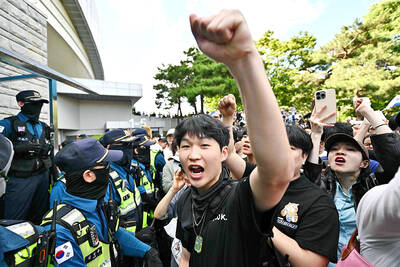
‘ABSURD MISTAKE’: The election commission said that there had been a failure to anticipate turnout after 14 polling stations ran short of ballot papers South Korean riot police yesterday cleared protesters from a Seoul polling station after a 35-hour blockade sparked by a shortage of ballot papers during local elections earlier this week. Wednesday’s election was the first nationwide vote since South Korean President Lee Jae-myung took office following the ouster of Yoon Suk-yeol over his short-lived martial law declaration. Lee’s ruling Democratic Party swept most races, but failed to flip the crucial Seoul mayoral seat. The South Korean National Election Commission apologized, blaming a failure to anticipate turnout after 14 polling stations in Seoul ran short of ballot papers. Some polling stations stayed open until 10pm to

France experienced its hottest spring on record, the French weather service said on Tuesday, after an exceptional early heat wave that also broke highs for the season in England and Wales. Meteo-France said the average nationwide temperature over March to May was 13.8°C — about 1.7°C above the norm, and surpassing records set in 2011 and 2020. “The warmest spring since records began in 1900,” it said in a bulletin. All three months were warmer than average, but the onset of an “unprecedented heatwave” late last month pushed the mercury to highs typically seen at the height of the summer. “Our country had never
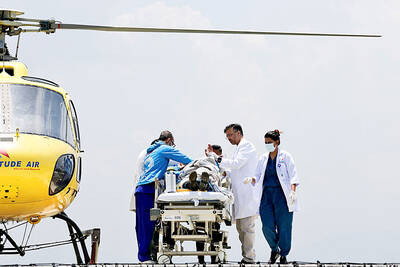
A Sherpa guide was found crawling to base camp on Mount Everest a week after he went missing and was reunited with his family, who had given up hope he would return. Dawa Sherpa was last seen on Friday last week descending the mountain, but he did not reach base camp even though his client did. The pair were among the last climbers on the mountain as the climbing season came to an end and the route was dismantled. Dawa was located by a cleaning crew on Thursday morning as he was crawling down the snowy slopes around the Khumbu Icefall, just above
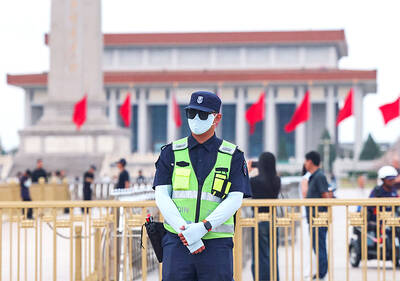
Chinese authorities are snuffing out any remembrance of the deadly 1989 military crackdown on student-led pro-democracy protests in Tiananmen Square, which happened 37 years ago yesterday, in a further tightening of a years-long campaign to erase what happened from public memory. Police told relatives of the victims they would not be allowed to visit a cemetery in Beijing on the anniversary of the crackdown, a person with knowledge of the matter said. Relatives of the victims visited the cemetery on the anniversary for more than 30 years to read memorial statements with police keeping watch, Amnesty International said. Hundreds of people,


 RSS
RSS