


The presidents of Brazil and France inspired 110 countries to back a new declaration to fight hunger and poverty and to increase funds for development, but the US was not among them.
On the eve of the annual gathering of the General Assembly, more than 50 heads of state and government joined a debate at the UN on Monday that focused on the impact of globalization and on ways to finance the war against poverty.
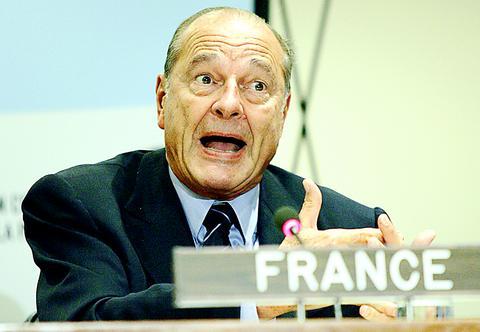
PHOTO: EPA
French President Jacques Chirac called the pledge to take action "unprecedented."
Brazil's President Luiz Inacio Lula da Silva declared that "the issue of hunger has once and for all become a political priority."
Asked whether he was concerned by the lack of US support for the initiative that he launched, Silva told journalists that the US had taken an important step by sending a representative.
US Secretary of Agriculture Ann Veneman said during Monday's debate that her government objected to proposals for international taxes, saying that they would be inherently undemocratic and impossible to implement.
US President George W. Bush skipped the two high-level meetings, but his speech to the General Assembly yesterday also will emphasize international humanitarian concerns as the world body begins two weeks of meetings amid an upsurge of violence in Iraq and a humanitarian crisis in Sudan.
One session focused on a UN report, released in February, that said the income gap between the richest and poorest countries has widened during the past four decades and that the vast majority of the world's population could fail to see the benefits of globalization. More than 1 billion people were living on less than US$1 per day in 2000, the report said.
Chirac, who traveled to New York solely for Monday's meetings, said he and Silva would propose new approaches to fund the alleviation of poverty, although the meetings resulted in no specific proposals.
"I believe taxation is a necessity," he said at a press conference following the meeting.
The large number of supporters for the declaration creates "a new political situation" for the US, Chirac said.
"You can't oppose that forever," he declared.
The French president, an outspoken critic of the US-led war in Iraq, was to head back to Paris Monday night and won't cross paths with Bush.
The US president, who has focused on Iraq in his last two speeches to the General Assembly, is making a dramatic shift this year. He said in his radio broadcast Saturday he would "talk about the great possibilities of our time to improve health, expand prosperity and extend freedom in the world."
Monday's meeting was aimed at setting the stage for a General Assembly summit next year to assess progress toward meeting the goals of the 2000 Millennium Summit. Those goals include halving the number of people living in dire poverty from 2000 levels, and ensuring that all children have an elementary school education, that all families have clean water and that the AIDS epidemic is halted -- all by 2015.

Chinese President Xi Jinping (習近平) is to visit Russia next month for a summit of the BRICS bloc of developing economies, Chinese Minister of Foreign Affairs Wang Yi (王毅) said on Thursday, a move that comes as Moscow and Beijing seek to counter the West’s global influence. Xi’s visit to Russia would be his second since the Kremlin sent troops into Ukraine in February 2022. China claims to take a neutral position in the conflict, but it has backed the Kremlin’s contentions that Russia’s action was provoked by the West, and it continues to supply key components needed by Moscow for

Japan scrambled fighter jets after Russian aircraft flew around the archipelago for the first time in five years, Tokyo said yesterday. From Thursday morning to afternoon, the Russian Tu-142 aircraft flew from the sea between Japan and South Korea toward the southern Okinawa region, the Japanese Ministry of Defense said in a statement. They then traveled north over the Pacific Ocean and finished their journey off the northern island of Hokkaido, it added. The planes did not enter Japanese airspace, but flew over an area subject to a territorial dispute between Japan and Russia, a ministry official said. “In response, we mobilized Air Self-Defense

CRITICISM: ‘One has to choose the lesser of two evils,’ Pope Francis said, as he criticized Trump’s anti-immigrant policies and Harris’ pro-choice position Pope Francis on Friday accused both former US president Donald Trump and US Vice President Kamala Harris of being “against life” as he returned to Rome from a 12-day tour of the Asia-Pacific region. The 87-year-old pontiff’s comments on the US presidential hopefuls came as he defied health concerns to connect with believers from the jungle of Papua New Guinea to the skyscrapers of Singapore. It was Francis’ longest trip in duration and distance since becoming head of the world’s nearly 1.4 billion Roman Catholics more than 11 years ago. Despite the marathon visit, he held a long and spirited

The pitch is a classic: A young celebrity with no climbing experience spends a year in hard training and scales Mount Everest, succeeding against some — if not all — odds. French YouTuber Ines Benazzouz, known as Inoxtag, brought the story to life with a two-hour-plus documentary about his year preparing for the ultimate challenge. The film, titled Kaizen, proved a smash hit on its release last weekend. Young fans queued around the block to get into a preview screening in Paris, with Inoxtag’s management on Monday saying the film had smashed the box office record for a special cinema


 RSS
RSS