


The UN began a three-day fact-finding mission in troubled Darfur yesterday to establish whether the Sudanese government has fulfilled its pledges to improve security and rein in Arab militia accused of months of atrocities.
Three UN teams, accompanied by Sudanese government officials, will fan out across the western region, before presenting their assessment to UN Secretary-General Kofi Annan on Aug. 31.
PHOTO: AP
The UN Security Council has threatened Khartoum with penalties if it doesn't make sufficient progress in disarming Arab militiamen, known as janjaweed, accused of killing and maiming black African farmers and burning villages across Darfur.
"We are coming very close to the moment of assessment. The clock is ticking," said UN special representative Jan Pronk at a news conference in the Sudanese capital Wednesday.
"The responsibility is for the authorities in Khartoum not only to make promises but to implement the promises, and to show that it does make sense to continue on this road. If not, the international community has to consider what is necessary," he said.
The UN says Darfur has become the scene of the world's worst humanitarian crisis since African rebels rose against the government in February last year, claiming discrimination in the distribution of scarce resources.
International rights groups have accused the government of arming the janjaweed to crush the revolt -- an accusation it denies, although last week the UN said Khartoum acknowledged it has "control" over some fighters.
On Aug. 10, the Sudanese government and the UN signed an action plan to create havens in Darfur within 30 days so civilians can search for food and water and farm without fear of attack.
The plan requires the cessation of all military operations by government forces, militias, and rebel groups in areas around camps where thousands of displaced people have taken refuge, as well as near towns and villages that still have large populations.
"The visits aim to check the implementation of these commitments," Radhia Achouri, spokesperson for the UN Mission in Sudan, told reporters.
"The most crucial part of this is to demonstrate an irreversible, substantial and sustainable improvement of security in the areas selected by the government of Sudan," she said.
She said the Security Council was scheduled to meet to consider Pronk's report on Sept. 2.
Pronk, accompanied by Sudanese Foreign Minister Mustafa Osman Ismail, will head the team in Geneina, West Darfur. UN deputy humanitarian coordinator Erick De Mul will visit Al-Fasher, the provincial capital of North Darfur, while deputy special representative Manuel Aranda Da Silva will visit the south.
All three plan to check on conditions and humanitarian access to some of the 147 camps for displaced people. The UN says about 1.4 million people have been driven from their homes and are now in some 147 camps throughout Darfur's three states, while another 180,000 Darfur refugees have fled into neighboring Chad.
At African Union-brokered peace talks in Abuja, Nigeria, a government delegate on Wednesday modified Sudan's previous rejection of an international peacekeeping force for Darfur. He said the government had no objections to an African Union force.

Four contenders are squaring up to succeed Antonio Guterres as secretary-general of the UN, which faces unprecedented global instability, wars and its own crushing budget crisis. Chile’s Michelle Bachelet, Argentina’s Rafael Grossi, Costa Rica’s Rebeca Grynspan and Senegal’s Macky Sall are each to face grillings by 193 member states and non-governmental organizations for three hours today and tomorrow. It is only the second time the UN has held a public question-and-answer, a format created in 2016 to boost transparency. Ultimately the five permanent members of the UN’s top body, the Security Council, hold the power, wielding vetoes over who leads the

A humanoid robot that won a half-marathon race for robots in Beijing on Sunday ran faster than the human world record in a show of China’s technological leaps. The winner from Honor, a Chinese smartphone maker, completed the 21km race in 50 minutes and 26 seconds, said a WeChat post by the Beijing Economic-Technological Development Area, also known as Beijing E-Town, where the race began. That was faster than the human world record holder, Ugandan Jacob Kiplimo, who finished the same distance in about 57 minutes in March at the Lisbon road race. The performance by the robot marked a significant step forward

An earthquake registering a preliminary magnitude of 7.7 off northern Japan on Monday prompted a short-lived tsunami alert and the advisory of a higher risk of a possible mega-quake for coastal areas there. The Cabinet Office and the Japan Meteorological Agency said there was a 1% chance for a mega-quake, compared to a 0.1% chance during normal times, in the next week or so following the powerful quake near the Chishima and Japan trenches. Officials said the advisory was not a quake prediction but urged residents in 182 towns along the northeastern coasts to raise their preparedness while continuing their daily lives. Prime
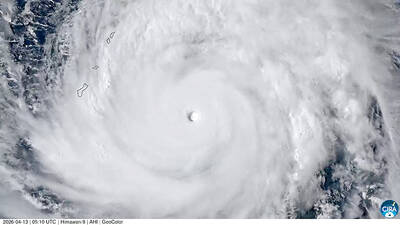
HAZARDOUS CONDITION: The typhoon’s sheer size, with winds extending 443km from its center, slowed down the ability of responders to help communities, an official said The US Coast Guard was searching for six people after losing contact with their disabled boat off the coast of Guam following Typhoon Sinlaku. The crew of the 44m dry cargo vessel, the US-registered Mariana, on Wednesday notified the coast guard that the boat had lost its starboard engine and needed assistance, Petty Officer 3rd Class Avery Tibbets said yesterday. The coast guard set up a one-hour communication schedule with the vessel, but lost contact on Thursday. A Coast Guard HC-130 Hercules aircraft was launched to search for the six people on board, but it had to return to Guam because of


 RSS
RSS