


Challenges abound for Leonel Fernandez as he returns to the presidency this week, aiming to lead the Dominican Republic out of its worst economic crisis in decades by asking its people to accept painful economic sacrifices.
Fernandez, who as president from 1996 to 2000 presided over relative stability, trounced outgoing President Hipolito Mejia in May 16 elections by promising a return to progress.
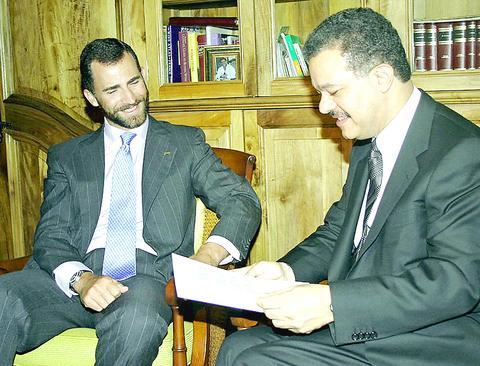
PHOTO: AFP
His new government is inheriting some US$6 billion in foreign debt, worsening power outages and a desperation among the poor that is driving thousands to risk illegal voyages by boat to the wealthier US territory of Puerto Rico.
US authorities have intercepted more than 7,000 Dominican boat people in the last 10 months. Last week, authorities rescued 39 Dominicans who drifted for 10 days after their motorboat broke down on the way to Puerto Rico. Forty-seven others disappeared at sea -- many of them jumping overboard in desperation -- and eight died of dehydration after being rescued.
Economists say Fernandez will face unpopular decisions in trying to address 16 percent unemployment, 32 percent inflation and a Dominican peso that has lost half its value against the US dollar in two years, doubling prices in the Caribbean nation of 8.8 million.
"This crisis will last at least two years and will be painful," said Miguel Ceara-Hatton, an economist with the UN Development Program in Santo Domingo.
Economists say a turnaround requires steep tax hikes and cuts in spending, meaning fewer social services, government jobs and subsidies for electricity and gas.
Fernandez's aides say he was to present a blueprint for such changes in his inaugural address following his swearing-in yesterday.
More than a dozen heads-of-state and ex-presidents were to attend, including Brazilian President Ignacio Lula da Silva, former US President Jimmy Carter and the Spanish prince and princess, Felipe de Borbon and his wife Letizia Ortiz.
Fernandez stepped down in 2000 due to a single-term limit that was later rescinded. He left office amid a scandal involving US$100 million allegedly embezzled from a government fund. He denied wrongdoing, but his successor Danilo Medina was easily defeated by Mejia in 2000.
Many Dominicans say they are frustrated with Mejia, who in defense said he faced a tourism lull after the attacks of Sept. 11, 2001, and a 2003 bank scandal that cost the treasury US$2.2 billion.
"I just hope Fernandez can bring a different attitude," said Juary Rodriguez, 32, a mechanic. "Mejia has given up."
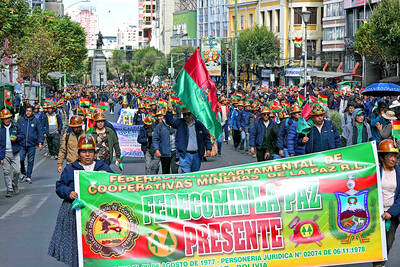
The Bolivian government on Friday struck a deal with protesting miners, but was still grappling with blockades and demonstrations by other workers across La Paz. Other groups are still blocking access roads into the city, which is also the seat of the government. Police on Thursday prevented the miners from entering the main square by using tear gas, while the demonstrators hurled stones and explosives with slingshots. Protests against the policies of Bolivian President Rodrigo Paz have convulsed the Andean nation since early this month, and roadblocks were choking routes into La Paz throughout Friday, the national road authority said. Miners demanded that Paz
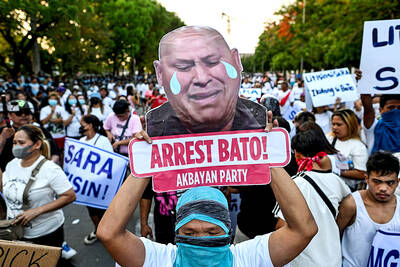
The Philippines said it has asked the country’s Supreme Court to allow it to arrest former Philippine president Rodrigo Duterte’s chief drug war enforcer to stand trial in an international tribunal. The International Criminal Court (ICC) last week unsealed an arrest warrant against Philippine Senator Ronald dela Rosa, accusing him along with Duterte and other “coperpetrators” of the “crime against humanity of murder.” Dela Rosa briefly sought refuge in the Philippine Senate last week while asking the Philippine Supreme Court to stop an ongoing attempt by government agents to arrest him. “By his own conduct, he has placed himself outside the protection of
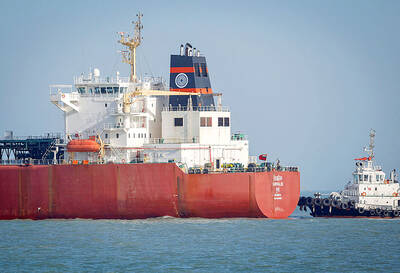
A ship anchored off the United Arab Emirates (UAE) was seized and taken toward Iran and another — a cargo ship near Oman — sank after being attacked, authorities said on Thursday, as tensions escalated near the Strait of Hormuz. It was not immediately clear who was behind these incidents, but they happened as a senior Iranian official reiterated his country’s claim of control over the waterway and another said it had a right to seize oil tankers connected to the US. The turmoil in the strait has been a sticking point for weeks in talks between the US and Iran to

Crowds in Bangladesh are flocking to snap photographs with an unlikely social media star — an albino buffalo with flowing blond hair nicknamed “Donald Trump” that is due to be sacrificed within days. Owner Zia Uddin Mridha, 38, said his brother named the 700kg bull over its flowing helmet of hair resembling the signature look of the US president. “My younger brother picked this name because of the buffalo’s extraordinary hair,” he said at his farm in Narayanganj, just outside the capital, Dhaka. Mridha said that a constant stream of curious visitors — social media fans, onlookers and children — have come throughout


 RSS
RSS