


With Afghanistan's historic presidential elections just weeks away, a battle that has broken out for control of the country's western provinces highlights how difficult it will be to provide security for the vote, analysts say.
The fighting Saturday erupted between forces loyal to military strongman Ismael Khan, the ethnic Tajik governor of the nation's most prosperous city, and militias commanded by a rival warlord.
Over 20 people have been killed so far in the conflict which pits the governor's men in Shindand and Chisti districts in Herat province against militias loyal to commander Amanullah Khan, a Pashtun.
It is unclear which side started the battle but forces from three surrounding provinces launched a combined attack on Shindand airport and its surroundings.
"We've got coalitions of forces from [the provinces of] Ghor, Badgdis, Farah, and an almost encirclement of Herat. It appears to be a co-ordinated consortium of forces," said Nick Downie, security coordinator for the Afghanistan NGO Security Office.
Sporadic fighting between local factional commanders in western Afghanistan has intensified in recent months forcing foreign aid organisations to roll back their presence in the country's west which had been considered safe.
Last month Medecins Sans Frontieres quit Afghanistan following the murder of five of their staff in Badghis province in June.
There were a number of skirmishes between militias in Ghor province last month, with an attack on a disarmament convoy aiming to demobilize local fighters in which three US soldiers were injured.
Downie said that for militias hostile to Ismael Khan to be showing their hand so close to the election, they must believe they have a chance of success.
"I think this is a point of no return for those forces. They must believe they have good chances, because they are exposing themselves," he said.
Late Saturday, President Hamid Karzai's office issued an unusually strong statement condemning the fighting and saying it was the "government's duty to prevent any kind of threats" to the country's first presidential elections on Oct. 9.
"The government will respond to the situation in Shindand and Herat Province in a firm manner and serious measures will be taken against the latest military operations," the statement said.
A senior defense ministry official told reporters that government forces would back Ismael Khan if the fighting intensified.
Around 900 people took to the streets of Herat on Saturday carrying banners reading "Death to the Central Government" and "Why Does the Central Government Not Chop Off the Hands of those Who Attack Our Peaceful City?"
Factional fighting adds to the many security problems facing Afghanistan, which is also plagued by attacks from members of the ousted Taliban regime, who have vowed to disrupt the presidential elections.

Four contenders are squaring up to succeed Antonio Guterres as secretary-general of the UN, which faces unprecedented global instability, wars and its own crushing budget crisis. Chile’s Michelle Bachelet, Argentina’s Rafael Grossi, Costa Rica’s Rebeca Grynspan and Senegal’s Macky Sall are each to face grillings by 193 member states and non-governmental organizations for three hours today and tomorrow. It is only the second time the UN has held a public question-and-answer, a format created in 2016 to boost transparency. Ultimately the five permanent members of the UN’s top body, the Security Council, hold the power, wielding vetoes over who leads the

A humanoid robot that won a half-marathon race for robots in Beijing on Sunday ran faster than the human world record in a show of China’s technological leaps. The winner from Honor, a Chinese smartphone maker, completed the 21km race in 50 minutes and 26 seconds, said a WeChat post by the Beijing Economic-Technological Development Area, also known as Beijing E-Town, where the race began. That was faster than the human world record holder, Ugandan Jacob Kiplimo, who finished the same distance in about 57 minutes in March at the Lisbon road race. The performance by the robot marked a significant step forward

An earthquake registering a preliminary magnitude of 7.7 off northern Japan on Monday prompted a short-lived tsunami alert and the advisory of a higher risk of a possible mega-quake for coastal areas there. The Cabinet Office and the Japan Meteorological Agency said there was a 1% chance for a mega-quake, compared to a 0.1% chance during normal times, in the next week or so following the powerful quake near the Chishima and Japan trenches. Officials said the advisory was not a quake prediction but urged residents in 182 towns along the northeastern coasts to raise their preparedness while continuing their daily lives. Prime
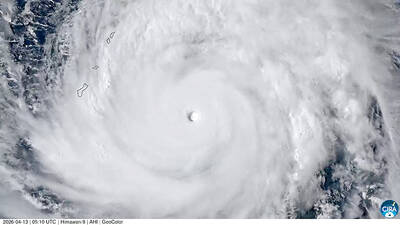
HAZARDOUS CONDITION: The typhoon’s sheer size, with winds extending 443km from its center, slowed down the ability of responders to help communities, an official said The US Coast Guard was searching for six people after losing contact with their disabled boat off the coast of Guam following Typhoon Sinlaku. The crew of the 44m dry cargo vessel, the US-registered Mariana, on Wednesday notified the coast guard that the boat had lost its starboard engine and needed assistance, Petty Officer 3rd Class Avery Tibbets said yesterday. The coast guard set up a one-hour communication schedule with the vessel, but lost contact on Thursday. A Coast Guard HC-130 Hercules aircraft was launched to search for the six people on board, but it had to return to Guam because of


 RSS
RSS