


Pope John Paul II yesterday was to call on leaders of the Roman Catholic church to attack feminist ideologies which assert that men and women are fundamentally the same.
The Vatican is concerned that this belief is eroding what it regards as women's maternal vocation. But a paper on the subject which was due to be published yesterday -- the Vatican's third major pronouncement on women's role in the quarter century of John Paul's papacy -- drew scornful criticism from feminists and academics.

PHOTO: AP
According to a leaked extract, the document accuses feminists of "blurring the biological difference between man and woman."
But it is also understood to break new ground by appealing to governments for help to be given to women so they can cope with their broader modern responsibilities.
It emerged on Friday that the Vatican itself had taken a further step towards incorporating women into the previously all-male leadership of the Roman Catholic church. A nun, who was not named in Italian media reports, was said to be working as a high-level aide to the Pope's "foreign minister," Archbishop Giovanni Lajolo.
The statement of doctrine on gender issues represents a first serious attempt by the Vatican to come to grips with a world of working women. But it is clearly intended to prevent any erosion of the church's resolute opposition to gay marriage, the incorporation of women in the priesthood and trends in gender studies the Pope has damned as "misleading conceptions of sexuality."
The Vatican's sights are trained in particular on the view that, while people's sex is anatomically determined, their gender identity and roles are entirely a product of conditioning. In a letter to bishops on the participation of men and women in the church and the world, the Pope's chief theological spokesman, the German cardinal Joseph Ratzinger, stresses, as the pontiff has done on several occasions, that the book of Genesis is unambiguous on this point.
The letter was drawn up inside Cardinal Ratzinger's Vatican "ministry," the Congregation for the Doctrine of the Faith. However, as a statement of doctrine, it would not have been sent for publication without the consent of the Pope.
The Vatican's letter acknowledges that the emancipation of women, which the pontiff applauded in his earliest pronouncements on the subject, has given them a vastly increased presence in the labor market.
Recent decades have seen a plunge in birth and fertility rates, particularly in the Roman Catholic heartland of southern Europe, as women struggle to combine jobs with their traditional roles as mothers, homemakers and caregivers.
Church representatives have argued that this is symptomatic of a breakdown in values, and particularly a greater selfishness among young couples more interested in consumer goods than in creating life.
Feminists have long held it is a result of the reluctance of men to share household tasks and the failure of governments to provide adequate support for families.
Cardinal Ratzinger's document appears to have embraced implicitly the feminist view on this point, though in language unlikely to win over many feminists.
According to a leaked extract in the German tabloid Bild Zeitung, his letter to bishops calls on governments to "create conditions that enable women not to neglect their family duties when they enter into a job."
Helena Cronin, an evolutionary psychologist at the London School of Economics, said "It's absolutely true that we are different, in a variety of ways. But I have no reason to expect the Pope to be correct about the way in which men and women are different, given his general grasp of science."
She said that in all mammals, females showed a greater propensity to caring for the young than males did. But she added: "That's not saying that women have no other vocations, or that they should be devoted [to motherhood]."
The feminist author Natasha Walter questioned whether there were essential differences between men and women at all.
"We have centuries and centuries of acculturation towards a `vocation' of maternity, and men have only had a couple of generations of acculturation towards active paternity," she said.
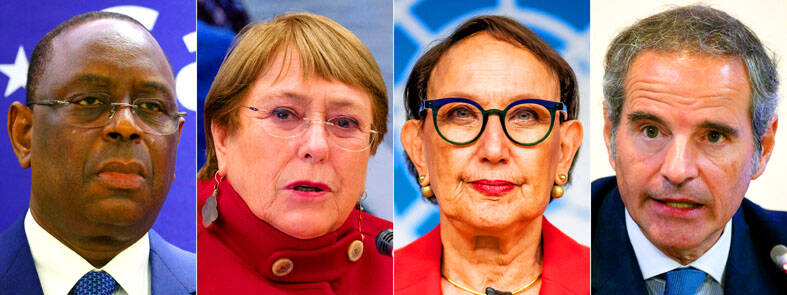
Four contenders are squaring up to succeed Antonio Guterres as secretary-general of the UN, which faces unprecedented global instability, wars and its own crushing budget crisis. Chile’s Michelle Bachelet, Argentina’s Rafael Grossi, Costa Rica’s Rebeca Grynspan and Senegal’s Macky Sall are each to face grillings by 193 member states and non-governmental organizations for three hours today and tomorrow. It is only the second time the UN has held a public question-and-answer, a format created in 2016 to boost transparency. Ultimately the five permanent members of the UN’s top body, the Security Council, hold the power, wielding vetoes over who leads the

A humanoid robot that won a half-marathon race for robots in Beijing on Sunday ran faster than the human world record in a show of China’s technological leaps. The winner from Honor, a Chinese smartphone maker, completed the 21km race in 50 minutes and 26 seconds, said a WeChat post by the Beijing Economic-Technological Development Area, also known as Beijing E-Town, where the race began. That was faster than the human world record holder, Ugandan Jacob Kiplimo, who finished the same distance in about 57 minutes in March at the Lisbon road race. The performance by the robot marked a significant step forward
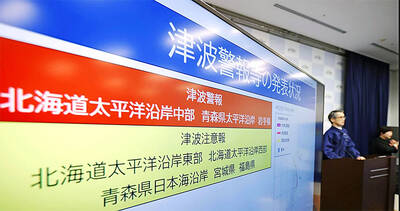
An earthquake registering a preliminary magnitude of 7.7 off northern Japan on Monday prompted a short-lived tsunami alert and the advisory of a higher risk of a possible mega-quake for coastal areas there. The Cabinet Office and the Japan Meteorological Agency said there was a 1% chance for a mega-quake, compared to a 0.1% chance during normal times, in the next week or so following the powerful quake near the Chishima and Japan trenches. Officials said the advisory was not a quake prediction but urged residents in 182 towns along the northeastern coasts to raise their preparedness while continuing their daily lives. Prime
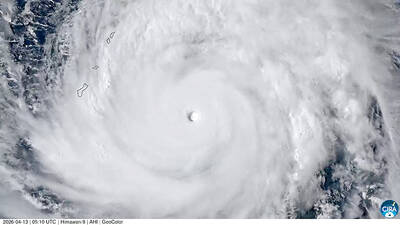
HAZARDOUS CONDITION: The typhoon’s sheer size, with winds extending 443km from its center, slowed down the ability of responders to help communities, an official said The US Coast Guard was searching for six people after losing contact with their disabled boat off the coast of Guam following Typhoon Sinlaku. The crew of the 44m dry cargo vessel, the US-registered Mariana, on Wednesday notified the coast guard that the boat had lost its starboard engine and needed assistance, Petty Officer 3rd Class Avery Tibbets said yesterday. The coast guard set up a one-hour communication schedule with the vessel, but lost contact on Thursday. A Coast Guard HC-130 Hercules aircraft was launched to search for the six people on board, but it had to return to Guam because of


 RSS
RSS