


A top anti-terrorism official said yesterday that suicide bombings against the US and Israeli embassies and the Uzbek chief prosecutor's office were the work of the same extremist group behind similar attacks earlier in the year that rattled this former Soviet republic.
Oleg Bichenov, Tashkent police anti-terrorism chief, told reporters that Friday's attacks that killed two and wounded nine others were retaliation for the ongoing trial of 15 suspects -- allegedly tied to al-Qaeda -- who are charged in the attacks four months ago that left at least 47 dead.
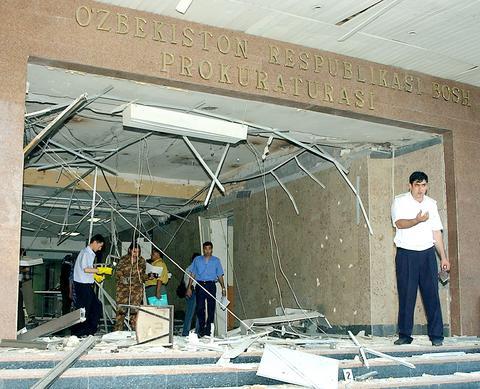
PHOTO: REUTERS
"It is connected to the trial and has been carried out by remnants of the same group," Bichenov said. "These are links in one chain."
Bichenov said police were taking "all necessary measures" to ensure security in the capital. He said no arrests had been made so far.
A trio of suicide bombers struck nearly simultaneously Friday evening in the Uzbek capital, killing two Uzbek guards outside the Israeli Embassy, including the ambassador's personal bodyguard. Seven people were injured at the general prosecutor's office, which suffered the heaviest damage, and two police were wounded outside the US Embassy.
President Islam Karimov returned home yesterday, cutting short a vacation to head a special government commission on the bombings.
The attacks in this Central Asian nation, a key US ally in the war on terror in neighboring Afghanistan, were the second to hit the country this year. In late March and early April, violence blamed on Islamic extremists -- including the region's first-ever suicide bombings -- left 33 militants, 10 police and four bystanders dead, according to Uzbek officials.
The first trial for those attacks began Monday in Uzbekistan's Supreme Court.
The defendants have all pleaded guilty and said the US and Israeli embassies were among the targets their extremist group, known as Jamoat, which means "society" in Uzbek, planned to attack. They have said the group ran training camps in Pakistan where they were taught by Arabs who the government says were al-Qaeda instructors.
Rabbi Abe David Gurevitch, the Tashkent-based chief rabbi for Central Asia, told reporters he felt no increased threat since the latest attacks.
"This is all politics," he said yesterday before Sabbath services, adding that he normally travels without any guards. "I'm not afraid. ... God protects me."
Just nine worshippers gathered for prayers at the synagogue, where there were no special security measures beyond a lone unarmed guard with a metal detector.
Other Jews at the services said they weren't taking any special precautions because of the bombings. "In Uzbekistan, people prefer Jews to (radical) Muslims," said Menachem Mandelblatt, referring to the generally friendly view of Jews in his majority Muslim country.
There are about 40,000 Jews in Uzbekistan, Gurevitch said.
The commander of the US base in the southern city of Khanabad, where hundreds of American troops are based, told AP he was monitoring the situation but there were no known threats against the facility. Security is always very high at the base, where US troops keep a low-profile and aren't allowed to go outside.
"We're aware of the incidents that occurred in Tashkent and are taking appropriate steps," US Army Leiutenant Colonel Neal Kemp said yesterday.
Opposition groups have said the earlier attacks, which targeted police, were motivated by anger at Karimov's repressive regime.
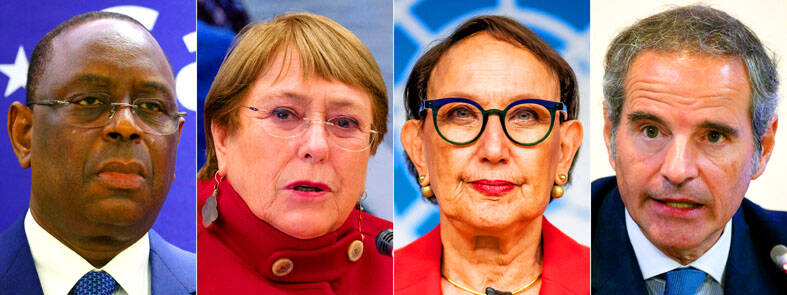
Four contenders are squaring up to succeed Antonio Guterres as secretary-general of the UN, which faces unprecedented global instability, wars and its own crushing budget crisis. Chile’s Michelle Bachelet, Argentina’s Rafael Grossi, Costa Rica’s Rebeca Grynspan and Senegal’s Macky Sall are each to face grillings by 193 member states and non-governmental organizations for three hours today and tomorrow. It is only the second time the UN has held a public question-and-answer, a format created in 2016 to boost transparency. Ultimately the five permanent members of the UN’s top body, the Security Council, hold the power, wielding vetoes over who leads the
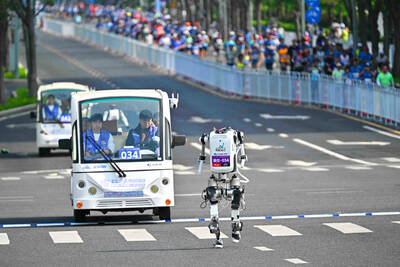
A humanoid robot that won a half-marathon race for robots in Beijing on Sunday ran faster than the human world record in a show of China’s technological leaps. The winner from Honor, a Chinese smartphone maker, completed the 21km race in 50 minutes and 26 seconds, said a WeChat post by the Beijing Economic-Technological Development Area, also known as Beijing E-Town, where the race began. That was faster than the human world record holder, Ugandan Jacob Kiplimo, who finished the same distance in about 57 minutes in March at the Lisbon road race. The performance by the robot marked a significant step forward

An earthquake registering a preliminary magnitude of 7.7 off northern Japan on Monday prompted a short-lived tsunami alert and the advisory of a higher risk of a possible mega-quake for coastal areas there. The Cabinet Office and the Japan Meteorological Agency said there was a 1% chance for a mega-quake, compared to a 0.1% chance during normal times, in the next week or so following the powerful quake near the Chishima and Japan trenches. Officials said the advisory was not a quake prediction but urged residents in 182 towns along the northeastern coasts to raise their preparedness while continuing their daily lives. Prime
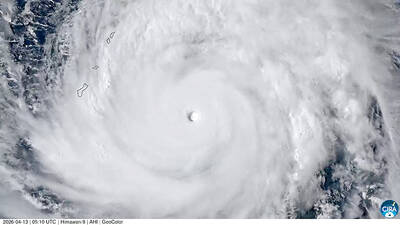
HAZARDOUS CONDITION: The typhoon’s sheer size, with winds extending 443km from its center, slowed down the ability of responders to help communities, an official said The US Coast Guard was searching for six people after losing contact with their disabled boat off the coast of Guam following Typhoon Sinlaku. The crew of the 44m dry cargo vessel, the US-registered Mariana, on Wednesday notified the coast guard that the boat had lost its starboard engine and needed assistance, Petty Officer 3rd Class Avery Tibbets said yesterday. The coast guard set up a one-hour communication schedule with the vessel, but lost contact on Thursday. A Coast Guard HC-130 Hercules aircraft was launched to search for the six people on board, but it had to return to Guam because of


 RSS
RSS