


Italian Interior Minister Giuseppe Pisanu said Wednesday claims for asylum made by 37 Africans who arrived in Sicily after three weeks at sea aboard a German humanitarian ship were "unacceptable" but said the final decision would be taken elsewhere.
"Although the asylum requests made by the non-[European] community citizens of the [ship] Cap Anamur are basically unacceptable, I prefer they be examined by the refugee commission," he said in Rome.
In Sicily an official from the German foreign ministry visited three men being held in prison in Agrigento in connection with the landing of the Africans, whom they had picked up in a dinghy in the Mediterranean on June 20.
Originally the Africans were thought to come from the strife-riven Darfur region of Sudan, but it subsequently emerged 30 were from Ghana, six from Nigeria and one from Niger.
Stefan Schmidt, captain of the Cap Anamur, Elias Bierdel, president of the humanitarian group of the same name, and first officer Vladimir Dhchkevitch face charges of abetting illegal immigration.
They were due to appear in court yesterday, where they were expected to be formally charged and then possibly provisionally released from prison.
They are accused of aiding and abetting illegal immigrants, an offence punishable by up to 12 years in jail and a fine of 15,000 euros (US$18,500) for each immigrant they brought into the country.
The issue has caused a diplomatic tussle between Rome and Berlin, which has demanded the three be released.
Interior ministry officials have said they were told a "pack of lies" by Cap Anamur that helped force Italy to accept the Africans under the glare of the international media.
The 37 have been transferred from the reception center at Agrigento to one in the central Sicilian town of Caltanissetta where their cases will be examined by the refugee committee.
German government spokesman Bela And raised the issue again on Wednesday at a Berlin press conference after a Cabinet meeting.
"We hope that the members of the crew will be released quickly," she said without elaborating.
Italy insists the case for political asylum should be heard under EU regulations in Malta, which was the ship's first port of call after picking up the Africans. The EU introduced the law to prevent refugees shopping around from capital to capital in a search for asylum.
Germany has refused to accept the Africans.
A spokeswoman for the UN High Commissioner for Refugees, Laura Boldrini, said the Africans had "partly filled in" official requests for asylum, and speculated that either they did not have enough time or lacked legal advice to fill in all the details.
Paolo Cento, a deputy for the Green party, which has supported the right of the Africans to land and remain in Italy, said that an attempt to expel them would "cover the Italian government with shame."
Italy allowed the ship to dock in Porto Empedocle in southern Sicily after the ship's captain warned of unrest and suffering among the refugees, some of whom had reportedly threatened to throw themselves overboard.
Italy has toughened up immigration laws to curb landings of Arab and African migrants along its long, exposed coasts.
Libyan officials said on Wed-nesday that the coast guard rescued 40 migrants from Africa or Arab countries when their boat got into trouble on the high seas as it was headed for Italy.
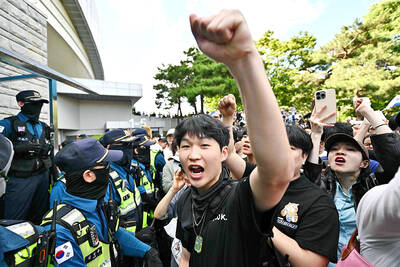
‘ABSURD MISTAKE’: The election commission said that there had been a failure to anticipate turnout after 14 polling stations ran short of ballot papers South Korean riot police yesterday cleared protesters from a Seoul polling station after a 35-hour blockade sparked by a shortage of ballot papers during local elections earlier this week. Wednesday’s election was the first nationwide vote since South Korean President Lee Jae-myung took office following the ouster of Yoon Suk-yeol over his short-lived martial law declaration. Lee’s ruling Democratic Party swept most races, but failed to flip the crucial Seoul mayoral seat. The South Korean National Election Commission apologized, blaming a failure to anticipate turnout after 14 polling stations in Seoul ran short of ballot papers. Some polling stations stayed open until 10pm to

France experienced its hottest spring on record, the French weather service said on Tuesday, after an exceptional early heat wave that also broke highs for the season in England and Wales. Meteo-France said the average nationwide temperature over March to May was 13.8°C — about 1.7°C above the norm, and surpassing records set in 2011 and 2020. “The warmest spring since records began in 1900,” it said in a bulletin. All three months were warmer than average, but the onset of an “unprecedented heatwave” late last month pushed the mercury to highs typically seen at the height of the summer. “Our country had never

A Sherpa guide was found crawling to base camp on Mount Everest a week after he went missing and was reunited with his family, who had given up hope he would return. Dawa Sherpa was last seen on Friday last week descending the mountain, but he did not reach base camp even though his client did. The pair were among the last climbers on the mountain as the climbing season came to an end and the route was dismantled. Dawa was located by a cleaning crew on Thursday morning as he was crawling down the snowy slopes around the Khumbu Icefall, just above
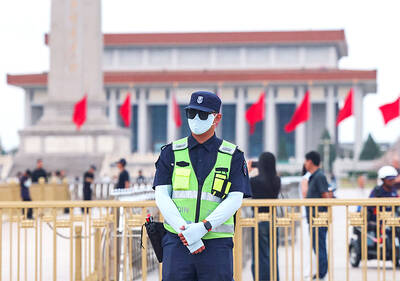
Chinese authorities are snuffing out any remembrance of the deadly 1989 military crackdown on student-led pro-democracy protests in Tiananmen Square, which happened 37 years ago yesterday, in a further tightening of a years-long campaign to erase what happened from public memory. Police told relatives of the victims they would not be allowed to visit a cemetery in Beijing on the anniversary of the crackdown, a person with knowledge of the matter said. Relatives of the victims visited the cemetery on the anniversary for more than 30 years to read memorial statements with police keeping watch, Amnesty International said. Hundreds of people,


 RSS
RSS