


China is celebrating the 15th century voyages of a Chinese eunuch admiral sailing as far west as the coast of Africa as evidence of its historical pursuit of peaceful relations with other countries and cultures.
Analysts say Zheng He's (
Festivities launched this week for the 600th anniversary of Zheng's voyages vaunt Beijing's benevolent diplomacy, remembering how the Muslim admiral led seven armadas through southeast Asia and beyond to spread Chinese influence from 1405 to 1433.
"Instead of occupying a single piece of land, building a fort or seizing treasure, Zheng He treated other countries with friendship," said Xu Zuyuan (徐祖遠), China's deputy minister of communications. "We think the legacy of Zheng He's seven voyages to the West is that a `peaceful rise' is the inevitable outcome of China's history."
Some China historians and maritime security experts take issue with Xu's assertion that Zheng's voyages bolstering the influence of the recently installed Ming dynasty were of a purely peaceful nature -- and not expansionist.
And a question mark hangs over the motives of Beijing's communist rulers as they slowly develop their coastal navy into a blue-water force capable of following in Zheng's wake and building relationships in southeast Asia.
"The current enhancement of the Chinese presence in the region is very much parallel to 600 years ago when Zheng He cruised through the region and tried to set foot in neighboring territory to extend Chinese influence," military expert Andrew Yang (楊念祖) said.
"The purpose is more or less identical -- to try to establish some kind of collaboration and cooperation conducive to China's long-term economic and national interests," said Yang, who is secretary-general of the Chinese Council of Advanced Policy Studies.
The goals of the 15th century admiral and his successors today have common features.
"They were military missions with strategic aims," writes scholar Geoff Wade of the National University of Singapore. "The military aspect of these voyages needs underlining, in part because of the stress placed on these missions in much current scholarship as `voyages of friendship.'"
Zheng wanted to not only spread imperial Ming influence but to develop trade. China's communist overlords want to have a say in regional diplomacy and also protect sea lanes that carry the oil to fuel their economy and their burgeoning exports.
"China's energy flows are very, very critical and will become more so in the years to come," said Prakash Metaparti, a former Indian navy commander and a naval expert at the Center for Asian Studies at the University of Hong Kong.
Several southeast Asian neighbors, and likely the US as well, worry about spreading Chinese influence and whether Chinese naval vessels will one day acquire the capability to sail into waters where Zheng's 62 warships and thousands of sailors conquered ports and gathered tribute.
Beijing may, for now, be more worried about ensuring an uninterrupted flow of oil imports through the Malacca Strait from the Middle East. It needs to guarantee that the industrial machine that has become the world's workshop provides a steady stream of jobs, boosts incomes and keeps the Communist Party in power.
"This is a long-term development strategy: to secure energy supplies in the surrounding sea area," Yang said. "Securing their maritime interests is vital for their economic and future survival."
Almost all of China's energy imports flow through the Malacca Strait, a narrow sea lane vulnerable to pirate attack. Terrorists have yet to strike there but security experts fear they may.
Oil accounts for 22 percent of China's total energy mix and a third comes from imports. The world's second-largest oil consumer will see oil accounting for 31 percent of its energy mix by 2020.
To protect those imports and expand the range of its influence, China takes a two-pronged strategy by spending on naval modernization and signing trade deals with neighbors.
But by 2020, it may only just be able to command a world-class navy. While Chinese submarines can now ply up to 500 nautical miles off shore, above the waves its ships still sail in a range little beyond 300 to 500 nautical miles from the coast.
"They will not be able to project their power anywhere beyond their immediate coast areas for at least 10 years, and maybe not for 15 to 20 years," Metaparti said.

With the midday sun blazing, an experimental orange and white F-16 fighter jet launched with a familiar roar that is a hallmark of US airpower, but the aerial combat that followed was unlike any other: This F-16 was controlled by artificial intelligence (AI), not a human pilot, and riding in the front seat was US Secretary of the Air Force Frank Kendall. AI marks one of the biggest advances in military aviation since the introduction of stealth in the early 1990s, and the US Air Force has aggressively leaned in. Even though the technology is not fully developed, the service is planning
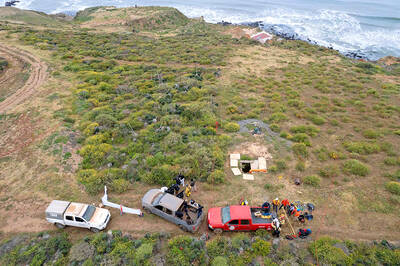
INTERNATIONAL PROBE: Australian and US authorities were helping coordinate the investigation of the case, which follows the 2015 murder of Australian surfers in Mexico Three bodies were found in Mexico’s Baja California state, the FBI said on Friday, days after two Australians and an American went missing during a surfing trip in an area hit by cartel violence. Authorities used a pulley system to hoist what appeared to be lifeless bodies covered in mud from a shaft on a cliff high above the Pacific. “We confirm there were three individuals found deceased in Santo Tomas, Baja California,” a statement from the FBI’s office in San Diego, California, said without providing the identities of the victims. Australian brothers Jake and Callum Robinson and their American friend Jack Carter

Le Tuan Binh keeps his Moroccan soldier father’s tombstone at his village home north of Hanoi, a treasured reminder of a man whose community in Vietnam has been largely forgotten. Mzid Ben Ali, or “Mohammed” as Binh calls him, was one of tens of thousands of North Africans who served in the French army as it battled to maintain its colonial rule of Indochina. He fought for France against the Viet Minh independence movement in the 1950s, before leaving the military — as either a defector or a captive — and making a life for himself in Vietnam. “It’s very emotional for me,”

UNDER INVESTIGATION: Members of the local Muslim community had raised concerns with the police about the boy, who officials said might have been radicalized online A 16-year-old boy armed with a knife was shot dead by police after he stabbed a man in the Australian west coast city of Perth, officials said yesterday. The incident occurred in the parking lot of a hardware store in suburban Willetton on Saturday night. The teen attacked the man and then rushed at police officers before he was shot, Western Australian Premier Roger Cook told reporters. “There are indications he had been radicalized online,” Cook told a news conference, adding that it appeared he acted alone. A man in his 30s was found at the scene with a stab wound to his back.


 RSS
RSS