


Sudan's president has promised to send troops to stop militia violence that has forced 1 million people from their homes in the state of Darfur, a Sudanese official said after meeting with UN Secretary-General Kofi Annan.
The pledge on Friday came as the US raised the possibility of sanctions against Sudan if the government fails to act quickly to end attacks by Arab militias and to allow aid to reach displaced people.
Annan arrived in Khartoum after visiting Sudanese refugees at a camp in Chad on a tour aimed at pressing President Omar el-Bashir's government to end the 16-month conflict.
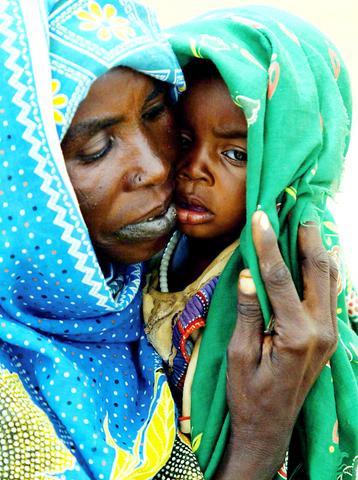
PHOTO: REUTERS
In particular, the UN chief wanted el-Bashir to make good on promises to disarm the Janjaweed, the militia blamed for attacks on thousands of black African villagers.
"My message is simple: violence must stop," Annan told reporters after meeting el-Bashir in a heavily guarded military headquarters. "The Janjaweed must be stopped and a ceasefire must be respected by all."
UN officials and human rights groups have accused the Sudanese government of backing the Arab militias in a campaign to violently expel African farmers from the nation's vast western region.
During tours of refugee camps inside Sudan and Chad, Annan said he learned firsthand of many human rights abuses, "including sexual violence against women."
But after Friday's talks, Annan said "now we have a commitment from President el-Bashir to remove all obstacles that face humanitarian action in Darfur."
US Secretary of State Colin Powell also visited Sudan this week and made clear to Khartoum leaders that the US is only willing to wait a "few weeks" for the government to act, said Andrew Natsios, head of the US Agency for International Development, who traveled with Powell.
"We're talking days, weeks, not months -- not a month -- to see whether or not they do what they said they would do," said acting US Assistant Secretary of State for African Affairs Charles Snyder, who joined Natsios in briefing the UN Security Council in New York.
Sudanese Foreign Minister Mustafa Osman Ismail told reporters that 6,000 soldiers and police would be deployed in Darfur to improve security, but he did not say when.
"The priority now is for security, then the return of the displaced persons, and this is to go hand in hand with the political settlement," Ismail said.
UN officials have called the situation the world's worst humanitarian crisis, and Annan has said it "is bordering on ethnic cleansing."
Many Sudanese who have fled tell similar stories of airplanes dropping bombs and raiders on horseback who burn, kill and loot.
Thousands of people have been killed and more than a million forced from their homes, most taking shelter in makeshift camps with little access to clean water or proper sanitation.
The Sudanese government denies any complicity in the militia attacks and says the warring sides are clashing over land and scarce water resources.
The UN children's agency in Geneva said Friday that many young people from Darfur either had been victims of violence or were scarred by witnessing violent acts, including rape and murder.
"I spoke with scores of children, who simply tell what they have seen -- infants shot in front of them, parents gunned down in fields, mothers raped ... and people being forced to run for their lives with nothing," said Dan Toole, UNICEF's director of emergency operations.
Thousands turned out to see Annan at the Iridimi Camp in Chad, 70km west of the Sudanese border.
"All we want is peace so we can return," said Saleh Hamid Moubarak, 57, who is living at the camp of flimsy shelters made from sticks and plastic sheets. "Our children were killed, our belongings looted, our women raped."
The US called on the UN to impose an arms embargo and travel ban on the Arab militias in a draft resolution submitted Wednesday to coincide with Powell's visit to Darfur.
The Justice and Equality Movement and the Sudan Liberation Army, two rebel groups drawn from the region's African tribes, took up arms in February 2003 over what they called unjust treatment by the government in their struggle over land and resources with Arab countrymen in Darfur. A ceasefire was signed April 8, but both sides accuse each other of violations.
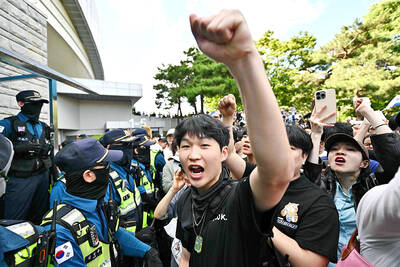
‘ABSURD MISTAKE’: The election commission said that there had been a failure to anticipate turnout after 14 polling stations ran short of ballot papers South Korean riot police yesterday cleared protesters from a Seoul polling station after a 35-hour blockade sparked by a shortage of ballot papers during local elections earlier this week. Wednesday’s election was the first nationwide vote since South Korean President Lee Jae-myung took office following the ouster of Yoon Suk-yeol over his short-lived martial law declaration. Lee’s ruling Democratic Party swept most races, but failed to flip the crucial Seoul mayoral seat. The South Korean National Election Commission apologized, blaming a failure to anticipate turnout after 14 polling stations in Seoul ran short of ballot papers. Some polling stations stayed open until 10pm to

France experienced its hottest spring on record, the French weather service said on Tuesday, after an exceptional early heat wave that also broke highs for the season in England and Wales. Meteo-France said the average nationwide temperature over March to May was 13.8°C — about 1.7°C above the norm, and surpassing records set in 2011 and 2020. “The warmest spring since records began in 1900,” it said in a bulletin. All three months were warmer than average, but the onset of an “unprecedented heatwave” late last month pushed the mercury to highs typically seen at the height of the summer. “Our country had never

A Sherpa guide was found crawling to base camp on Mount Everest a week after he went missing and was reunited with his family, who had given up hope he would return. Dawa Sherpa was last seen on Friday last week descending the mountain, but he did not reach base camp even though his client did. The pair were among the last climbers on the mountain as the climbing season came to an end and the route was dismantled. Dawa was located by a cleaning crew on Thursday morning as he was crawling down the snowy slopes around the Khumbu Icefall, just above
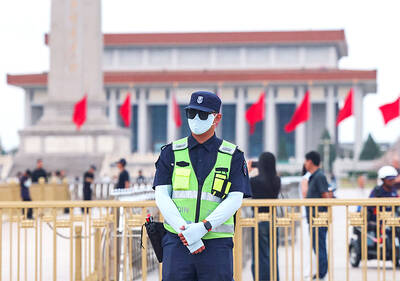
Chinese authorities are snuffing out any remembrance of the deadly 1989 military crackdown on student-led pro-democracy protests in Tiananmen Square, which happened 37 years ago yesterday, in a further tightening of a years-long campaign to erase what happened from public memory. Police told relatives of the victims they would not be allowed to visit a cemetery in Beijing on the anniversary of the crackdown, a person with knowledge of the matter said. Relatives of the victims visited the cemetery on the anniversary for more than 30 years to read memorial statements with police keeping watch, Amnesty International said. Hundreds of people,


 RSS
RSS